
Account Intelligence vs. Intent Data: What’s the Difference and Why It Matters
Follow us

The B2B buying journey is not a linear one. They might visit pricing pages, recruit new hires, adopt new technology, and change leadership without talking to sales. They might want to read industry content, compare vendors, hire new people, adopt new technology, or change leadership, prior to talking with Sales. Though this poses a dilemma: how do marketing and sales people find the right accounts to generate revenue?
To answer this question, we must first grasp the concept of the differences between Account Intelligence and intent data. Account Intelligence provides the entire information to evaluate if the account is in line with your ICP. It also considers if anything has changed within the business, or who might be involved in the purchasing goods. It also includes why it is a good time to reach out, too. This is important for B2B teams to know so they can better prioritize accounts, tailor their outreach, and not spend their resources chasing false leads.
Account Intelligence vs. Intent Data: The Simple Difference
Intent Data Tells You Who’s Researching; Account Intelligence Explains the Bigger Picture
Intent information sheds light on the organizations that are actively engaging in research. It can be on a topic, based on their Internet behaviours (browsing and content consumption). However, account intelligence provides a detailed, full picture of companies such as their structure, technology departments, key contacts and financial history. These tools can give insights into the interest in potential clients as well as keep track of those that are retained.
Why B2B Teams Need Both Fit and Timing to Prioritise Accounts
While B2B marketing teams are sometimes reluctant to target simply because the sales cycles in these industries can be 3-6 months long. But they must take fitting the account and timing into consideration. It’s important to know who is in the market at the moment because some may not be in the frame of mind to consider solutions right now. However, buyer intent data is important for providing these accounts that are currently researching and making purchases. Thereby, teams can focus on higher-quality leads.
Furthermore, teams can use account intelligence for initial contact lists, fit based on an account’s technographic data and so much more. The combination of this working proactively will allow teams to have the opportunity to work with the right accounts and individuals before the competitor does. Therefore, it increases the likelihood of a successful sale of a complicated solution that may require a great deal of research.
How Does Account Intelligence Help You Understand Your Target Accounts?
From Static Account Data to Real-Time Account Insights
These are the traditional account attributes you may have such as the company size, the industry, its location and its revenue. This profile is refreshed in real time thanks to account intelligence.
How Predictive Analytics Turns Multiple Signals Into Account Priorities
These signals are then made into predictive models and look for accounts that warrant attention. Teams do not respond to one activity; rather they evaluate the fit, interest, timing and potential value of opportunities and rank them.
How Does Intent Data Help You Understand What Buyers Are Interested In?
First-Party Intent: What Buyers Do Across Your Own Digital Properties
The information that is gathered from your website is called first party intent data. These might be forms which are filled out for exclusive content material, website analytics, customer interactions, outbound e-mail or social media.
Third-Party Intent: Research Happening Beyond Your Website
Any data that is gathered from other websites is considered third party intent data. This involves tracking back to the:
- IP number
- Content consumption
- Data aggregation
This is information which is collected by intent data providers like Cognism’s Bombora partner who offer it to buyers.
Account-Level vs. Contact-Level Intent Signals
Intent is tracked in the aggregate across the company with account-level intent signals, and across individual contacts, with more identifiable buying signals such as:
- Direct actions
- Job changes
- Social activity
- Technology adoption, with contact-level intent signals
Both levels offer customers some level of information about their possible buying preference, but with links that are more or less generic.
Explicit vs. Implicit Buying Signals
Explicit buying signals are voluntary direct information, which the customer shares about their preferences. In contrast, implicit buying signals arise from customer behavior and actions, providing insights into their true preferences without direct communication. You can gain insight from each type of the scanning to improve customer needs understanding and sales methodology.
Why One Intent Spike Doesn’t Automatically Mean “Sales Ready”
It will be a single spike, such as a research project, student project, job training or education. While B2B intent data can provide clues about potential interest, account intelligence can provide the context to determine if there is a viable commercial opportunity.
Account Intelligence vs. Intent Data: Side-by-Side Comparison
| Dimension | Account Intelligence | Intent Data |
| Focus | Broad account profile | Specific buying signals |
| Data Type | Static and firmographic | Dynamic and behavioral |
| Timing | Always relevant (account exists) | Time-sensitive (signal fades) |
| Use Case | List building, qualification | Trigger-based outreach |
| Depth | Deep: 20+ data points | Narrow: 1-3 specific signals |
The Account Intelligence Layer: Turning Raw Signals Into Sales Context
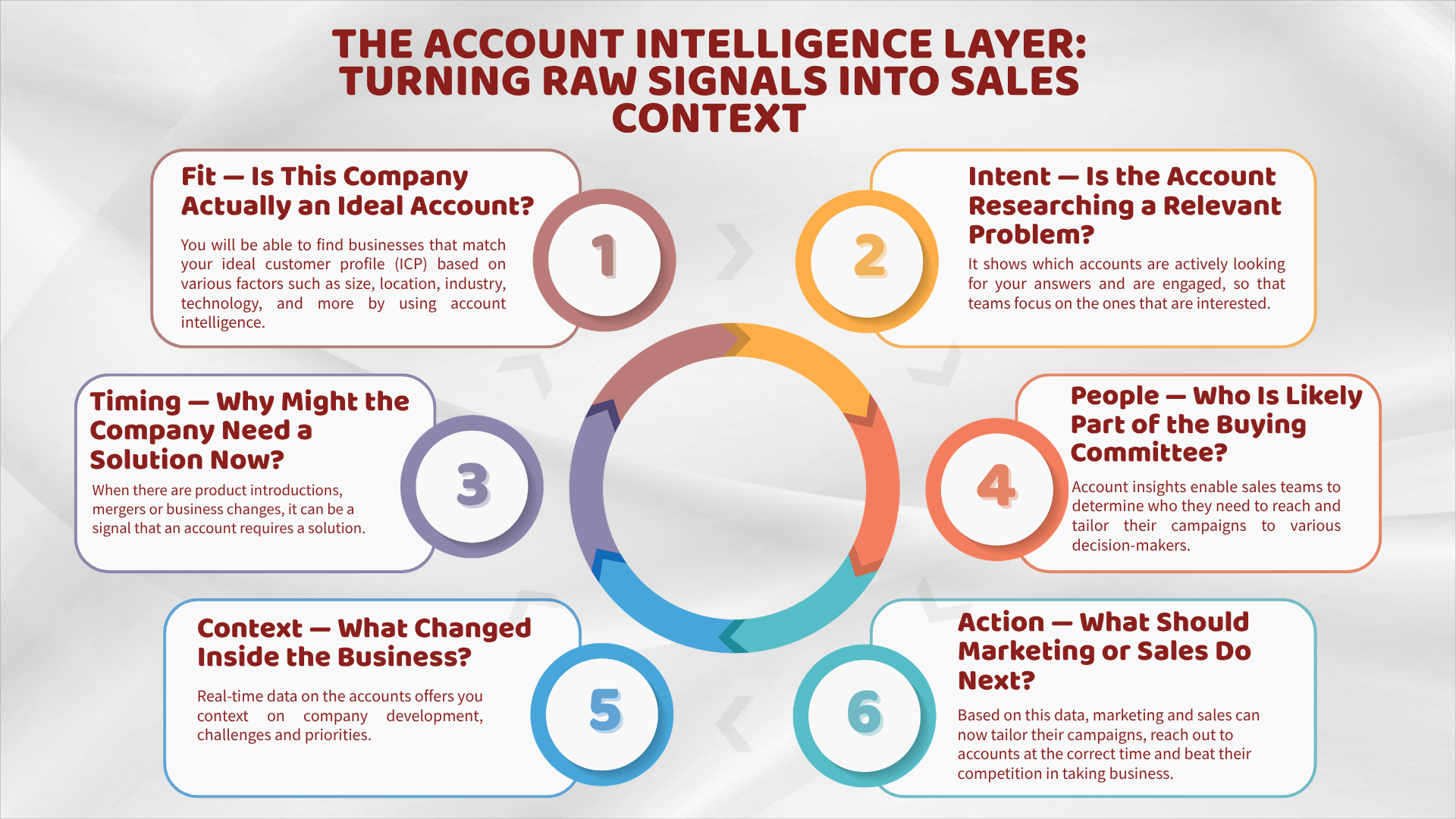
Buying Signals That Make Account Intelligence More Actionable
Buying Signals are cues from a lead that they are showing an interest in products or services, and help B2B sales teams prioritize their leads.
Signs to look for include prospects, conducting product research, visiting websites, looking at pricing pages, downloading content, comparing products, visiting review pages, performing search activity and more topic research.
By understanding intent data, Bombora can let sales teams know when companies are actively searching for products or services on Google that are relevant to them. Instead of simply being on their keyboard looking for YouTube content, they are ready to make a purchase.
For example, of 100 decision makers, intent data can identify 12 companies that are actively looking into a product category, which is worth focusing on.
Ideally, sales signals should not just highlight data, but it also must give clarity on what matters and support sales teams to take next steps based on the information.
Why Intent Data Alone Can Create False Positives
1. Visitor browsing: Visitors could be researching but never ready to purchase, which means that the interest they have is an incorrect impression.
2. Competitor Analysis: Competitors can explore your content, targeting those, and that could lead you to act on non-prospective leads as you pursue them.
3. Industry-wide Research: The product may not be as appealing to the prospect as the industry, which in turn provides unqualified leads.
4. Wrong Role in the Organization: Some involved people aren’t decision makers; it could be a time and resource waste pursuing them.
5. Geography Based Signals: Intent data can come from the wrong areas making businesses miss out on leads outside of their target markets.
How Account Intelligence and Intent Data Work Better Together
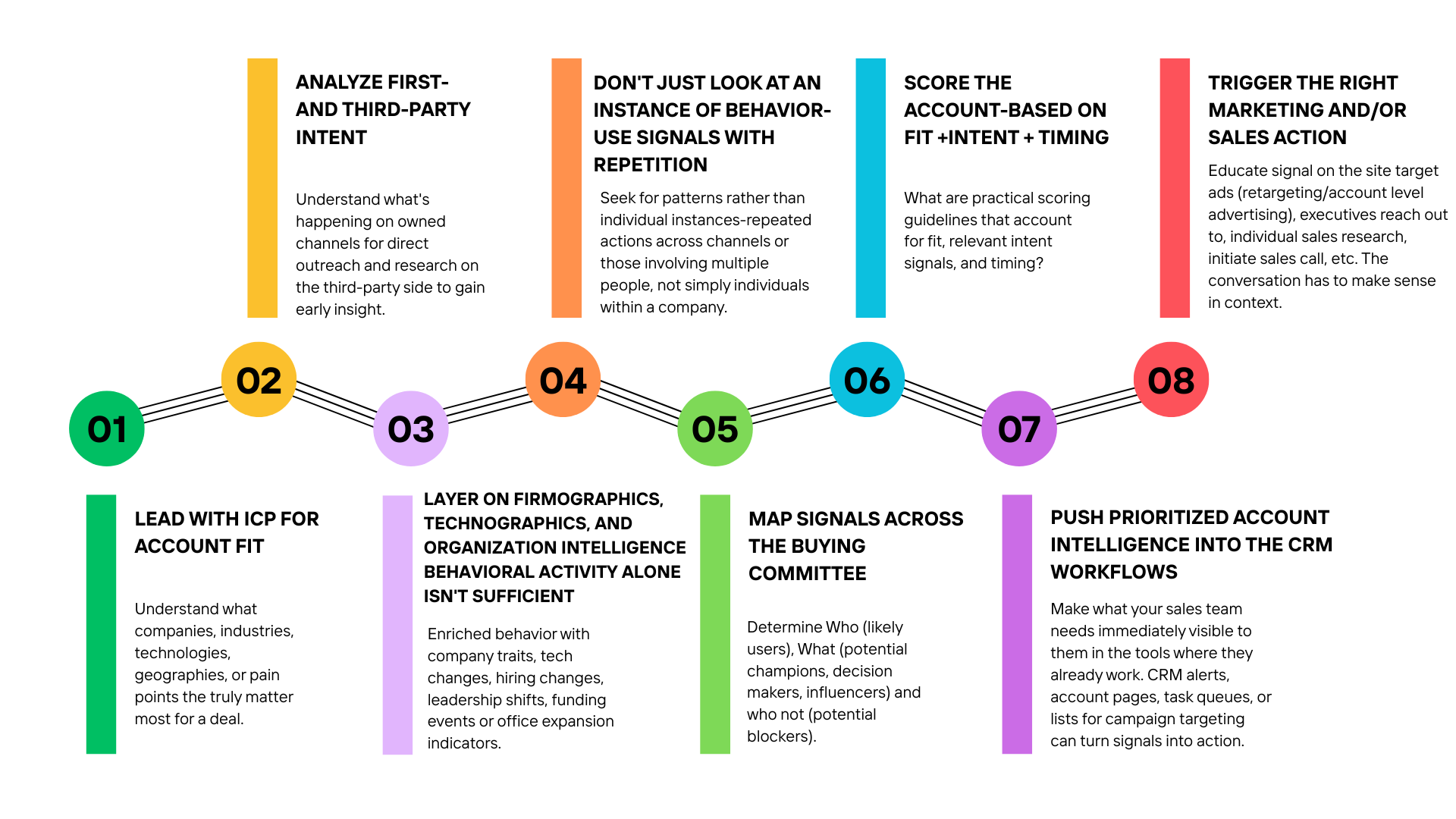
How AI Is Changing Account Intelligence in 2026
AI Connecting Thousands of Disconnected Buying Signals
AI relates website actions, hiring, financial events, technology data, news and CRM activities. This assists groups shift from ineffective paper documentation to ever-evolving account priorities.
Predictive Analytics Identifying Accounts Before They Raise Their Hands
Predictive models are able to identify patterns that are often found prior to a form fill or demo. They enable sales to explore new demand at an earlier stage and maintain human input.
Automated Buying Committee Discovery and Relationship Mapping
AI listens out for potentially influential stakeholders, common relationships, reporting lines, and engagement practices. These tips will support sellers to draw up an exhaustive account strategy.
AI-Generated Account Summaries for Faster Sales Research
A seller doesn’t need to read several records, they get a short summary of the business, activity, business partners, changes, and active business opportunities.
Next-Best-Action Recommendations Based on Account Momentum
AI suggests a nurture sequence, touching on relevant content, the audience for ads, meeting requests, or as an executive introduction based on momentum. These recommendations are only as good as the data they draw upon, its openness to scoring, and its management.
What to Look for in an Account Intelligence Platform
Consider account matching, real time data, first and third-party intent, firmographic and technographic coverage, mapping buying committees, predictions scores, CRM integration, explainable recommendations, and robust data privacy controls. The tools used for Intent Data and Account Intelligence are listed below:
For Intent Data:
- The research and behavioral intent information is supplied by 6sense.
- Demandbase provides research and account indicators.
- With Bombora’s intent you have third-party intent.
- Madison Logic’s researched approach to intent.
For Account Intelligence:
- ZoomInfo provides very general company and contact information.
- Clearbit provides enriched company data and available data.
- Apollo has a contact Database, and also email finder.
- Verified contact information and email provided by Hunter.
Account Intelligence or Intent Data: Which Does Your Team Need?
Choose Intent Data When Your Main Gap Is Knowing When Accounts Are Researching
If you only want to detect category interest, engagement in the Web and external research, intent data can be sufficient.
Choose Account Intelligence When You Need to Understand Who, Why, When, and What Changed
Select the wide picture when you need account selection, organizational context, stakeholder mapping, opportunity research, and next-best-action guidance.
Use Both When You Need Predictable ABM Strategy and Pipeline Prioritization
The easiest way to answer this question is to say, intent data is a signal layer. The intent + the wider account info is used as the basis for the account intelligence context and decisions. They are not mutually exclusive strategies for mature revenue development teams (B2B).
The Future Is Account-Centric, Not Lead-Centric
Compared to traditional marketing, ABM can produce returns of 21% to 350% greater, with ROI ranging from 87% greater on average in some programs. The numbers typically go up under the “moves” banner as teams that do the move see increased win rates on target accounts, larger deals, and improved retention, because they’re funding the top companies with the high probability of purchase and growth.
The deeper win is when marketing finally aligns with actual B2B buying patterns.
The clear answer is: intent data can be considered as you think of it as a signal layer. The intent plus more comprehensive account information, context and decision layer correlates to account intelligence. If you’re an mature B2B revenue team, they aren’t rivals; they’re companions.
Conclusion — Intent Finds Interest; Account Intelligence Finds Opportunity
Intent data identifies potential buyers’ interest. The art of account intelligence is accounting context, accounting company fit, upcoming organizational changes, people, timing, relationships, and broader buying context. Sales intelligence is a strategy that identifies the proper people to connect with. Revenue intelligence relays information on account and opportunity activity to pipeline outcomes. When combined, these layers will provide a better perspective of the B2B buying process.
The best way to do it doesn’t question whether it’s intent data or account intelligence. It poses the question of how both parties can collaborate. Intent data can hold information that a particular account is investigating a relevant problem. Account Intelligence can provide insight into whether a particular account is worth investigating, such as what is prompting that account, who might be interested, and what action should be taken.
That combination will help marketing to spend more efficiently and provide better context for sales. It also improves bottom-to-top interactions between revenue teams. Lastly, it can help them move from being reactive in their lead follow-up to being coordinated in their account prioritization.

Author: IDBS Global
Turning Data into Demand, Fueling B2B Growth with Precision and Purpose.