

The Psychology Behind B2B Performance Marketing: How Decision Science Drives Conversions
Follow us

B2B performance marketing is best achieved when marketers appeal to the human element of purchase decisions. Decision science demonstrates the effectiveness of sub-process psychological signals over raw data squeezes to make conversions and revenue. This blog discusses performance marketing strategy, so you can come up with campaigns to convert better.
Why Psychology Is the Engine of B2B Performance Marketing
The driver of B2B performance marketing is psychology since it helps marketers to overcome the disjunction between rational, data-driven choices and the underlying human feelings, apprehension, and biases of the decision-makers. People often say that B2B buying is completely logical, but the truth is that people are buying when they don’t want to take risks, the sales cycle is long, and they need to feel validated. This means that emotions are needed to be successful.
From Rational Buyer to Human Decision-Maker: The Hidden Psychology in B2B
The Myth of Pure Logic in B2B Buying
The misunderstanding of pure logic in B2B buying is that every B2B purchasing action is determined by data-driven, rational decisions (without taking into account the emotional, personal, and social components of the humans behind the machine). This is not the case, as it has been shown in the Google’s study that emotions highly influence decisions made by B2B. It is usually because the personal danger to the buyer (image, employment) is greater than in consumer (B2C) purchases.
Decision Science: Understanding What Really Moves Buyers
The marketing decision science breaks down biases such as loss aversion, in which B2B buyers are more afraid of loss than gain. This is evidenced by a McKinsey study, which found that 60% of executives are more concerned with negative results than with positive ones.
Remaking your value proposition as a risk-reduction strategy can be revolutionary. A compliance software vendor revised their promotional slogan to focus on preventing costly mistakes, such as the $2 million penalty paid to the FTC due to inadequate IT compliance. This shift emphasizes the importance of proactive measures rather than just streamlining audits. In three months, landing page conversions on their free audit tool increased twice.
Core Psychological Principles That Supercharge B2B Performance Marketing
Autonomy & Choice Architecture: Less Pressure, More Action
Autonomy and choice architecture focus on the design of decision-making situations so as to manipulate choices and still maintain freedom. In the industrial sector of B2B marketing, it is a framing of options in the order in which they are presented. The primacy effect and contrast effect place the more profitable products on the front burner and the less expensive ones on the rear burner when extremely pricey items accompany them. Choice architecture can help businesses induce customers to make the appropriate choices that serve their interests, increase the level of conversion, and improve customer satisfaction.
Social Proof & Norms: Trusted Signals Win More Leads
Social proof remains a very important factor in the B2B lead conversion strategy. Currently, leads are more confident in a product or service when they observe others having positive experiences.
There is a strong demand for reviews, case studies, and testimonials, which help to create credibility. Vivid success stories and real-life lab instances can assist the companies to assure the leads that they are not making a harmful and uninformed choice.
Emotional Motivators Behind Rational Decisions
An emotional connection is the main column of successful sales. Shoppers do not merely buy the products, but they invest in solutions to their issues or wants. Storytelling is a way to tap into this emotion that reveals how a product or service can truly change the lives of people in some way. It can be the story of a brand or the story of a customer success; a strong narrative makes one feel empathetic and trusted. For example, the story of a company that eliminated difficulties or helped a customer reach their objectives will bring the brand closer to the listener.
The Simplicity Principle: Clarity Drives Conversion
When it is cluttered, it will not convert, whereas when it is simple, it will have more sales. Jargon should be replaced with important forms and pictures, as pages with fewer alternatives perform better in B2B performance marketing. A corporate IT company reduced site content by 60%, used simple navigation, and included a Schedule a Security Audit button, which reduced bounce rates by 35%.
Incremental Engagement: The Power of Step-by-Step Conversion Paths
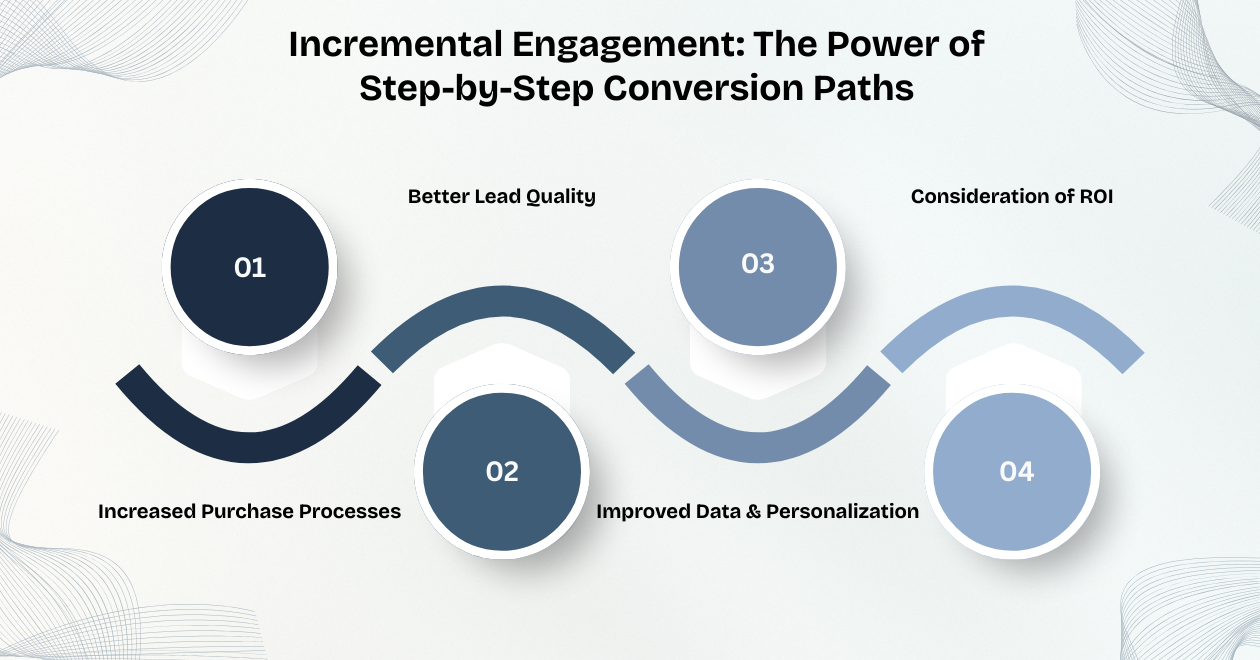
- Increased Purchase Processes: Incremental journeys involve multiple steps and have the ability for conversion rate optimization. One such example is that a multi-step form solution is likely to improve conversion by balancing the user effort with the lead quality.
- Better Lead Quality: Taking small steps will help you get more information about the leads, which will improve the quality of the leads and make it easier for the sales teams to close transactions.
- Improved Data & Personalization: Every step will give the data on what the user likes and what they are unhappy with, which can be used to retarget and personalise them more efficiently.
- Consideration of ROI: Incremental strategies tend to lead to greater Return on Ad Spend (ROAS) and a reduced Customer Acquisition Cost (CAC) because they allocate resources to engaged users.
Mapping Psychological Triggers Across the B2B Buyer Journey
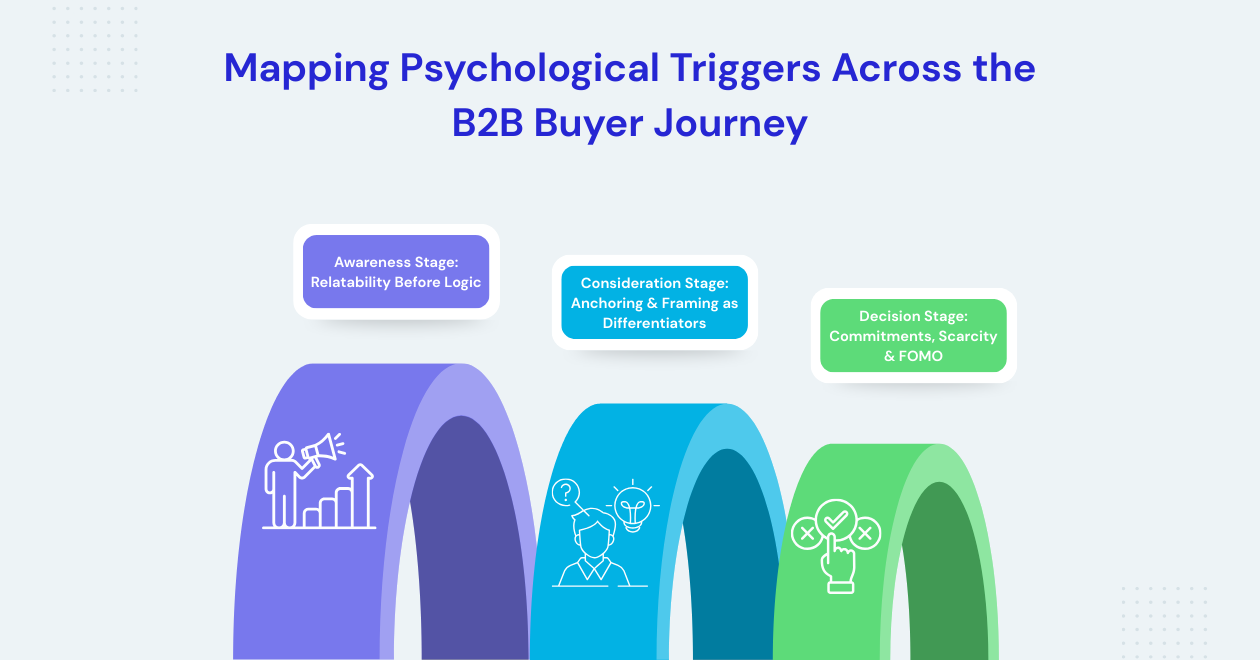
Awareness Stage: Relatability Before Logic
During the awareness stage, the prospects are aware of their problem or needs, and they are ready to receive new information among different stimuli. Marketers should focus on psychological ways to get people’s attention, like using catchy headlines and interesting stories that show how things are different or new. Emotion, such as wondering or being shocked, can help generate an immediate bond with the audience.
Consideration Stage: Anchoring & Framing as Differentiators
In the consideration phase, buyers are busy doing their own research and comparing solutions, and they want to get credible information to make their decisions. Social proof is a key principle in psychology, as it relies on testimonials to validate the credibility of a product. Authority also plays a significant role, as expertise and thorough guidance foster a sense of confidence among potential consumers. Together, these principles enhance the persuasive power of marketing strategies.
Decision Stage: Commitments, Scarcity & FOMO
The buyers decrease their choice in the decision stage with the goal of a smooth purchasing process. There are two psychological principles that can help with this: scarcity (offering things for a limited time creates a sense of urgency) and simplicity (being able to show simple information and make it easy to navigate to avoid moral paralysis). It is important to lead the buyer down the most appropriate path to ensure the most efficient decision-making process.
Decision Science in Practice: B2B Lead Gen & ABM with Psychology
Aligning ABM with Human Biases
B2B consumers are drawn to vendors regarded to be industry leaders and providers of items with a high level of competence; products with the corporate logo are not an option. As an illustration, Salesforce does not lag far behind in CRM, using specially designed webinars, Gartner ratings, and prominent case studies. Likewise, one of the mid-size logistics software companies released a quarterly report called State of Supply Chain with proprietary data, and the number of demo requests sent by interested parties almost doubled. This plan is also a good way to establish the brand as an expert consultant, representing the concept of account-based marketing (ABM) and human psychology as a source of authority and knowledge.
Behavioural Segmentation for Better Lead Scoring
This strategy would consist of using B2B data to segment your target market based on industry, job position, size of business, and buying behavior. It allows customizing advertisement experience and supports the unique needs and interests of each group, which increases the engagement and the conversion rates.
Personalization That Resonates (Not Creeps)
Buyers today expect custom experiences because generic messaging does not go well in a competitive market. Personalization increases conversion rates via personalizing messaging, emails that include preferences or previous engagements, and product suggestions based on previous queuing or purchase. Such customization creates a perception of knowing and being valued, makes leads feel they are being offered a custom-made offer, and therefore enhances their bond with the brand.
Content’s Psychological Role in B2B Performance Marketing
The content of B2B performance marketing is a psychological trigger that connects rational business motivation with decision-making that is emotional to create conversions. It builds trust through its strength, reduces cognitive dissonance to help people make tough buying decisions, and grows understanding when the buyer is the main character of the story.
Narrative, Storytelling & Cognitive Resonance
Storytelling is a forum used by marketers to create emotional bonds with their audience, turning sales pitches into experiences to which more people can relate. The brands can demonstrate the benefits of a product and evoke trust by telling stories that appeal to the potential, such as case studies or personal stories. Developing relevance in the message by creating relatable situations in line with the target market is more effective in messaging. Also, it is beneficial to include personal stories as they make brands more approachable. A strong call-to-action (CTA) utilizes compelling narratives to guide prospects through the sales funnel. It effectively addresses the audience’s pain points and desires. By employing impactful messaging techniques, it encourages potential customers to take the next step.
Case Studies: Psychology in Action (Real Performance Wins)
- Company A: Company A posted detailed case studies and testimonials of clients on LinkedIn, and the result is that B2B lead generation doubled by 30% in six months. They also built trust with their potential customers with regard to their posts, bringing to the fore certain outcomes and customer satisfaction.
- Company B: Company B has partnered with the industry influencers, and it has also made a successful social media campaign with expert endorsements. Such a strategy made them grow their social media following and also experienced a 25% increment in qualified leads.
- Company C: Company C ran a user-generated content campaign in which clients were encouraged to share their experiences on X (Twitter) and LinkedIn. The credibility behind such posts reached a strong chord with potential leads, leading to the generation of a massive engagement and lead request.
Conclusion: Make People Your Strategy
The evolution of B2B performance marketing lies in its focus on people, rather than pixels. Decision science converts biases into conversions. Ditch rational myths: Have autonomy, evidence, and cues towards journeys that make sense. You’ve seen how simple and incremental ideas, when translated into stages, behavioral ABM, and stories, lead to success. Begin campaign auditing: add options, remove clutter, test FOMO. Competitive B2B performance marketing: Human insight divides leaders. Monitor measures; also experiment with one B2B marketing strategy for one week. Hearts first, that is what is agreed, the strategies that respect this win big with your buyers.

Author: IDBS Global
Turning Data into Demand, Fueling B2B Growth with Precision and Purpose.