
AI Agents in Demand Generation: From Lead Routing to Autonomous Campaign Triggers
Follow us

Historically, timing has driven demand generation. A lead lands on your website, downloads a document, attends a webinar, or opens a sales message. The faster you are aware of that behavior and can respond, the higher likelihood you’ll turn it into a sales conversation. Unfortunately, most demand generation strategy today still happens with disconnected tools, manual reviews of signals in spreadsheets, and siloed and laggy handoffs. Marketing gets signals, sales review signals, and ops keep everything together. Yet, buyers are waiting. That is about to change, with AI Agents in DemandGen. Unlike existing AI solutions that focus solely on generating content or summarizing data, AI Agents work across a platform, monitor signals, interpret intent and make decisions about and trigger the next action to occur. It can route leads, refresh account intelligence, execute campaign automation steps, tailor messaging or inform a sales team of increasing intent signals. The objective is not to replace marketing or salespeople, but rather to create a living, working system. Where automation of decisions occurs by machines, freeing the humans to focus on the relationships, strategy, creativity, and, of course, the sales conversations!
AI Agents in DemandGen: What Makes Them Different From AI Tools?
| Key Difference | AI Tools | AI Agents |
| Autonomy vs. Reactivity | AI tools wait for an instruction before performing tasks such as sending an email or creating an ad asset. | AI agents proactively query buyers by initiating, tracking, triggering, and proceeding with sequences without manual assistance. |
| Task Scope | AI tools typically perform a single task, such as drafting a subject line or resizing an image. | AI agents manage end-to-end processes, from tracking a dropped-off lead to updating the CRM and personalizing cross-channel web retargeting journeys. |
| Memory & Adaptation | AI tools are generally static and do not retain information about past campaigns unless the relevant context is provided again. | AI agents are stateful and track multi-touch engagement. They can learn from performance metrics and optimize campaigns while they are running. |
| Outcome Focus | AI tools primarily produce standalone digital outputs, such as content, images, or email copy. | AI agents continuously optimize campaigns in real time, focusing on business and revenue KPIs rather than individual outputs. |
AI Tools Respond to Prompts; AI Agents Pursue Goals
AI tools enable agents to respond to prompts by pursuing goals semi-independently, engaging in extended tasks and decision loops. An effective agent prompt will have the following qualities:
- Lay out the nature of the job the agent will be asked to play.
- Establish clear objectives for the agent to meet.
- Describe behaviors or principles that the agent should follow.
This systematic approach is crucial to prevent agents from becoming too unpredictable or ineffective in intricate situations. There is much similarity between encouraging an agent and character-building, because an agent’s worldview and behaviour are influenced by these actions.
Where AI Automation Ends and Agentic DemandGen Begins
Automation is driven by fixed instructions. When a lead fills out a form, for instance, the automation routes the lead to a sales rep. When it is predictable the situation is efficient.
Agentic demand generation is most helpful when there’s a need to interpret. The agent can assess the lead’s industry, account size, website activity, content engagement, and past interactions. They need these aceess to determine if the lead requires urgent attention for sales or should be nurtured.
This does not suggest agents should come up with all decisions on their own accord. This lowers the chance that the number of clicks and steps involved in complicated workflows will grow. It is because workers had to gather details from various systems and then follow the same logic down multiple paths.
The Main Types of AI Agents Used in Demand Generation
AI Prospecting Agents — Finding New ICP-Fit Accounts
Existing database outbound prospects are replaced by dynamic outbound workflows driven by signals provided by the AI prospecting agents. These bots can identify and proactively profile new accounts that are a good fit for your Ideal Customer Profile (ICP) without human intervention. They do this through persistent, data-focused web crawling, technographic profiling, intent signals, and lookalike matching,
AI Research Agents — Turning Account Data Into Actionable Insights
The AI research agents pull out information from a variety of sources based on the information in an account. They pull data from the CRM, financials, and web. They validate and synthesize that data, creating trigger alerts to notify you, buying committee maps, next-best-action recommendations, without having to do the work yourself.
AI Intent Agents — Detecting Buying Signals
In real time, AI intent agents analyze digital behavior, channels and firmographic updates to find buying signals. Technologies such as HubSpot’s Buyer Intent can help you qualify target accounts based on specific information, so you can send targeted outreach instead of cold outreach.
AI Lead Scoring Agents — Identifying the Leads Most Likely to Convert
Data captured in real time, supplemented with firmographics and past conversion data, enables AI lead-scoring agents to automatically analyze and prioritize prospects. It is done through machine learning features and predictive targeting and analytics. These dynamic systems modify their behavior based upon the new interactions, then sales teams can focus – on the fly – on the interactions that are high-intent.
AI Qualification Agents — Determining Whether a Lead Is Sales-Ready
Lead qualification agents powered by AI evaluate the prospective customer and their intent during the conversation. They do it through a set of strict decision rules, regardless of how the interaction happens – via chat, email or voice. They can use factors such as budget, authority and need as soon as a prospect is ready for sale. It brings them directly to human reps and bypassing slow and cumbersome manual screening.
AI Lead Routing Agents — Sending Leads to the Right Sales Rep
AI lead routing agents instantly analyze, enhance, and assign inbound leads to the most suitable salesperson. These AI-powered tools work without relying on round robin logic but on real behavioral data and intent analysis. They take hours of speed-to-lead times down to seconds without causing lead hoarding or missed opportunities.
AI Outreach Agents — Personalizing and Executing Prospect Engagement
AI Outreach Agents save time on prospect research, generate personalised text and perform various multi-contact sequences using AI capabilities built on Outreach’s AI Platform or custom engines. They add contextual intelligence to basic mail-merge templates from company sites, trigger events and CRM signals.
AI Content Agents — Matching the Right Content to the Right Buyer
AI Content Agents match the accurate content to the correct customers in real-time. They compare the buyer’s intent with the real-time signal in the community. Then they format the catalog and copy into machine-readable files like PDFs and XML. In contrast to website design, B2B stacks automate product-aware text matching shopper search, saving time and money.
AI Campaign Agents — Launching and Optimizing DemandGen Campaigns
AI Campaign Agents are standalone marketing software systems that plan, run and optimize campaigns on their own. They can leverage machine learning and generative AI to perform real-time media buy, re-allocate budgets dynamically, create personalized content and qualify leads, among others, without manual supervision.
AI Conversation Agents — Converting Website Visitors Into Leads
AI conversation agents is best for AI lead generation. As they interact with prospects in real-time, without scripts, and turn website visitors into leads. They respond to product and pricing queries from approved knowledge bases, determine their intent to purchase and capture information about the buyers via phonebook booking or contact form. They do it without manual work from staff, both day and night.
AI Sales Enablement Agents — Preparing Sales for Better Conversations
AI sales enablement agents move teams from a training library to real-time, context-driven execution. These agents can help salespeople address customer objections and facilitate smarter discussions by identifying instant battle cards, adapting to the customer’s situation through role-play and more.
Building an Agentic DemandGen Workflow From Signal to Pipeline
Step 1 — Define the DemandGen Goal
Begin with a clear business outcome (lead response time, qualified meetings, reactivating high-fit accounts). Do not build an agent unless you know the business outcome it should contribute to.
Step 2 — Connect CRM, Intent, and Marketing Data
Agent needs accurate context-connect it to CRM records, web behavior, AI marketing automation, advertising platforms, content consumption, and intent data where possible.
Step 3 — Give the Agent Clear Decision Rules
Define what an agent is able to score/evaluate and the criteria/meaning of each signal. Also identify thresholds, exclusions, escalations, and data privacy.
Step 4 — Connect the Agent to Marketing and Sales Tools
Define actions an agent can take across systems and approve of their use (update CRM field, assign to lead, create a task, alert humans, enroll in nurture flow).
Step 5 — Create Human Approval Points
Automation should not be for everything. Ensure high-risk outreach, large dollar movements, unusual accounts, or strategic customers gain human approval.
Step 6 – Pilot One workflow before expanding
Select one high-volume, high-friction processes to launch and build one workflow. Measure and tune in parallel to manual, then evaluate for use cases:
Step 7 — Measure Pipeline Impact and Refine the Agent
Measure response time, lead acceptance, meeting creation, opportunity formation, conversion rates and revenue. Don’t just measure the number of actions the agent can perform.
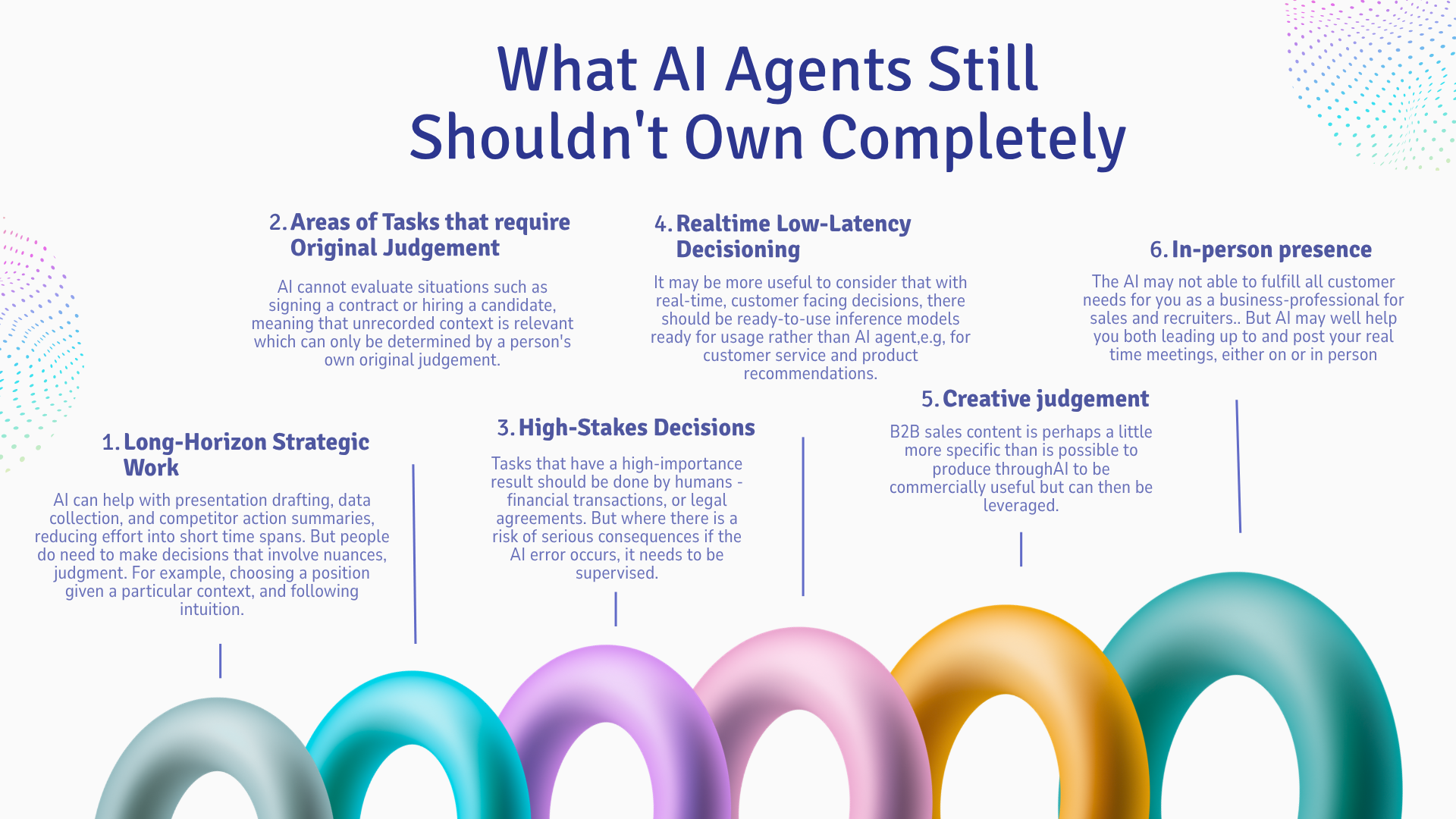
What AI Agents Still Shouldn’t Own Completely
There are six factors where AI Agents still shouldn’t own completely. These are mentioned below:
- Long-Horizon Strategic Work
- Areas of Tasks that require Original Judgement
- High-Stakes Decisions
- Realtime Low-latency Decisioing
- Creative Judgement
- In-person Presence
How Industries Are Using AI Agent Demand Generation
1. Banking and Financial Services: Financial services is a industry which agentic AIs can bring increased productivity and efficiency too. The use of AIs to detect fraud and monitor regulatory compliance, expedite loan decisions, possibly saving about 30,000 workdays. It’s believed to raise productivity levels between 20%-59%. Using AI Agents to offer personal wealth and financial planning services, get you the best rates and returns.
2. Disaster response: AIs agents will have the capacity to make sense of input from all angles like satellite pictures, human observations and social media feeds. It can process them quickly into relevant outputs that get to the right authorities at the appropriate times. So that the affected and impacted people can be rescued in time and with efficiency. Thereby, bring down the overall loss and number of causalities in disasters.
3. Education: Education is being adapted to the modern age through the creation of AI learning agents. These agents are capable of adjusting lesson plans and their delivery according to an individual’s personalized needs. This also include the specific ways a given individual learns. This approach promotes custom learning modules tailored for individual students who are in need of educational help. They facilitate with personal tutoring, feedback, in-depth assessment and feedback in the higher education system. It speeds the learning and development process that involves generating personalized assignments and feedback. Therefore, it uses agentic learning programs that create immersive personal tutors and custom learning content for language education, math help, etc.
4. Healthcare: The healthcare industry is becoming “smarter”, with agents providing a “powerful” AI workforce to the medical community. AI Agents in Demand Gen can process, interpret, and diagnose the patient’s condition through a thier detailed health information, and optimizing for treatment. It speeds the efficiency of all duties related to the process. Lastly, the medical agents monitor the vital statistics and also help reduce overall errors.
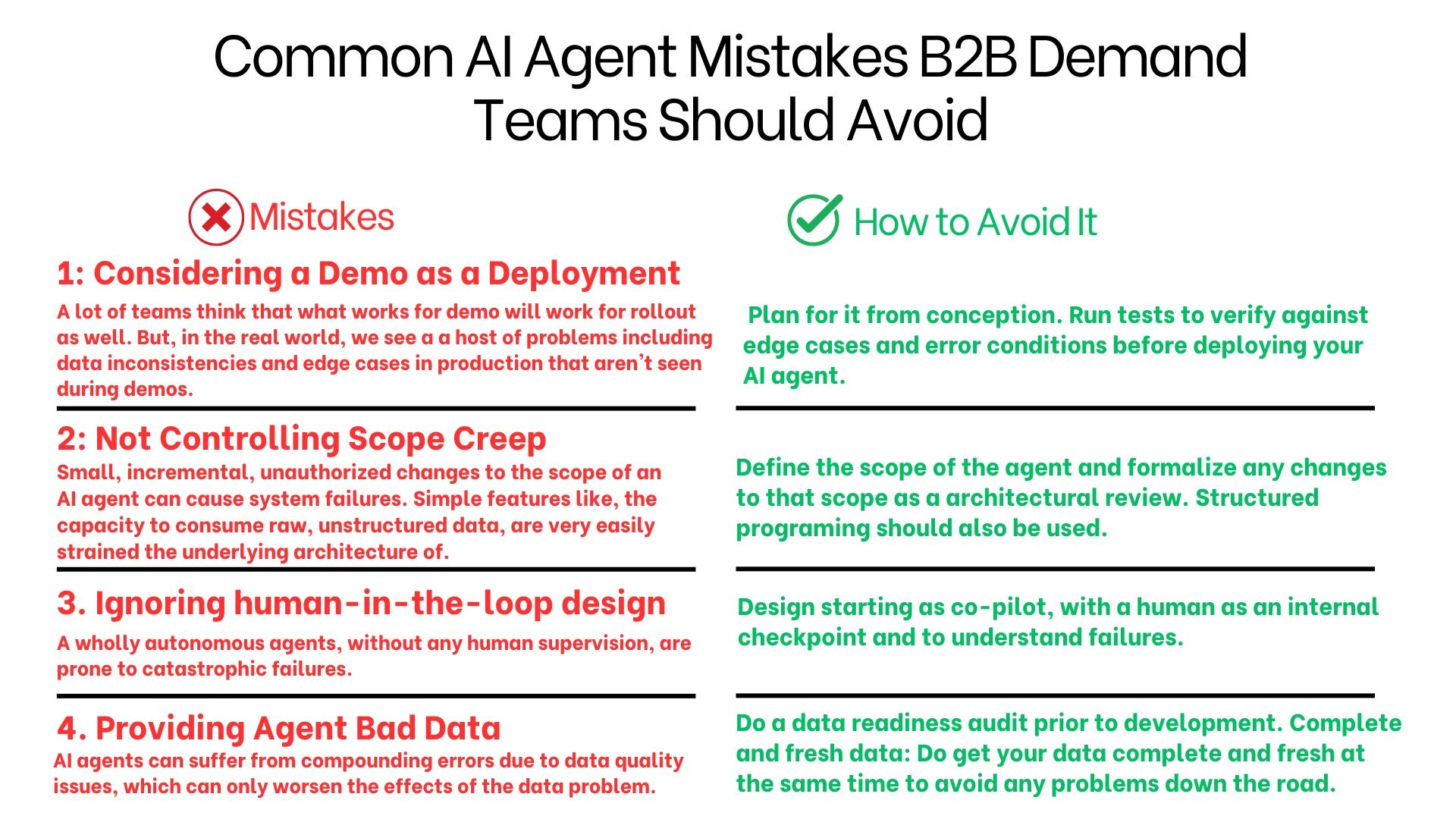
Common AI Agent Mistakes B2B Demand Teams Should Avoid
Conclusion: Humans Set the Strategy, Agents Run the Motion
The best-in-breed demand generation systems of tomorrow integrate machine decisioning and human direction. Human marketers will continue to focus on determining the target audiences, positioning, creative, value propositions and customer journey experience. AI Agents in Demand Gen will act as the operational engine running under your strategy, monitoring website signals, integrating signals across disparate systems. Thereby, deciding and executing approved actions on behalf of autonomous marketing. The fundamental elements of an effective demand generation system will shift from the following:
Data > Signal > Intelligence > Decision > Execution > Handoff to Human.
All systems and actions feed the model. Thereby enabling the system to learn from new information, optimize further, and empower those human teams to invest less time reacting and more time in strategy. Demand generation shifts from a discrete series of marketing campaigns to an always-on machine. It’s about creating an AI powered operation enabling faster responsiveness, more precise interactions, and tighter integration of all marketing efforts with the sales pipeline. It frees marketing and sales leaders to focus not just on the strategy, but also on a fast, always-on intelligent system for executing strategy.

Author: IDBS Global
Turning Data into Demand, Fueling B2B Growth with Precision and Purpose.