
GTM Engineering vs RevOps: How to Audit Your Revenue Stack and Eliminate Operational Waste
Follow us

Revenue teams are nothing but complex stacks of tools, data flows and workflow processes today. But even most organizations are facing problems with duplicate platforms, breaks in integration, manual processes which takes lots of time and money. When discussing problems, the discussion on GTM engineering versus RevOps arises. Having the GTM engineering side vs the RevOps side of the business understood will help you determine your priority as a process-driven or technical decision. An audit of your revenue stack using the GTM engineering approach or the RevOps lens reveals the places where you have revenue that is leaking out. In this guide, you’ll get a layman’s explanation of GTM engineering vs RevOps, and how to assess your current RevOps stack. Moreover, we will go through how GTM engineering vs. RevOps have the biggest impact, and when to spend on them. Lastly, we will find out the best ways to avoid waste within your income operations.
GTM Engineering vs RevOps: What’s the Actual Difference?
Simply put: RevOps strategy creates the revenue operating model and GTM Engineering creates the technical systems to enable that model. It is a comparison of GTM engineering and RevOps, it with a clearly means “you lose me process planning, RevOps wins forecasting, or RevOps wins tool selection”. Whereas, GTM Engineering is a supplier of automation, enrichment and integration to move pipeline.
Where RevOps and GTM Engineering Overlap
GTM Engineering’s and RevOps roles both have an interest in revenue efficiency, data quality, and system reliability. They both run in your CRM, marketing, or sales automation and enablement products. The intersection is problematic, as is the difference for hiring and accountability.
Strategy vs. Technical Execution: The Simplest Way to See the Difference
| Dimension | Strategy (The “Why” & “What”) | Technical Execution (The “How”) |
| Core Focus | Direction, goals, and long-term vision. | Actions, processes, and immediate output. |
| Primary Question | “Are we doing the right things?” | “Are we doing things right?” |
| Time Horizon | Long-term (months to years). | Short-term (days to weeks). |
| Success Metric | Market growth, ROI, competitive advantage. | Speed, accuracy, system stability, code quality. |
| Analogy (Building) | Architect designing the blueprint. | Construction crew pouring concrete. |
What Does RevOps Actually Own?
RevOps is on the hook for the whole revenue system; not just reporting on it. It helps build the connection between strategy and execution from Marketing, Sales, and Customer Success. Lastly, it is based on a shared revenue model instead of optimizing in isolation.
Aligning Marketing, Sales, and Customer Success Around Revenue
RevOps is the glue which connects and owns it, occupying a position at the intersection, running horizontally instead of vertically. It safeguards against revenue leakage in hand-offs and encourages behaviour towards shared goals through (mis)alignment of incentives.
Building Consistent Processes and Revenue Definitions
RevOps is all about how work flows from one stage to the next in the funnel: it covers stage gates, decision points, shared metrics, etc. Otherwise, companies practice optimisation in local, but not global, sense.
Improving Data Quality, Governance, and Reporting
RevOps delivers clean data integrations between tools, and rev decisions based on trusted, governed data that are not siloed in dashboards.
Managing the Revenue Technology Stack
Owns tool selection, integration, and adoption, not as an admin task, but to impact and reinforce process discipline.
Identifying Operational Bottlenecks Across the Customer Journey
However, RevOps identifies them in situations where report designs fail to take process into account. In other words, execution gaps and closes the loop by fixing the process rather than the reports.
What Does a GTM Engineer Actually Do?
A GTM Engineer “translates” the commercial go-to-market strategy into reliable and automated technical systems. It power pipeline creation and revenue efficiency. They intersect with sales operations, marketing operations, RevOps, and engineering, creating the backbone to enable scalable and measurable modern GTM motions.
Turning GTM Strategy Into Technical Workflows
GTM Engineers are proficient in converting ICP definitions, messaging playbooks, and sales processes into actionable workflows, such as via a tool like Clay. They create multi-step automation flows for prospect research, scoring, routing and enrichment that simulate business criteria.
Connecting CRM, Data, Enrichment, and Automation Tools
The central orchestration point is the CRM. A field mapping document created by the GTM Engineers defines data ownership, direction of syncs, how to handle data conflicts and trigger mechanisms. They create enrichment pipelines from multiple sources to get 80%+ on key attributes such as headcount, tech stack, funding, etc.
Building APIs, Data Pipelines, and Custom Integrations
GTM Engineers connect multiple APIs together, reverse engineer rate limits and create custom integrations throughout the revenue stack! They design data infrastructure such as:
- Identity resolution
- Routing rules
- Event tracking
- Connections to warehouse applications (It can be connected to scoring models).
Automating Repetitive Revenue-Team Tasks
Core automation features such as lead routing, owner assignment, lifecycle stage, SLA alerts and account contact scoring, based on frameworks like SPICED scores are included. They remove the manual triage process by delivering qualified leads to the right AE without requiring extra manpower for conversions from MQL to SQL.
Creating Scalable Systems for Modern GTM Motions
GTM Engineers create outbound systems built on signals. They automatically identify funding rounds, key hires, and tech changes, and send targeted outreach at the right time. They instrument all of their workflows, conduct experiments, and optimize using data. It starts to enable agile teams to function as full departments.
GTM Engineering vs RevOps: Comparing the Roles Side by Side
| Dimension | Fractional RevOps | GTM Engineering |
| Primary focus | Operating the revenue engine | Building automated pipeline systems |
| Output | Process, alignment, reporting | Automated workflows, enrichment pipelines |
| Skills required | Strategy, data analysis, CRM admin | SQL, APIs, automation tools, data engineering |
| Engagement model | Ongoing retainer (monthly) | Project-based or retainer |
| Who it serves | The whole GTM org | Primarily sales and outbound |
| When to engage | Revenue function is undefined or broken | Outbound is manual and not scaling |
How RevOps and GTM Engineering Work Better Together
RevOps Defines the Business Requirement
RevOps has the control of the governance layer which covers funnel definitions, KPI hierarchies, SLAs, forecast logic and a CRM single source of truth. Prior to a system in place, RevOps defines a qualified lead, stages, and what success will mean for the business.
GTM Engineering Builds the Technical Solution
The requirements are translated into systems: enrichment pipelines, signal detection, AI agents, custom CRM extensions and automations that multiply productivity, facilitated by GTM Engineering. RevOps sets the “what” and “why” while GTM Engineering determines the “how” process by coding, integrating, and designing the workflow.
RevOps Tests Processes and Measures Business Impact
After the system is activated, RevOps tests the performance against the KPIs such as pipeline coverage, conversion rates, reply rates etc. It also includes revenue attribution. That way, new constructions are not only capable, but they actually drive revenue data.
GTM Engineering Optimizes the System Based on Performance Data
GTM Engineering leverages insights from RevOps to fine-tune and enhance models. They enhance automations and routing constraints for greater accuracy and efficiency.
Creating a Continuous Revenue Operations Feedback Loop
They are combined to create a “Build vs Run” model with GTM Engineering building and prototyping. Whereas, RevOps governs, measures and scales. By building continuously, misaligned builds are avoided. Thereby, there is less tool sprawl, and sustainable revenue growth is realized.
How to Audit Your Revenue Stack Before Fixing It
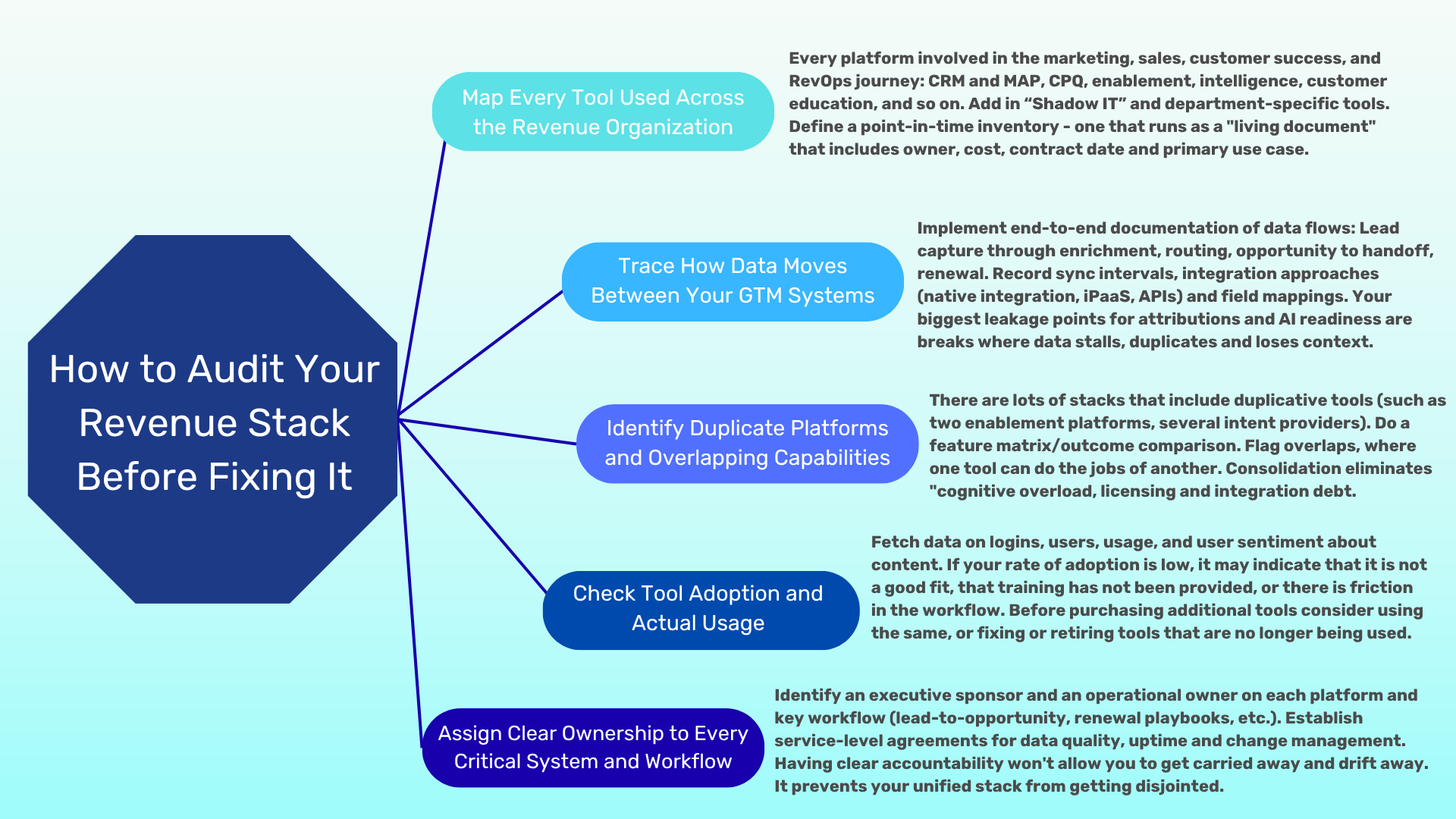
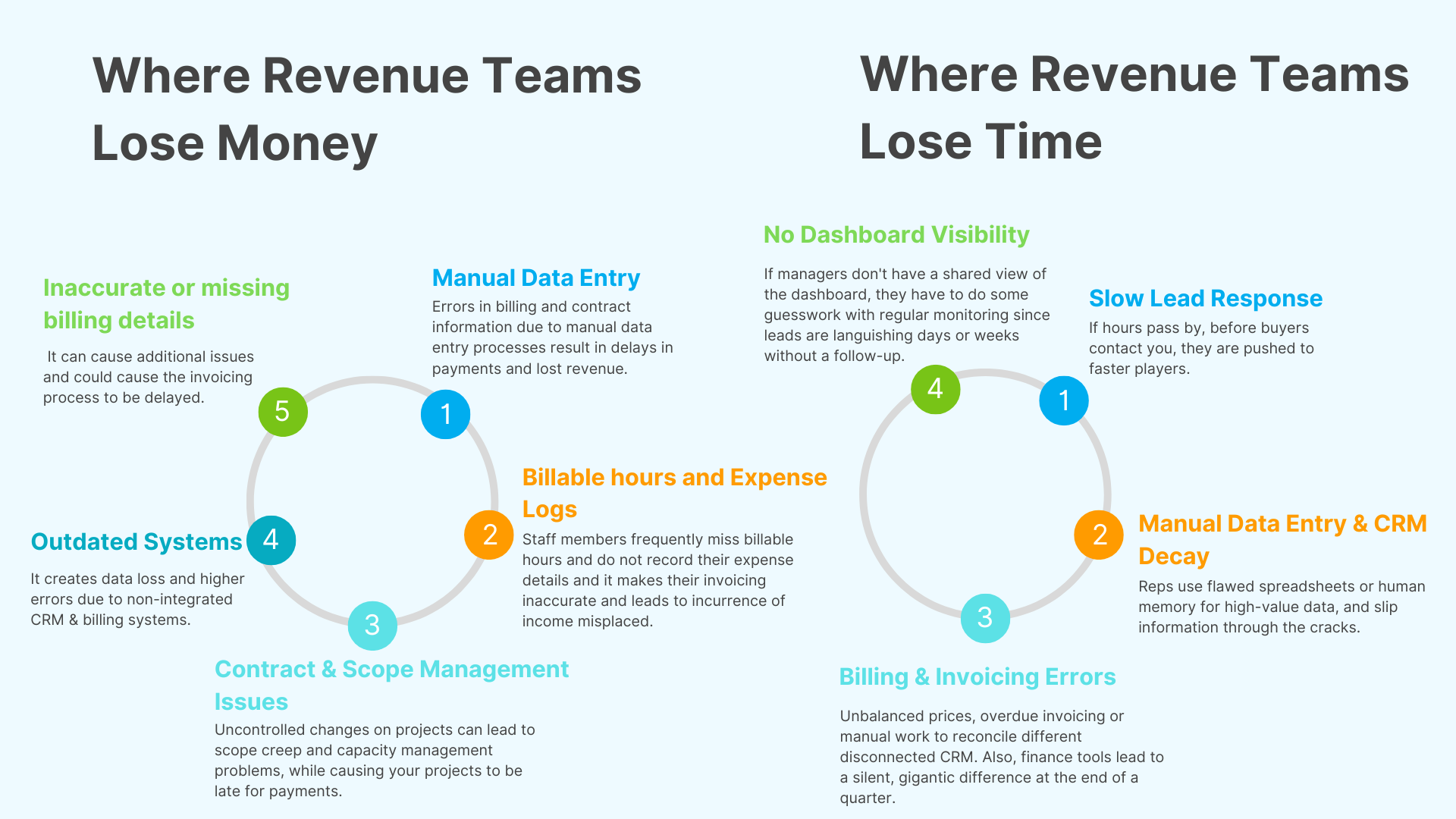
Where Revenue Teams Lose Time and Money
Using GTM Engineering to Eliminate Operational Waste
Automate Repetitive Data Collection and Enrichment
APIs get firmographic information and tech stacks from backends with only the email address sent, without any friction in the forms. Waterfall type enrichment uses AI to query multiple providers one by one, and completes all the fields you need to push downstream (routing, scoring etc) directly.
Connect Disconnected Revenue Systems
The solution from GTM engineering eliminates the manual process of data duplication from Google Sheets to CRMs and sequencing/automation platforms. Purpose-built sync layers view CRM native constructs of revenue as first-class objects and allow you to accurately propagate them into other tools without custom development.
Build Automated Lead Routing and Qualification Workflows
Just set up scripts that verify incoming leads with ICP filters and keep unqualified leads out of the CRM. A differentiated routing path automatically routes hot leads to AEs whose profiles are full while exception queues route records that never reach AEs.
Create Real-Time Data Flows Across the Revenue Stack
The events used for automation triggers the creation of new leads, stages of opportunities, or when products are used. Maintains accurate records without manual effort. This will provide one source of truth for revenue across Marketing, Sales and Customer Success systems.
Replace Fragile Manual Processes With Scalable Automation
AI RevOps tools handle the manual workflow that teams need to cobble together in applications like Zapier or Tray.io, from enrichment to scoring to routing to data hygiene. The outcome: reps and AI agents are able to operate on complete and up-to-date information in real time.
When Should a Company Invest in GTM Engineering?
Your Revenue Team Is Outgrowing Manual Processes
Manual workflows turn into a growth bottleneck when sellers and marketers waste hours translating data from one tool to another. It also happens when building lists manually for reporting with duplicate customer data. It’s a good indicator that your revenue team has reached a point where something clearly lacks an automated approach, systematic or otherwise.
RevOps Is Spending Too Much Time Fixing Technical Problems
When your RevOps team is still facing integration problems or resolving broken Zaps, rather than optimizing strategy. This is the sign that it’s time for them to hire dedicated GTM engineers. This allows for a focus on insights and planning instead of firefighting and allows RevOps to do what it does best.
Your GTM Tools Are Not Sharing Data Reliably
You have a data reliability issue when your data systems disagree with one another. Issues also happen when your workflows need some engineering assistance and the product teams can’t invest the time. A GTM engineer makes sure that your stack is communicating well.
Custom Automation Is Becoming Critical to Your GTM Strategy
There are clearly situations where speculative hiring makes sense for companies. If they have a rich set of product usage data, a super high-growth team, or a TAM larger than 50,000 accounts. Then they can hire sooner. As your GTM motion develops, custom automation integrates marketing, sales and product information into a single system.
Your Revenue Stack Needs to Scale Without Adding More Manual Work
When creating a job, be sure you have your automation gaps identified. Your GTM playbook is in place and your new tech stack is API-friendly. Make sure everyone signed up to buy in, and you have clear pipeline accountability with a tool budget and a solid data foundation. This sets your income machine for a smooth performance as it grows.
Choosing Between GTM Engineering and RevOps or Building Both
Choose RevOps When Process and Cross-Team Alignment Are the Bottleneck
Sales, Marketing, and Customer Success teams may have poorly aligned processes, or handoffs from one team to the next, or someone taking credit for someone else’s work, so RevOps provides structure. Perfect for maintaining operational discipline, not yet in need of technical scale.
Choose GTM Engineering When Technical Execution Is the Constraint
With multiple products, regions, or 20+ tools included in your GTM stack, AI/automation or data infrastructure becomes a priority. GTM Engineering makes sure it functions as a fully coordinated system. This role takes strategy and uses it to drive scalable technical delivery.
Build a Combined Function When Systems and Processes Are Equally Complex
Both are required in companies larger than 200 people that have well-established data and processes that are a mess. A hybrid function makes people, processes, and technology work together for the highest revenue efficiency.
Start With the Biggest Revenue Bottleneck, Not the Job Title
Employ for effect, not for certification. You have an intractable constraint: whether it’s a broken process, or a brittle system, solve that constraint first.
Conclusion: GTM Engineering and RevOps Solve Different Parts of the Same Revenue Problem
When you view GTM as a rival to RevOps, this doesn’t make sense. The truth is that GTM engineering vs. RevOps is two halves of a complete revenue operating system. RevOps governs data, rules the teams, and sets the rules. GTM Engineering creates the automations, integrations, and pipelines to enforce them at scale. Revenue stack audits with the GTM or RevOps allow you to identify areas of wasted effort in your process. This also includes where technical debt has accumulated. It’s because those gaps need to be closed, and both aspects of GTM engineering vs RevOps should work together. RevOps is the definition of good; GTM Engineering delivers the system that makes it real. As GTM engineering improves revenues, RevOps will constantly help it optimize that efficiency. At the core, it is the ability to analyze the issue from various perspectives and identify the root cause. Next, proper investment in the correct combination of both is needed to eliminate waste in operations and scale reliably.

Author: IDBS Global
Turning Data into Demand, Fueling B2B Growth with Precision and Purpose.