
Understanding and Influencing the B2B Buyer Journey to Win More Deals and Drive Conversions
Follow us

The B2B buyer journey has changed from being a clearly defined sales funnel, to a process of self-navigation, multiple stakeholders, and a customer journey. This can sometimes end long before sales gets involved. So today’s B2B buyers utilize AI tools, networks and review websites to pinpoint issues and explore fixes themselves, with the marketing and sales team remaining vulnerable. The B2B buyer journey is no longer a choice but the bottom line of making deals or watching prospects slip away. Learn about the modern B2B buyer journey and why it varies by account, and learn how to create content for buyers where they are in their journey.
What Is the B2B Buyer Journey and Why Has It Changed?
B2B buyer journey maps the entire process a potential client goes through to get a product/service and become a repeat buyer. B2B buying also differs from consumer buying as it includes several parties, extended buying or sales cycle. It also includes dozens of touchpoints that span across a set of distributed channels. The road trip way of shopping has completely transformed, as 67% of it takes place online, and only 5-6% of the time is spent interacting with sales reps. This shift has proposed pace by AI-driven exploration with 45-48% of buyers creating blended vendor information by utilizing generative AI before jumping to the sites.
Why the Modern B2B Buyer Journey Is No Longer a Straight Funnel
While the basic funnel is linear, with “awareness” followed by “consideration” then “action” leading to “purchase,” today’s buyers are bound to bounce back to the awareness phase. It is when they are further along in their journey and need to understand the impact of each stage. This real and non-linear truth means that funnel-based demand programs don’t appropriately simulate purchasing buyer behavior.
How Self-Guided Research Changes the Role of Sales and Marketing
Most research is done independently of each other where the content and brand capital must do the bulk of the work while sales engagement can take the back seat. Teams can no longer rely on vendor-provided funnels to push prospects. Rather, they are shifting from pushing prospects through funnels to providing buyers with the information they need. So that they can confidently make a decision.
Why Buying Committees Make the Journey More Complex
Enterprise deals with 6-10 stakeholders, who each have their own set of priorities and information needs. The CFO and ROI are part of the equation; IT directors need to deal with integration; end users must have usability. This means more than one persona is needed to handle content.
The Key Stages of the Modern B2B Buyer Journey
Problem Awareness: When Buyers First Recognize a Business Need
The journey starts with a stakeholder noticing an area of pain, inefficiency, or opportunity to grow that needs to be addressed. At this juncture, buyers are looking to gain knowledge on how to detail a problem but not offer a solution.
Solution Exploration: How Buyers Research Possible Approaches
After understanding the problem, users visit the categories of problem solutions and then make comparisons. They read thought-leading articles, how-to pieces, and comparisons to see what an effective solution is and what paths are possible.
Vendor Evaluation: How Shortlists and Preferences Begin to Form
Once buyers have an idea of what type of person they want for their approach they start ‘short-listing’. For instance, they consider 2-4 vendors according to the properties that they have specified. It is because teams evaluate fit, capability, and risk, demos, case studies, security documentation, and peer reviews are essential.
Validation and Decision: What Buyers Need Before They Commit
Buying groups confirm the decision within the group prior to the signature. They require ROI models, references, pilot results and, most importantly, pricing to justify the investment, legal, and leadership buy-in.
Post-Purchase: Why Implementation and Adoption Still Matter
The contract starts and continues the journey. Adoption enables a successful onboarding, training, and value creation, which minimizes churn and paves the way for growth and fostering brand loyalty.
How Buyers Research, Evaluate, and Choose Vendors
How Buyers Define Their Problem Before Looking for Vendors
Buyers define their business issue, their expected results, money available and business measure of success before they start looking for vendors. There is an internal alignment, which means that they are looking for solutions that match their needs. Thereby avoiding reacting to vendor communication.
How Buyers Research Solutions Across Search, AI, Reviews, and Peer Recommendations
Customers investigate options on search engines, AI, industry directories, discussions with peers and review platforms. They do research on how good they are, the price-level and the reputation to compile a shortlist of suppliers.
How Buyers Shortlist Vendors Based on Expertise, Fit, and Credibility
Shortlisting emphasizes vendors that have the relevant experience, the industry and certifications, and solid references. They look for buyers that have demonstrated their experience and have an easy-to-navigate website that allows them to develop confidence in them.
How Buying Committees Compare Vendors, Pricing, Features, and Business Outcomes
Cross-functional committees make a side-by-side comparison of vendors and compare their pricing, features, services, and return on investment. Final ranking may be influenced by competing priorities such as the cost of service versus quality of service.
Why Social Proof, Case Studies, and Customer Reviews Influence Vendor Selection
Review, testimonials and case studies assure potential customers of reliability and performance. Perceived risk is decreased and makes vendors appear unique in crowded markets.
How Buyers Validate Vendors Before Engaging With Sales
Buyers request samples, trials, financial statements, and even site visits to validate the capability. These are a validation of vendors being able to deliver on their commitments with respect to qualifications, budget, and timelines.
What Happens When Multiple Stakeholders Evaluate the Same Vendor
User and IT value usability, finance value costs, different stakeholders value criteria differently. Can cause stresses but results in even choices.
How Procurement, Finance, IT, and End Users Shape the Final Purchase Decision
All departments have an impact on the results: procurement deals on conditions, finance decides on funds, IT assures compatibilities, and end users confirm functions. Some consensus between groups may be needed.
Why Buyers Often Go Dark During the Evaluation Process
Buyers can choose not to communicate and can take time to speak in their own heads, search in private, and wait for budget approvals. This “going dark” period can be a nuisance for vendors waiting for feedback.
How B2B Brands Can Stay Relevant Throughout the Buyer Journey
Brands need to keep the volume of useful, instructive material, frequent follow-up contacts and adaptable engagement as crucial elements. When presenting a proposal takes time to peruse, a vendor’s ability depends on being both helpful and visible, but not intrusive.
How Buyer Intent Signals Reveal Where an Account Is in Its Journey
| Journey Stage | Account Activity / Signals | What It Means |
| Awareness (Top of Funnel) | • Reading broad educational blog posts• Searching for industry trends or problems• Attending high-level introductory webinars | The account knows it has a general problem or interest, but it does not know your specific solution yet. |
| Consideration (Middle of Funnel) | • Comparing your product with competitors• Downloading product guides, whitepapers, or case studies• Visiting pricing or feature comparison pages | The account is actively defining its problem and evaluating different types of solutions and vendors. |
| Decision (Bottom of Funnel) | Booking a product demo• Contacting sales or requesting custom pricing• Multiple stakeholders visiting high-intent product pages | The account is ready to buy and is choosing between final vendor options. |
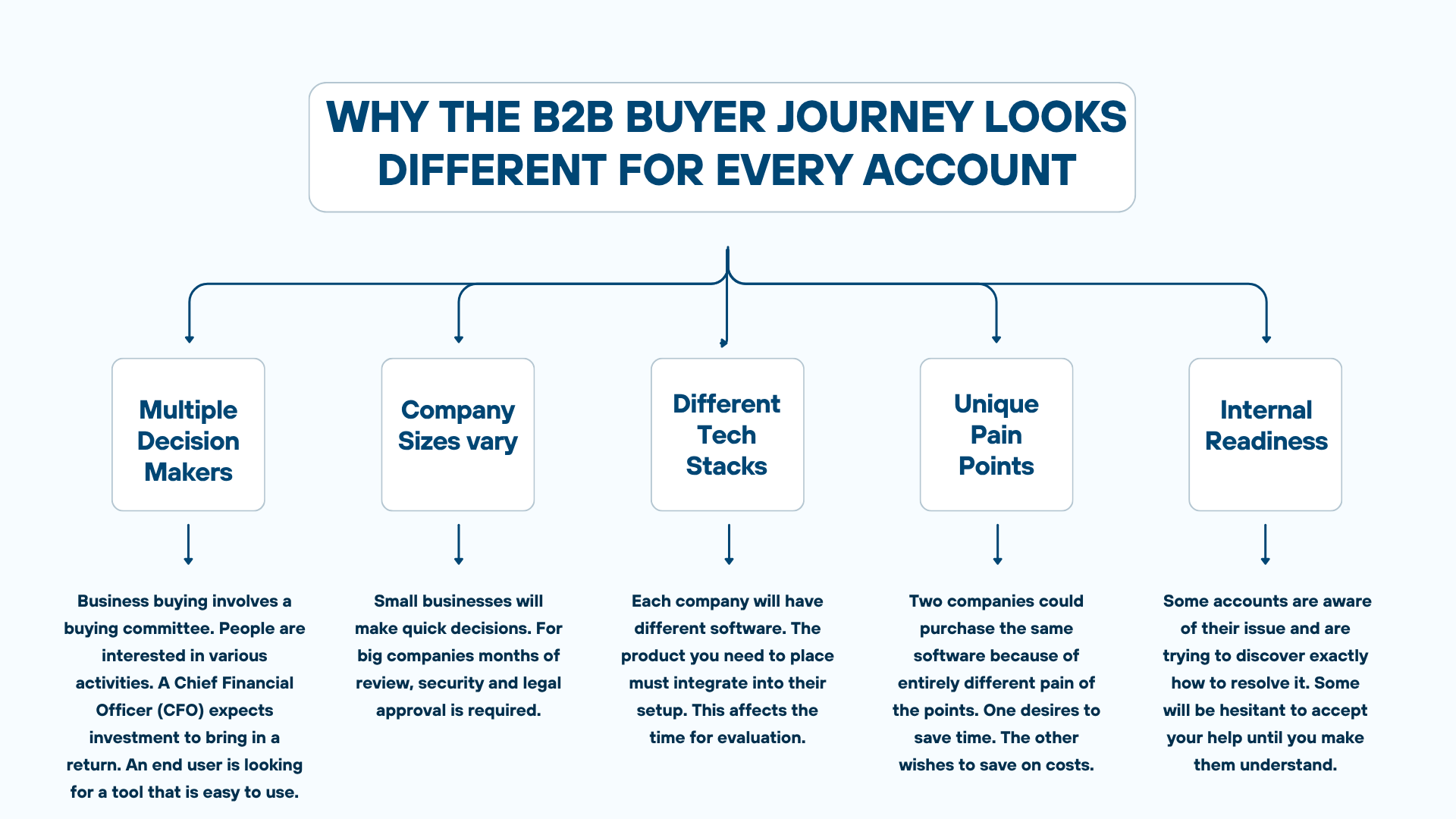
Why the B2B Buyer Journey Looks Different for Every Account
There are many reasons why the B2B buyer journey looks different for every account. Let us look at them one by one:
How to Build Content Around the B2B Buyer Journey
Creating Educational Content for Early-Stage Research
Buyers are aware of a problem, but not the solutions. Create content around pain points (e.g., how-to guides, industry report, checklists, or brief explainer videos) that explain the problem, measure the effect, and explain frameworks, but aren’t too “salesy.” Target for search intent and local/industry keywords to get some research traffic.
Using Case Studies and Comparisons to Support Evaluation
Buyers make comparisons in consideration. Generate complex case studies complete with measurable results, competitor comparisons, feature-benefit documents, and walkthroughs of the demos. Let third-party validations (quotes from analysts, reviews) be a stark accent to the technologic possibilities. Highlight examples of location or industry, for more relevance and more trust.
Providing ROI, Proof, and Product Information for Decision-Stage Buyers
Offer pricing pages, guides to implementation, security/compliance documentation, ROI calculators and customer reference call to decision-stage. Be rid of last-mile uncertainties and deal with TCO, timelines and after-sales support.
Giving Sales Teams Content That Helps Buyers Build Internal Consensus
Give reps one-pagers, executive summaries, business case templates and slides to pass around inside the organization. To simplify multi-approver approvals, incorporate value narratives, risk mitigations, and FAQs for each stakeholder.
Using One Content Strategy Across Multiple Buyer Personas
Have a consistent messaging structure and content schedule, and customize messaging for persona (economic buyer, technical evaluator, end user) with changes in tone, examples, and metrics. Consistently reuse the core assets, but add persona specific overlays to make the assets more relevant for each role.
Case Study: Selection of the right AI vendor for automating lead qualification
Challenge
One of the mid-sized B2B SaaS companies from Mumbai had to choose the proper AI vendor to automate the Lead Qualification process for B2B outside of the city. Several vendors were able to demonstrate polished demos, but there is no development of rubrics internally to evaluate operational fit and integration with their HubSpot CRM. This includes a long-term measuring stick of accountability as well. What follows: the one that doesn’t happen, ROI uncertainty and the risk of shelfware once deployed.
Solutions
The company was using a scorecard as their measure, but it was based on overall business results, not the number of leads that were routed, manually reviewed, or used for sales capacity. Technical performance, CRM integration depth, adoption risk and post-launch governance, were selected as the criteria. Performance of accuracy, latency, and exception handling was tested by a paid pilot on real inbound data. Governance metrics were incorporated in the contract prior to signing, which included adoption, time-to-value, and quarterly reviews.
Results
Within 90 days after going live, lead response time decreased by a whopping 42% and manual effort on triaging leads was reduced by 60%. Furthermore, the sales reps saved more than 15 hours per week for high-value outreach. Punishment was applied to the vendor by means of monthly KPIs with reference to the original score card. This was implemented in a way that it could be replicated for future procurements of AI in marketing and service teams.
Where B2B Companies Commonly Lose Buyers Along the Journey
You know who your buyers are and you understand their buying mechanisms, but do you understand how they actually make decisions?
Instead of specific, actionable insights, companies overload buyers with generic whitepapers. They display the same offer to all leads, when buyers are looking for personalized and targeted suggestions. They use old-fashioned sales methodologies which are not aligned with the typical buying process of most buyers. If you want to win in the B2B buying journey in 2026, you have to know more about your buyers. Look for questions like:
- What are they waiting for?
- What is known?
- Where are they taking their comfort level to confident in a decision?
Conclusion: Winning the B2B Buyer Journey Before the Sales Conversation
B2B buyer journey begins long before sales ever gets a call, usually through AI tools, networking or reviewing platforms.” The key to winning is becoming an authoritative, credible source other users (including buying committees) will cite when doing their own research. Align your articles to the various phases of the B2B purchase journey, such as problem-awareness essays, to decision-stage ROI models. Qualify champions with assets to be passed on, which promulgate your solution to 10+ stakeholders in the silent evaluation phases. Monitor intent signals to know where accounts are in the B2B buyer journey, and how to get the message across at the right point. Above all, understand that the B2B buying process is non-linear, multi-agent and less reliant on traditional sales paradigms than ever before. Brands that embrace the era and deliver focused educational materials, as well as social proof, and maintain a presence in AI. As far as search and peer channels are concerned, they’ll secure more wins and boost B2B conversion. The B2B buyer journey belongs with those who are ready to speak with the buyers who are there, and not the ones they assume should be there.

Author: IDBS Global
Turning Data into Demand, Fueling B2B Growth with Precision and Purpose.