

Appointment Generation Framework: How to Qualify Prospects and Book Better Sales Meetings
Follow us

It’s not the number of meetings or where they’re booked that makes money, it’s what occurs during them that does. Sales time can be easily lost, team morale can be negatively affected. As for your sales pipeline, it can be burdened with accounts that will never make a purchase. Especially, when they are filled with unqualified conversations in the calendar.
The right B2B appointment generation process will be concerned with quality first. It discovers who they are whether they fit your typical customer and describes what your business challenge is – and that a sales discussion is appropriate. This is where the appointment setting pilot framework comes in handy.
The appointment setting pilot framework provides sales/marketing teams with a structure to test them out on each:
- Sales outreach
- Lead qualification questions
- Messaging
- Meeting handoff
Therefore, test the above before scaling up. Teams don’t take anything for granted when they book meetings; they track and assess whether they result in actionable opportunities and pipeline. A 60 to 90-day pilot is typically used to help ensure targeting, messages, and meeting quality is optimal before rolling out to a scale-up program. This blog discusses how to qualify prospects, conduct more powerful discovery calls, and make discovery a repeatable revenue machine.
What Makes an Appointment Setting Pilot Worth Running?
An appointment setting pilot is worthwhile when it’s a test of the entire motion of the pipeline, rather than just the ability of a vendor to fill a calendar. Scaling without a strong pilot signifies bad targeting, messaging, qualification and handoffs, and no repeatability.
Why Meeting Volume Alone Is Not a Measure of Success
But all the sales meetings that are booked and nobody shows up and prospects that attend don’t follow through on their purchasing, are no good at all. Measuring and showing results like sales acceptance rate, opportunity creation, and early pipeline contribution tell more than the measures.
A case in point is that 30 weak-ICP meetings might not be as valuable as 12 decision making meetings when the business need is active. A pilot should therefore track advancement of the buyer journey; it’s not activity.
Define the ICP Before Starting Appointment Setting
Ahead of the outreach, making all the industries, company size, geography, buyer personas, accounts criteria and excluding criteria clear. Failing to have a specific ICP will result in your setters talking to contacts who can’t or won’t buy what you have to offer. The can’t influence a purchase, or don’t have the problem you’re helping them solve.
Focusing the scope makes the test significant: choose a focused market, customer list, personas, messaging, and reporting schedule. This way, you know that your motion reflects more on your market than if it can just be done in outreach.
Set Qualification Standards for Every Sales Appointment
The ‘Meeting’ term must be defined by both the appointment-setting team and sales. Specify necessary qualities like having a decision-maker, budget control, timeline, genuine initiative, and concern with business pain point.
“Vague qualification” can actually yield mixed results: one team can legitimize any meeting that is agreed to. Whereas another team (sales) will expect a clear decision-maker who has a real need. Clear standards ensure high-quality meetings, high sales buy-in rates and meaningful, measurable proof for a scale decision.
Start With the Right Discovery Questions
Discovery questions ensure that appointment setters have insight into whether a prospect needs, has urgency, and has the ability to decide whether to act. Specific questioning highlights if there is a project in the works and curiosity.
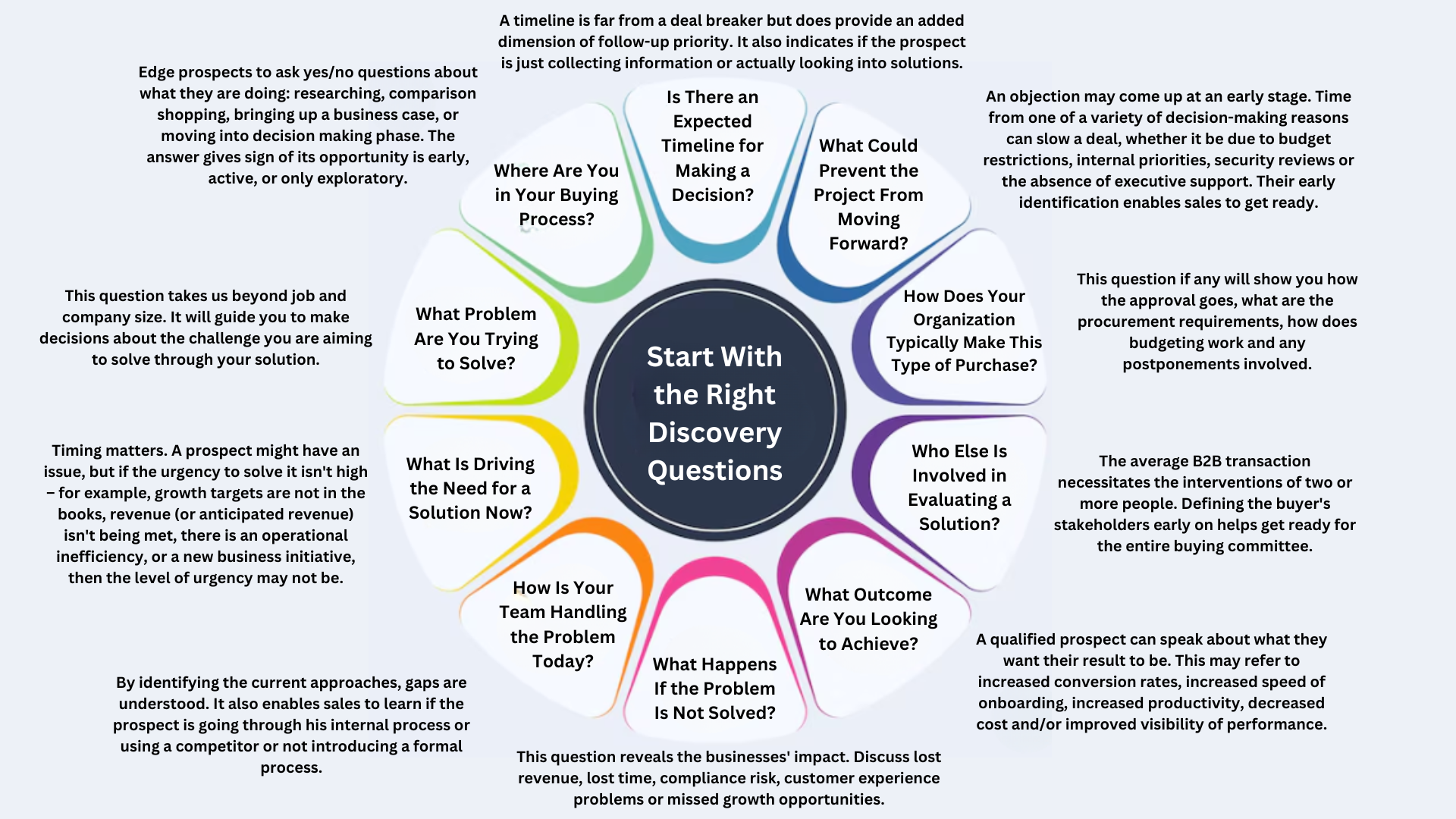
How Discovery Questions Qualify a Sales Appointment
Confirming the Prospect Has a Relevant Business Need
Use open-ended questions, like
- What are the 2 or 3 pain points?”
- If you went on doing nothing differently, what would you do?
Those questions aren’t “general interest” questions. They should be questions that spell out whether or not there is really a problem. It considers sales prospect cares about and expects you to have the solution to.
Checking Account and Persona Fit
Fit-check questions help your prospect determine that your company, industry, size and role are a good fit for your Ideal Customer. Ask questions to each persona, a CFO might want to ask about cost efficiency, and an end user about workflow friction.
Identifying the Buying Trigger and Timeline
Ask questions about the “why now” such as, “Why did you investigate choices at this time?” and “What are some of your stages in the decision process?” This will help to differentiate an active, time-sensitive opportunity from a research stage one.
Understanding Decision-Making Authority
Identify the buying committee and who is the owner of the initiative, who must sign off on the purchase and who are stakeholders that would slow the purchase decision. This reveals who makes the actual decision and enables sellers to gain access to the correct individuals.
Confirming a Clear Reason for the Sales Conversation
Establish desired results before pitching and the future of the next encounter. Questions are relevant, well framed and progress the opportunity making it a real one of success: What does success look like after implementing a solution?
What Information Should Be Captured Before the Meeting?
Prospect Pain Points and Current Challenges
Understand the prospects day to day issues like low growth, complexity of operations, low visibility, high cost/expense etc. Read about the news of an account, earnings calls, job postings or existing discussions to gain insight into what has changed and why.
Existing Solutions and Gaps
Write down the tools, processes or vendors that the prospect uses, and how bad they are. This allows you to focus on a realistic or actual gap in the solution (implementation challenges, ROI issues, control challenges, etc.), rather than on challenging the current provider.
Buying Intent and Timing
Inspect indicators of urgency such as budget, leadership changes, expansion plans, mention of competitors or new initiatives. These triggers can help to understand if the prospect is in the process of considering a solution or if there could be decisions in the near future.
Stakeholders Involved in the Decision
Identify all attendees by roles of: decision maker, influencer, and gatekeeper. Recognize the individual priorities, concerns and approval authority in a discussion. This ensures finance, technical, operational, and strategic needs are applied.
Agreed Meeting Objective and Next Step
Identify one key result in the language of the looking-to players (confirm priorities, discuss timeline, and/or agree to technical consideration). Conclude meeting with a specific and agreed upon next step, put into the CRM.
The 90-Day Appointment Setting Pilot Framework
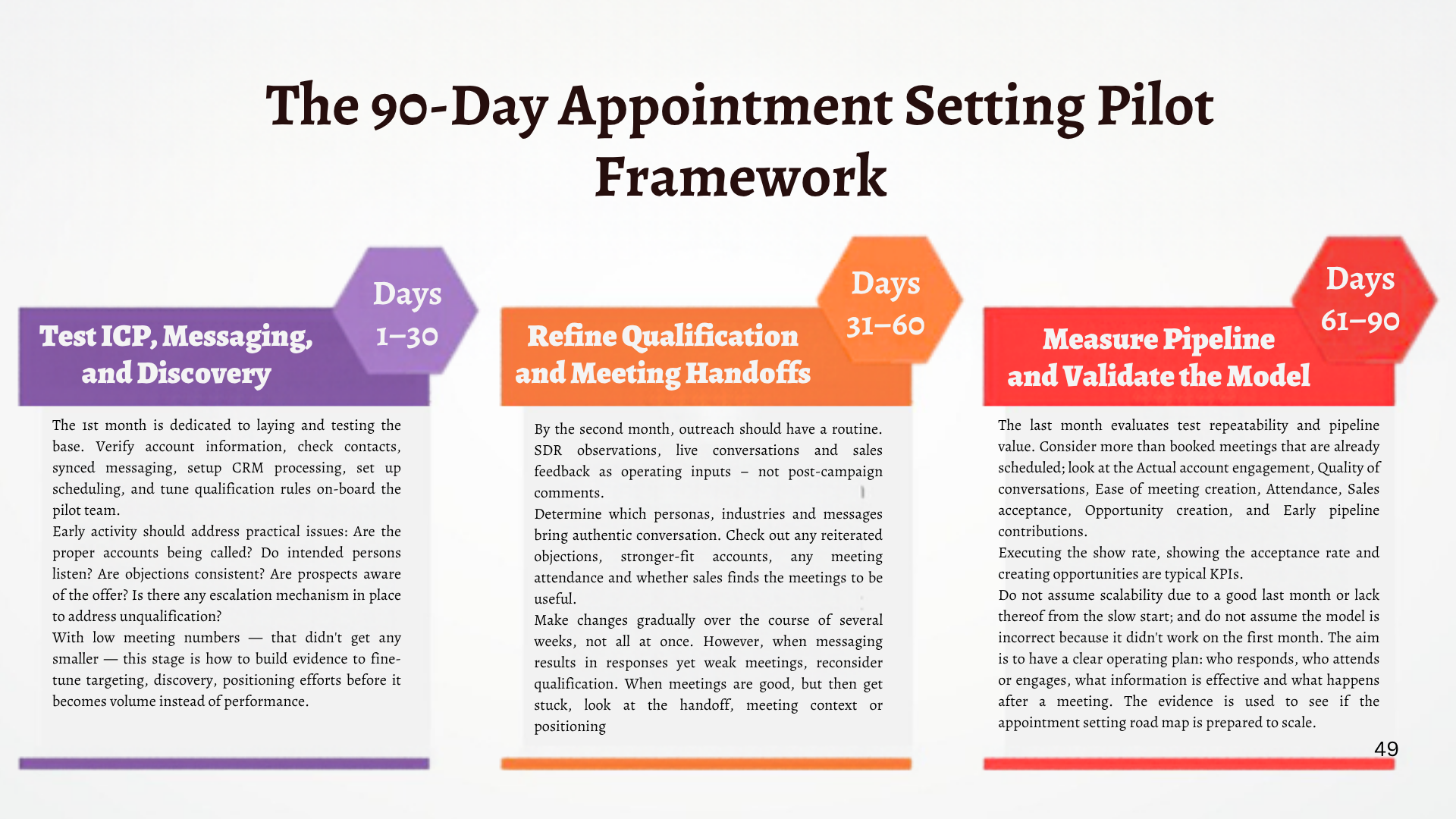
How to Measure Appointment Quality During the Pilot
| Metric | Definition | Formula |
| Call-to-Appointment Rate | Measures how effectively outbound calling campaigns convert call attempts into booked appointments. | (Unique Appointments Booked ÷ Outbound Call Attempts) × 100 |
| Lead Response Time | Measures how quickly the team responds to a prospect’s inquiry or reply. Report the median response time. | Median (Time of First Human Response − Time of Prospect Inquiry or Reply) |
| Appointment Show Rate | Measures the percentage of scheduled appointments that prospects attend. | (Held Appointments ÷ Appointments Due) × 100 |
| Appointment-to-Opportunity Conversion | Measures the percentage of held appointments that result in qualified sales opportunities. | (Held Appointments That Create an Opportunity ÷ Held Appointments) × 100 |
| Revenue per Held Appointment | Measures the revenue generated by appointment cohorts relative to the number of appointments held. | Closed-Won Revenue Attributed to the Cohort ÷ Held Appointments in the Cohort |
| Cost per Booked Appointment | Measures the campaign cost required to generate each unique booked appointment. | Campaign Costs Attributed to the Cohort ÷ Unique Appointments Booked |
| Lead Quality Score | Evaluates lead quality against documented criteria, such as ideal customer profile fit, decision-making authority, budget, and business needs. | Total Points Earned ÷ Maximum Possible Points × 100 (for a percentage-based scoring model) |
| Sales Acceptance Rate | Measures the percentage of reviewed, held appointments that sales accepts as suitable. | (Sales-Accepted Held Appointments ÷ Held Appointments Reviewed by Sales) × 100 |
| Monthly Appointment Volume | Measures the number of unique appointments booked during a calendar month. | Count of Unique Appointments Booked During the Month |
| Account-to-Appointment Rate | Measures how effectively outbound outreach converts contacted target accounts into booked appointments. | (Unique Target Accounts With a Booked Appointment ÷ Unique Target Accounts Contacted) × 100 |
| Marketing-Sourced Appointments | Measures the number of appointments attributed to marketing activities under predefined attribution rules. | Count of Appointments With Marketing as the Primary Source |
| Client or Sales-Team Feedback Score | Measures satisfaction with appointment quality, prospect fit, preparation, and readiness using a consistent review rubric. | Total Feedback Points ÷ Total Points Available Across Completed Reviews × 100 (for a percentage-based rubric) |
| Pipeline Velocity | Estimates the value of qualified sales pipeline generated per day based on opportunity volume, deal value, win rate, and sales-cycle length. | (Open Qualified Opportunities × Average Deal Value × Win Rate) ÷ Average Sales-Cycle Days |
| No-Show Rate | Measures the percentage of scheduled appointments that prospects miss without attending. | (Appointments Missed by Prospects ÷ Appointments Due) × 100 |
| Follow-Up Completion Rate | Measures the percentage of follow-up tasks completed by their specified deadlines. | (Follow-Up Tasks Completed by Due Date ÷ Follow-Up Tasks Due) × 100 |
| Decision-Maker Contact Rate | Measures how effectively outbound calls reach and engage decision-makers. | (Decision-Maker Conversations ÷ Outbound Call Attempts) × 100 |
| Opportunity Win Rate | Measures the percentage of closed sales opportunities that result in a win. | (Closed-Won Opportunities ÷ Total Closed Opportunities) × 100 |
| Average Deal Size From Appointments | Measures the average closed-won deal value generated by appointment-sourced deals. | Closed-Won Revenue From Appointment-Sourced Deals ÷ Number of Closed-Won Deals |
| Appointment Cancellation Rate | Measures the percentage of scheduled appointments cancelled before their scheduled time. | (Appointments Cancelled Before Scheduled Time ÷ Appointments Due) × 100 |
| Cost per Accepted Appointment | Measures the campaign cost required to generate an appointment accepted by the sales team. | Campaign Costs Attributed to the Cohort ÷ Sales-Accepted Appointments in the Cohort |
Use Prospect Feedback to Improve the Next Outreach Cycle
Identify Common Objections and Buying Barriers
Code interaction outcomes when prospects are tagged as interested, provide objectivity, do not provide a signal, and when they raise an objection. Collate individual responses by week into categories (budget, priority, competitor, fit) to show trends that individual responses might not pick up.
Find the Discovery Questions That Produce Useful Answers
Get immediate feedback on what touched them, what didn’t, what went to cold calling lists, and what needs to change for the opportunity to become a priority through questions. Do this at close range that seek their feedback, such as one-click reply options and a three question post-demo survey.
Refine Messaging Around Real Prospect Pain Points
Practice responding to the 1-2 biggest objections from the previous email/call. Test the new version with the same experimental groups against the original version first. Then implement the version that makes more positive replies and improves the responses.
Adjust Targeting When Account Fit Is Weak
If there is a clear need for some industries, sizes, or restricted roles to get higher budget relevance, adjust ICP criteria accordingly upstream. Behavioral data and signals and Intent (IDI) can assist in identifying the value of accounts to be invested in direct outreach versus nurture.
Create a Feedback Loop Between Appointment Setters and Sales
The reason for sales appointments should be documented, along with reasons for misses and disqualifications. Sales should provide a discovery and demo note in sales reports. Assign every outreach cycle to the CRM fields, sequence logic and shared dashboards to make it relevant.
When Is the Pilot Ready to Scale?
Consistent ICP-Aligned Meetings
Scale if meetings are regularly scheduled from a predetermined set of accounts, industries, geographies, buyer personas. While a meeting count might be healthy, it is not if the accounts are inaccurate. The people you are meeting are not influential, or your business problem is weak.
Strong Sales Acceptance and Meeting Quality
The number of appointments made is one good measure of sales activity. But a better indicator is whether sales is accomplished or not. It means whether the appointment setting team and sales have the same perception of what “qualified leads” looks like. The pilot is delivering real demand, not just meeting bookings, when sales routinely schedules meetings and decides to pursue the conversations.
Repeatable Discovery and Qualification Process
A pilot is prepared to extend, when the team can talk through what works in accounts, which engage in his or her messages, what happens during and after meetings, etc. Repeatable discovery, qualification, feedback and optimization suggest an operating model and not a one-time campaign.
Clear Evidence of Opportunity and Pipeline Creation
The best scale signal is measurable progress towards opportunities and pipeline. There is a clear line between favorably received meetings and a potential buying signal. One of those is a long sales cycle that gives you more time for poor ICP fit, conversation, or business strategy. The other is very different.
Conclusion: Turning Qualified Conversations Into a Repeatable Appointment Setting Engine
The better the qualification, the better the appointments are going to be. Rather than after meeting volume go after someone who has the problem, the why-to-do action, and the right role to play in the buying decision.
The appointment setting pilot framework provides a real-world test of ICP targeting and discovery questions, messaging, meeting handing, and performance measurements before scaling them. It gives sales & marketing a roadmap that they can follow to achieve more than one month’s worth of accomplishments in less than 90 days. Optimize for the best and eliminates the worst, and turns this journey into a repeatable process.
Every conversation with the sales team is more productive when the appointment taker gets the right information requested and gets well-qualified meetings. This translates to increased pipeline, improved sales effectiveness and a consistent appointment scheduling engine that generates sustainable revenue.

Author: IDBS Global
Turning Data into Demand, Fueling B2B Growth with Precision and Purpose.