
The 13+9 Problem: How Modern B2B Buying Committees Are Changing DemandGen
Follow us

B2B purchasing has evolved from a single thread to a group purchasing scenario. The “13+9 problem” reflects multi-stakeholder marketing. That is, every purchase in a modern business organization includes 13 internal stakeholders in addition to 9 external influencers. It is a feature that makes every interaction an act of consensus. This is about optimizing for accounts and accounts groups to the detriment of individual leads for demandgen teams. Today B2B pipeline velocity, message relevance, and the bottom line are at the hands of buying committees. If you still have a single point of contact in your strategy, you’ll be constructing weak pipeline that gets stuck in legal, procurement or financial review. In this post, we will outline why B2B buying committees are driving demandgen and how you can map them early. We will also personalize all touchpoints, which will accelerate your sales and reduce risk.
What Is a B2B Buying Committee and Why Does It Matter?
A B2B buying committee (also referred to as a B2B buying group) is a cross-functional group of individuals with different roles in a B2B purchase decision. When this committee researches, qualifies, and approves a B2B purchase, its members play distinct roles based on priorities and risks, representing a diverse set of backgrounds and interests.
It is significant because the purchase decisions today are group, rather than individual, decisions. They are based on the majority, if not all, of 6-11 people from finance, IT & operations is defines a group, then understand them. It keeps the deal moving without hitting any stops and without missing any specific, distinct risk or need.
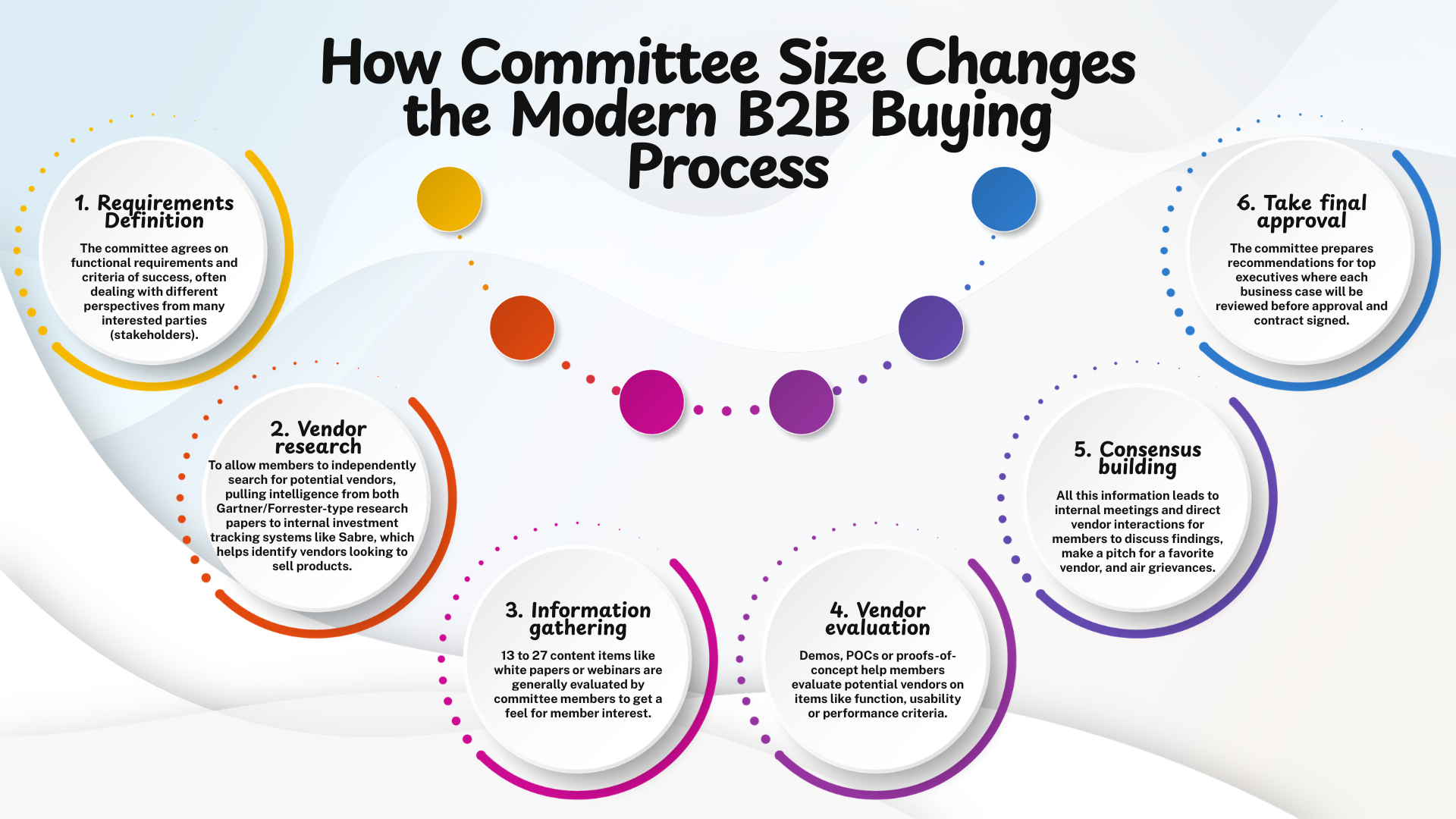
How Committee Size Changes the Modern B2B Buying Process
Here’s how the committee process typically works.
The 13+9 Problem: Why B2B Buying Committees Keep Getting Bigger
Forrester’s report The State Of Business Buying 2026 states that generative AI is reshaping the way business buyers discover, evaluate, and purchase products. AI search boosts the process, but we, as consumers, rely on inter-party influences and internal stakeholders to justify and de-risk our purchase. Every time there is a purchase, 13 internal stakeholders and nine external influencers are involved. This leads to more complex purchases.
Let us see who these 13+9 are in the table below:
| Sr.no | 13 internal stakeholders |
| 1 | Executive Leadership (CEO/C-Suite) |
| 2 | Finance / CFO |
| 3 | Procurement / Purchasing |
| 4 | IT and Technology Management |
| 5 | Information Security / Cybersecurity |
| 6 | Legal / Compliance |
| 7 | Data Governance / Analytics |
| 8 | Operations |
| 9 | Product Management |
| 10 | Marketing |
| 11 | Sales Leadership |
| 12 | Human Resources |
| 13 | Risk Management |
| Sr.no | 9 External Influencers |
| 1 | Industry Analysts (e.g., Gartner, Forrester) |
| 2 | External Consultants / Advisors |
| 3 | Peer Networks / Professional Colleagues |
| 4 | Online Communities and Professional Forums |
| 5 | Special Interest / User Groups |
| 6 | Past Vendors and Trusted Contractors |
| 7 | Legal / Regulatory Bodies |
| 8 | Industry Subject Matter Experts |
| 9 | Third-party Integrators / Partners |
Even with the difficulty of large buying groups, 94% of buyers who have six or more in their group say it brings significant benefits, including:
- Varied perspectives
- Shared validation of solutions
- Better budget acquisition
- Increased chances of getting the deal approved
As we have understood why the 13+9 problem is rising and its benefits, let us look at their involvement in the buying process in depth below:
More Internal Stakeholders Are Entering the Purchase Decision
All internal teams now want influence over tools that impact their processes, data, or finances. Consequently, B2B buying groups comprise cross-functional leaders who are eager to ensure a good fit before buying. The wider buying group lessens your risk but complicates your sales process.
External Influencers Add Another Layer of Complexity
External advisors, consultants, peer references and industry analysts are often “lurking in the aisles” of B2B buying teams. They don’t directly select suppliers but influence who makes the short list and determine how risky a deal looks. You can’t afford to disregard their views.
Finance, IT, Legal, Procurement, and Users Have Different Priorities
Each function looks at the same solution in a different way. Finance looks at payback and budget impact. IT looks at integration and security. Legal and purchasing look at terms and vendor risk. End users look at ease of use and how it fits within their workflow. All of those considerations have to be balanced by a B2B buying team.
The Champion Is Not Always the Final Decision-Maker
Your champion might adore your solution but not have the budget authority. On many B2B buying teams, the official buyer (CFO or Vice President) is the final member with power for B2B decision making. This decision can be made by procurement and legal members to decide commercial and contract risk. Pitching the champion as “the buyer” builds false confidence.
Why Treating One Contact as “The Buyer” Creates Pipeline Risk
Deals fall apart when a single-threaded deal stalls because a missing buyer stakeholder raises a new objection late in the cycle. B2B buying committees increase pipeline risk if you haven’t mapped roles, priorities and blockers upfront. Multi-threaded engagement takes a win from the entire buying group.
Understanding the Key B2B Buying Committee Roles
| Buying Committee Role | Typical Titles | Primary Priority | Common Concern |
| Economic Buyer | VP, C-suite, budget owner | ROI, business impact, strategic fit | Weak business case, unclear ROI timeline |
| Champion | Manager or director who initiated interest | Looking good internally, solving a real pain point | Lack of internal proof points to sell it upward |
| Technical Evaluator | IT, engineering, security lead | Integration, scalability, data security | Technical debt, security gaps, poor documentation |
| End User | Individual contributor who’ll use the product | Usability, workflow fit, time saved | Clunky UX, disruption to existing workflow |
| Procurement / Legal | Procurement manager, legal counsel | Contract terms, pricing, compliance, risk | Unfavorable terms, vendor risk, non-standard contracts |
| Influencer | Analyst, consultant, or respected peer | Best-in-class solution, industry fit | Being ignored or bypassed in the process |
| Blocker/Gatekeeper | Anyone protecting the status quo | Minimizing disruption, protecting turf | Change itself, if not framed as low-risk |
| Marketing Influencer | CMO, VP of Marketing, Demand Gen Director | Brand visibility, pipeline growth, customer acquisition cost, and campaign ROI. | “Will this integrate with our stack?” / “Does it match our target audience data?” |
| Finance Influencer | CFO, VP of Finance, Controller | Total cost of ownership (TCO), budget allocation, cash flow, and clear payback periods. | “Is the ROI fast enough?” / “Can we cut costs elsewhere to fund this?” |
| Sales/Business Influencer | VP of Sales, Head of Revenue Operations, Sales Manager | Rep productivity, quota attainment, lead velocity, and closing deals faster. | “Will my team actually adopt this tool?” / “Will it slow down our current pipeline?” |
How Modern B2B Buying Committees Are Changing DemandGen And AI
How Modern B2B Buying Committees Are Changing DemandGen
Demand generation is changing as B2B buying committees become more complicated and focus on groups of people, rather than single leads. Marketers have to focus not just on individual decision makers, but on all stakeholders. It also includes all members of a committee and develop their messaging for each specific role. Teams are now identifying purchases groups early through buyer intent data and hub-to-hub engagement is now the new rule, instead of traditional one-to-one outreach.
To succeed, sales and marketing need to be aligned around strategies at the account level. Have content the buyer can use internally to sell for the provider, and leverage AI to identify the stakeholders and buying signals required.
We’d like to note that teams shouldn’t just measure MQL activity, but also measure how engaged the buying-group is in your organization. It may involve converting account activity to pipeline moments and maintaining committee data on time throughout the sales cycle. This enables you to have consensus among various decision makers, and promote revenue-driven B2B demand generation.
How Modern B2B Buying Committees Are Changing AI
Forrester reports a significant rise in B2B buyer behavior, with 89% currently using or planning to use generative AI for self-guided research, projected to reach 94% by 2025. Buyers increasingly prefer generative AI and conversational search over traditional vendor websites and sales interactions.
They utilize AI tools like ChatGPT for competitive analysis, consult third-party review platforms for summaries, and generate content and pricing checklists. This trend indicates that buyers are making decisions before contacting companies, marking a shift in B2B advertising that traditional attribution methods may struggle to capture.
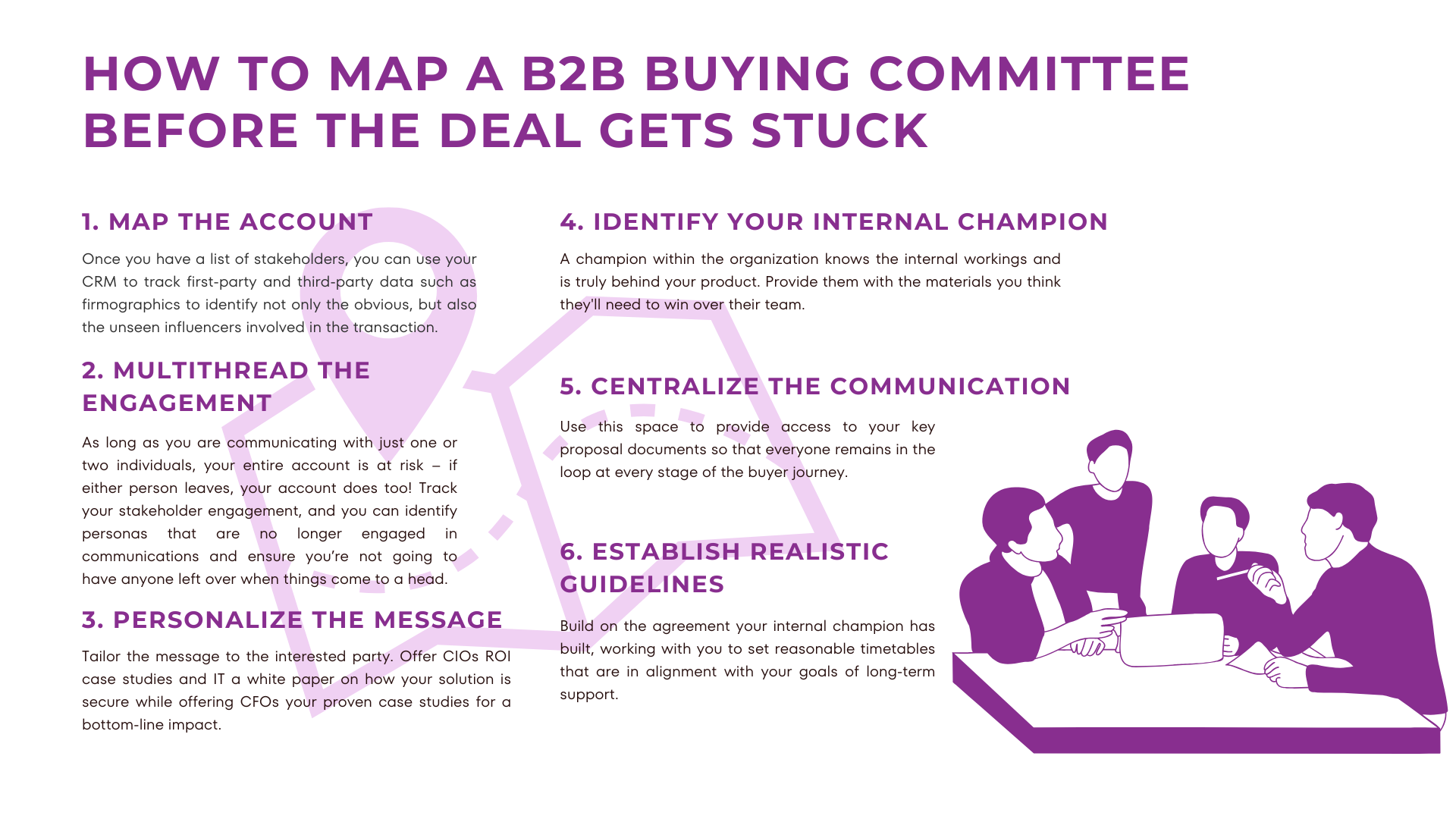
How to Map a B2B Buying Committee Before the Deal Gets Stuck
Personalizing DemandGen for Every Buying Committee Role
1. Economic Buyer: Thinks in terms of business results not product. Wants to know his return on investment and risk. Core elements he wants: how are you attributing revenue, pipeline velocity, are you strategic? Proof points; customers with quantifiable results; Calls to action on business cases, ROI summaries.
2. Champion (Internal Advocate): User and proponent of the product on the ground floor. Wants proof it’s going to solve their problems and can make a case for the economic buyer. Talk in terms of workflow pain/solutions. Also, have them lead the conversation by mentioning peer case studies as proof. Product review or demos are best as a call to action to clarify value and workflows.
3. Technical Evaluator: Needs to know if this will integrate with current systems, if it will work, who has to manage it. Talk in terms of integration architecture and implementation needs.
4. Procurement: Interested in contract terms, risk of working with a vendor, how it complies with internal processes. Usually only comes in near the close of a deal so be sure not to lose the opportunity by waiting; Talk about clear pricing, contract flexibility and security compliance,
How AI Is Changing Buying Committee Mapping
Use AI to Discover Previously Unknown Stakeholders
Behavioral signals across accounts highlight people who fall outside your CRM. If AI recognizes coordinated research—multiple company members receiving the same content, it reveals stealth buying-team members before they identify themselves.
Automatically Connect Contacts to Target Accounts
Consolidated, centralized data syncs with other systems to link people to their parent accounts in real time. Eliminate cumbersome account mapping, and you’ll know every touch point in a buyer’s journey as it relates to their entire organization.
Identify Buying Roles From Behavioral and Firmographic Data
By synthesizing firmographic information and behavioral data, AI predicts buying roles (champion, evaluator, decision-maker) without stakeholders formally stating their titles. Technical roles evaluating documentation, finance departments reviewing costs or leadership participating in strategy presentations all demonstrate distinct behaviors AI can categorize.
Predict Which Accounts Are Building an Active Buying Group
AI notices several people at the same company researching related content within the same timeframe, providing early warning of a buying committee’s emergence before you go to market against other organizations.
Recommend the Next Stakeholder Sales Should Engage
From identifying roles and tracking progress toward a decision, AI recommends which individual to engage next, and at what point along the buying cycle. This approach helps revenue teams quickly nurture the right people within each account.
Keep Humans in Control of AI Buying Committees
AI helps humans to be more than the ones in the office and more of the advisors, the strategizers. You just have to trust this and work, work on the quality of data. This not only the aim is a more earlier but better and more intelligent kind of contact without automating the whole human touch point.
Common B2B Buying Committee Mistakes to Avoid
1. Mistaking Job Titles for Real Influence
Mistake: High status titles mean they are decision makers.
Solution: Map the deal reality. This refers to digging into who does and does not sign off on deals. It also shows who is influential enough to challenge them by using meeting notes to catalog people in attendance. It should dig into who influences the meetings as well.
2. Single Champion Dependence
Mistake: Counting on one champion for approval and updates.
Solution: Multi-thread early. Focus on getting five or so contacts across a deal so that you have multiple resources with you.
3. Overlooking Key Stakeholders Across Functionality
Mistake: Focusing only on those you’ve initially been directed to, such as Marketing, Sales, or the “end user.”
Solution: Pre-map the organization. Before you get to a deal, have the key players involved in each relevant department identified. Make sure you have materials tailored specifically to them.
4. The Buying Committee
Mistake: Treating everyone buying as part of one entity.
Solution: Map out your persona’s and have persona based tailored messaging. Speak to what their needs and pains are and how you will address it in your conversations.
5. One Message Fits All
Mistake: Presenting the same presentation to everyone involved in a deal.
Solution: Customize Communications If you present the same deck to everyone involved, that makes everyone feel the presentation is not addressed to them.
6. Outdated Stakeholder Map
Mistake: Using original buyer’s map through long cycle deal.
Solution: Keep Updated After your first major deal interaction, refresh your stakeholder map to accommodate the changing internal dynamics of the organizations you sell to.
7. Disregarding Internal Conflict
Mistake: Taking it for granted that all departments involved with deal support each other.
Solution: When approaching each function for the first time, ask about what kind of internally developed conflict to be aware of. Accordingly, plan on providing information they would value to help resolve these issues internally.
Conclusion: B2B Buying Committees Is Account-Level, Not Lead-Level
In future, the 13+9 problem won’t go away. Demandgen and the B2B buying committee are about to clash head-on, with the former making the majority of the decisions impacting enterprise. The key is to think of opportunities as B2B buyer journey. It starts with a target account, mapping the entire buying committee journey, knowing the roles of each stakeholder, and leveraging intent signals. This is done to tailor the approach to each one. Help buyers pull content that can be consumed within their organization, get buy-in from multiple stakeholders, and turn account engagement into pipeline. Don’t just focus on MQLs, but also the buying group’s engagement; and keep B2B buying committees data up-to-date over the entire cycle. The way to revenue is now via the committee:
Target Account → Buying Committee → Stakeholder Roles → Intent Signals → Personalized Engagement → Buyer Enablement → Consensus → Opportunity → Revenue.

Author: IDBS Global
Turning Data into Demand, Fueling B2B Growth with Precision and Purpose.