

B2B Marketing Attribution: How Agencies Can Meet Growing Client Expectations
Follow us

B2B marketing is evolving, and clients now expect their agency to demonstrate how all marketing activity directly leads to qualified opportunities, sales pipeline and, eventually, revenue. This has made B2B Marketing Attribution a key requirement in agency reporting and strategy. B2B purchase processes have traditionally been long and complex. A prospect may read a blog, attend a webinar, view a product video, download a white paper, talk with sales and eventually interact with an ad before converting into a customer. A simple conversion report cannot provide insights into the role of all these individual marketing touches.
Attribution represents a new opportunity for agencies to shift from reporting activity to more strategic consulting. It reveals the value of specific channels, accounts affected, and opportunities moved forward by certain campaign attribution. Combined with the right data, B2B Marketing Attribution can translate marketing reports into actionable business insights for clients. Thereby enabling better decisions about budget allocation, campaign targeting, and overall business growth.
What Is B2B Marketing Attribution and Why Does It Matter More Now?
B2B Marketing Attribution is the process of assigning value or credit to marketing and sales touchpoints that influence a prospect’s journey toward conversion and revenue.
It matters more now because B2B customers research independently and involve several decision-makers. They often interact with a brand across multiple channels before speaking to sales.
Why Clients Want More Than Clicks, Leads, and CPL Reports
Clients want to know whether marketing created demand, improved pipeline quality, supported sales conversations, and contributed to closed-won revenue. A high volume of affordable leads means little if those leads never become opportunities.
Why Traditional B2B Attribution Models Fall Short
Traditional ones generally focus on the first or last interaction. These approaches are easy to understand, but they ignore the many activities that influence long B2B buying cycles. They may also give credit to a channel simply because it captured a conversion, even when another channel created the original demand.
The B2B Customer Journey Has More Touchpoints Than Your CRM Shows
CRM systems may not capture anonymous website visits, podcast exposure, peer recommendations, event conversations, dark social activity, or multiple contacts from the same company. As a result, agencies may underestimate marketing’s true influence unless they combine CRM, advertising, automation, intent, and offline data.
Choosing the Right B2B Marketing Attribution Model
First-Touch Attribution: Useful for Understanding Demand Creation
First-Touch Attribution gives all of the credit to the first touchpoint a lead attribution comes in contact with a brand. As it works great in helping to find out where leads first came in contact with the brand. But, it ignores subsequent interactions, which are important for extended B2B sales cycles.
Last-Touch Attribution: Helpful for Identifying Conversion Triggers
Last Touch Attribution gives credit to the last touch point before a conversion as a measure to gauge closing efforts. However, it doesn’t consider previous relational contacts.
Linear Attribution: Sharing Credit Across the Customer Journey
Linear Attribution gives every interaction its share of the credit, giving credit to every touchpoint. All interactions, however, are viewed as equally influential rather than replicating the level of influence they actually have.
Time-Decay Attribution: Giving More Weight to Recent Interactions
Time-Decay Attribution is the more recent trend that credits newer touchpoints. It allows them to gain more weight on longer sales cycles, especially in the B2B space. However, it can extinguish positive interactions that helped build trust and awareness in the early part of the engagement.
Data-Driven Attribution (DDA): Where Fusion Of ML and Data Bring Better Conversions
By using machine learning to observe the past and allocate a credit score, DDA ensures a more accurate credit score. This business is best suited for businesses with established data, and needs high enough conversion level to work.
Multi-Touch Attribution: A More Complete View of B2B Influence
Multi-Touch Attribution distributes credit between multiple touchpoints of the funnel, which works well for B2B funnels. Strong data integration is needed, which may be a challenge using siloed systems. There are two models in this attribution: the first is U-shaped and the second is W-shaped. Now, let us take a quick look at the two briefly stated below:
- U-shaped models emphasise the first touch and lead creation.
- W-shaped models introduce opportunity creation to give agencies more touchpoints to link between crucial points in the funnel.
Account-Based Attribution: Measuring Impact Across Buying Committees
Account Based Attribution directly maps multi-stakeholder B2B sales-marketing touchpoints to target-account-based revenue. It fills in missing coverage in complex B2B buying committees. A typical committee is comprised of 6–10 decision makers that exchange in numerous channels and over long-term periods.
Multi-Touch Attribution: A Better Fit for Complex B2B Buying Journeys
Multi-touch attribution helps provide insight into the customer journey and works by speculating about touchpoints that had a role in the final conversion.
The big picture helps better understand marketing effectiveness and enables resources to be optimally deployed because sources of the marketing efforts are attributed proportionately.
Evaluation of touchpoints results in the optimization of marketing budgets, with more money being spent on effective touchpoints, and less on ineffective ones.
Furthermore, it allows for engagement gains by discovering hot spots with the capacity to convert, which results in higher engagement.
Finally, the multiple touch point attribution gives a true ROI estimation, which allows to make better decisions and strategies.
Account-Level Attribution: Stop Measuring Leads in Isolation
A lead is not always the right unit of measurement. One contact may download a report while another executive attends an event and a procurement manager visits the pricing page. Account-level attribution combines these signals to show whether marketing is building engagement within a valuable target account.
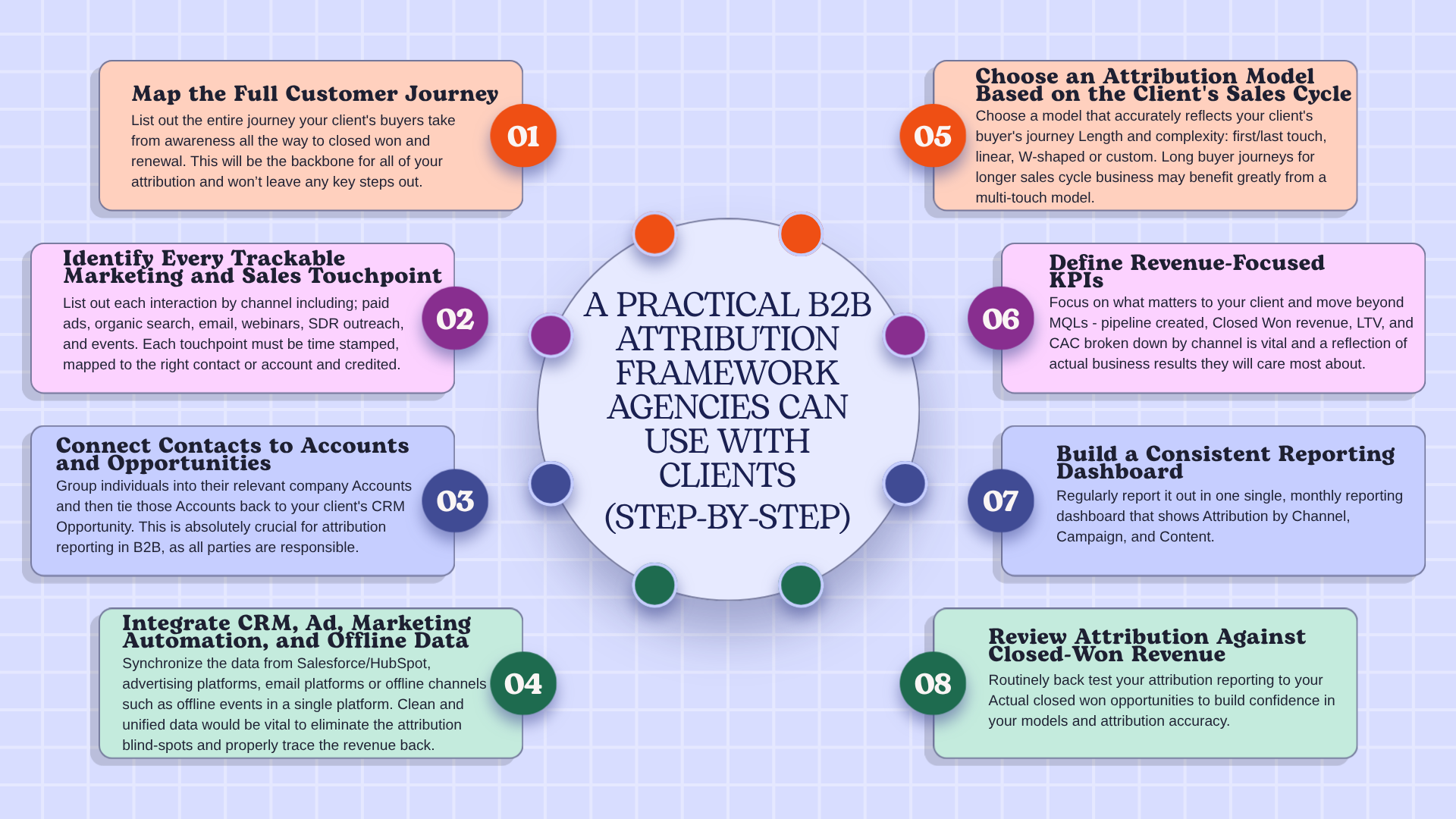
A Practical B2B Attribution Framework Agencies Can Use With Clients
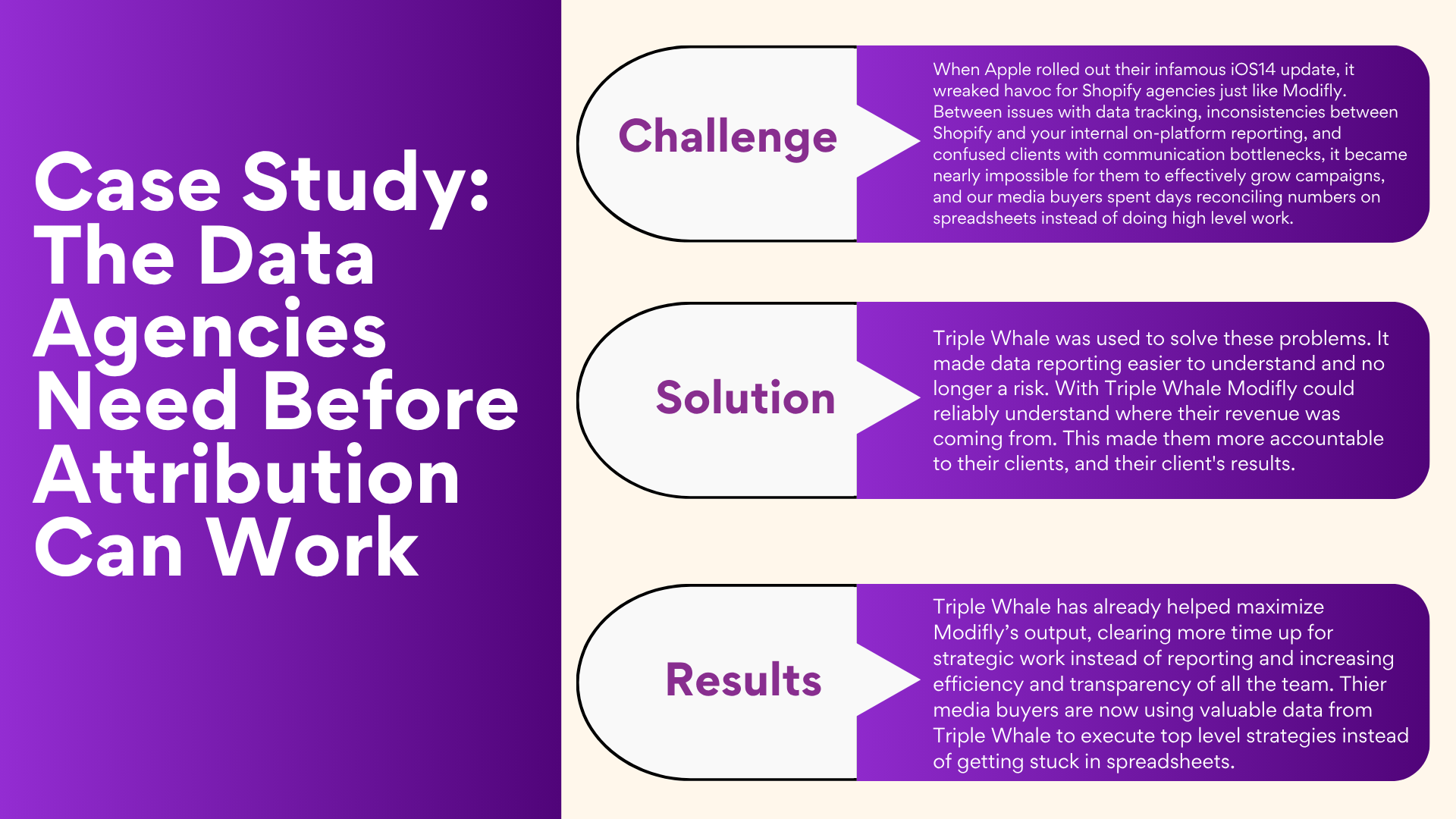
Case Study: The Data Agencies Need Before Attribution Can Work
From CPL to Pipeline: The Metrics Clients Actually Want to See
| Metric | What it is | Why it matters | Formula |
| Pipeline Velocity | Measures how quickly opportunities move through the sales funnel and generate revenue. | Helps identify whether your sales process is moving efficiently. A slow velocity can reveal bottlenecks that delay revenue. | Pipeline velocity = (Opportunities x average deal size x average win rate) ÷ length of average sales cycle (in days) |
| Pipeline Coverage Ratio | Compares the total value of your sales pipeline with your sales target or quota. | Shows whether you have enough opportunities to reach revenue targets after accounting for expected deal losses. A common benchmark is 3×–4× coverage. | Total pipeline value / Sales quota |
| Win Rate by Stage | Measures the percentage of opportunities that are won after entering a specific pipeline stage. | Shows where deals are most likely to succeed or drop off, helping sales leaders focus coaching and enablement efforts. | (Opportunities won / Opportunities entered per stage) × 100 |
| Sales Cycle Length | The average number of days required to move an opportunity from opening to closed-won. | Reveals how quickly your team converts opportunities into revenue. Shorter cycles can improve cash flow, rep productivity, and forecast reliability. | Average (Closed-Won Date − Opportunity Created Date) |
| Conversion Rate by Stage | Measures the percentage of opportunities that move from one pipeline stage to the next. | Highlights specific funnel bottlenecks, such as weak qualification, ineffective demos, or problems during contract negotiations. | (Opportunities that move to the next stage / All opportunities in the stage) × 100 |
| Pipeline Growth Rate | Measures how quickly the total pipeline value is increasing or decreasing over a specific period. | Shows whether your team is generating enough new opportunities to support future revenue targets. | ((Current period pipeline − Previous period pipeline) / Previous period pipeline) × 100 |
| Lead Response Time | Measures the average time a sales representative takes to follow up with a new lead. | Faster follow-up can improve lead engagement and conversion, especially in competitive markets. | Total response time for new leads / Number of new leads |
| Cost per Lead (CPL) | Measures the average amount spent to generate a new lead through sales and marketing activities. | Helps evaluate demand-generation efficiency and determine which channels or campaigns deserve more budget. | Total Campaign Cost ÷ Number of Leads Generated |
| Customer Acquisition Cost (CAC) | Measures the total cost required to acquire a new customer, including marketing, sales, software, salaries, and overhead. | Shows whether customer acquisition is financially sustainable and helps businesses evaluate growth efficiency and profitability. | Total sales and marketing spend / Number of new customers |
| Lead-to-Opportunity Conversion | Measures the percentage of leads that become active sales opportunities. | Indicates lead quality and the effectiveness of marketing and sales qualification. A low rate can signal poor targeting or weak lead-scoring criteria. | (Number of opportunities created / Total number of leads) × 100 |
How Agencies Can Extend Attribution Beyond the 30-Day Window
Start With the Client’s Average Sales Cycle
Before choosing any attribution model, audit the client’s CRM to identify a median sales cycle by segment. Self-serve Small and medium-sized businesses (SMBs) can only afford 30 days, sales-assisted SMB require 60 days, mid-market warrants 120 days, and enterprise demands 180 days and longer. Custom windows of up to 365 days can be created with the purpose-built B2B attribution tools, which are greater than the default window lengths of the ad platforms.
Compare Short and Long Attribution Windows
Short windows are about making platforms easy to report on and not about business reality. Whether that’s 60, 90 or 180 days, the attribution window available on most ad platforms won’t go that far back in time. The 30-day window places invisible as far up as the top of the funnel with 90-day sales cycles.
Separate Early Demand Creation From Late-Stage Conversion
Activity metrics are those metrics that the agency has control over such as impressions, engagement rate, volume of MQLs and that the agency should include in its weekly reports. Outcome metrics are ones that the client cares about or things that belong in Quarterly Business Review or QBRs. QBR metrics are moving accounts to pipeline, deal velocity, influenced revenue, etc. Putting them together leads to a loss of trust in agencies.
Track Pipeline Movement Over Several Months
As long as weekly pipeline and win/loss data is reported down to the account level, and this data is linked to marketing activity – even if not fully integrated CRM – it’s enough. This is to be used in the sales process prior to the contract signing. Agencies who view it as something they can commit to rather than it being a request of their operational obligations stand a greater chance of winning.
Avoid Claiming Revenue Credit Before the Buying Journey Is Complete
If the primary reason for using attribution is in order to justify the agency’s fee, then the model is chosen for persuasive properties rather than its accuracy. Attribution is understood by agencies that regard it as a mutual optimizing tool to foster positive client relationships which last longer and give more long-term benefits. Even if there is no direct benefit in the organic program, if there is a measurable benefit in branded search and in direct traffic later on, this influence can be estimated.
Connecting Marketing Attribution to Real Client Revenue
In order to make this connection, marketing attributes need to be translated to actual client purchases, or sales, dollars ending with the exact marketing campaign, ad, or touchpoint that resulted in the purchase. The integration of CRM systems with attribution platforms like CallRail, WhoActive or WhatConverts and sales data makes it possible, so that companies can stop guessing and get clear marketing ROI insights. A few indispensable parts of revenue attribution are:
- Sales System/CRM Integration: Directly connect closed-won leads to their respective lead source or link ID of the ad that leads them to sales.
- Attribution software: Utilize software such as WhatConverts or HubSpot that attribute multi-touch journeys in your customer funnel and not rely just on last-click data.
- Lookback Window: Make sure your attribution window length matches the length of your sale cycles, not a short default of what’s most common on the market.
Where AI and Predictive Analytics Fit Into B2B Attribution
The dawn of AI and predictive analytics marked a seismic shift in B2B attribution from mere historical reporting to a dynamic, forward-looking measurement. They audit complex Multi-touch Buyer journeys, apply the machine learning to distribute credit to the channels and predict the likelihood of conversions. Key capabilities include:
- Pattern Recognition at Scale: AI unlocks previously unrecognized patterns at scale, as data is contained in these unpredictable touchpoints. These random touchpoints hold data that can be served to AI for pattern recognition.
- Dynamic Credit Allocation: Machine learning when used with multi-touch attribution and marketing mix regression can be used to evaluate impact from channels.
- Intent Signal Integration: Real-time account behavior and engagement data to consider for conversion readiness using predictive marketing analytics.
- Engagement Tracking: Algorithms track and give insights on the prospect that is leaving the pipeline before they make it into the regular CRM reporting.
Common B2B Marketing Attribution Mistakes Agencies Should Avoid
| Common B2B Marketing Attribution Mistake | What Goes Wrong | How Agencies Can Avoid It |
| 1. Undervaluing Content Performance | Assuming that more impressions automatically lead to more sales can cause agencies to overlook content that actually influences buyer decisions. | Use tools such as Hotjar to track clicks, scrolls, and other engagement signals beyond form submissions. Invest more in high-quality content that generates meaningful engagement and supports conversions. |
| 2. Choosing the Wrong Attribution Model | Relying only on a last-click attribution model can overlook important touchpoints that influence a B2B buyer before conversion. | Use a multi-touch attribution approach and tools such as Google Analytics to understand how different marketing channels contribute to leads, opportunities, and sales throughout the buying journey. |
| 3. Relying on Limited Data | Tracking only button clicks, form submissions, and sales provides an incomplete picture of how prospects discover and interact with a brand. | Track customer behavior across multiple marketing channels, including email clicks, social media engagement, website interactions, content downloads, and other relevant touchpoints. |
| 4. Relying Solely on Attribution Data | Focusing only on which channels generate sales can cause agencies to overlook important stages of the overall customer journey, including where prospects lose interest. | Combine attribution data with Google Analytics and other marketing analytics. Identify where prospects drop off and use these insights to improve lead nurturing and conversion strategies. |
| 5. Confusing Attribution with Marketing Mix Modeling | Attribution and marketing mix modeling answer different questions. Treating them as interchangeable can lead to inaccurate conclusions about marketing performance and budget allocation. | Use attribution tools to understand individual customer journeys and marketing mix modeling to evaluate the broader impact of marketing investments. Use financial and media measurement platforms, such as Nielsen Visual IQ, where appropriate, to support budget decisions. |
| 6. Failure to understand the marketing channels | Failing to recognize the intent of different marketing channels can lead to misjudging their impact on customer conversions. This results in poor decision-making. | Assess each channel’s role in the customer journey, acknowledging that some may facilitate interactions rather than direct sales. Evaluate the overall contribution of all channels to the conversion process to make informed decisions. |
How Agencies Can Turn Attribution Into a Client Reporting Advantage
- Poor channel-to-channel optimization within agencies presents a major difficulty and can result in budgets being locked and lack of agility.
- 66.4% of B2B marketers don’t regularly reallocate budgets as a result of performance, constraining them to a slow approval process, limited technology and annual budgets.
- Cross-channel optimization becomes very difficult, if not impossible, when clients are using multiple agencies for multiple channels.
- The report finds agencies that are identified as Attribution Leaders are six times more likely to regularly reallocate funds between channels.
- Such agencies provide flexibility and not only do they make their clients more effective, they do the same to their own businesses.
- Lastly, reporting should be treated as a holistic process and become a strategic tool in the hands of clients.
Conclusion: B2B Attribution Should Explain Revenue, Not Just Activity
B2B Marketing Attribution must provide clients with the knowledge of how marketing directly impacts the business rather than simply the actions taken on the campaign. A first-touch model can highlight the source of initial demand generation. A last-touch model shows what touched the prospect just before a conversion. However, multi-touch attribution provides a more comprehensive view of the influences impacting the prospect along a buying journey. At an account level, it provides a sense of the overall B2B buying process in which there are multiple touchpoints from an organization. Agencies can provide clients with a consultation that identifies the channels creating demand. Which content enables sales, and why a particular account has a higher propensity to convert.
Ultimately, revenue attribution addresses clients’ core need: Was the marketing campaign driving pipeline and revenue. By reliably providing answers to this question, the agency shifts marketing reporting from a monthly reporting routine to a strategic opportunity.

Author: IDBS Global
Turning Data into Demand, Fueling B2B Growth with Precision and Purpose.