
Turn Ad Spend into Revenue with B2B Performance Marketing
Follow us

B2B performance marketing converts ad budgets into attainable income since it concentrates on the results attained instead of the vanity metrics. Such a strategy will make sure that each dollar invested will be used to power pipeline and sales in complicated B2B settings. It focuses on decision-making based on data, targeting with high intent, and full-funnel attribution, unlike conventional b2b marketing strategies, to provide the ROI that executives require.
What “Performance Marketing” Really Means in B2B And Why It’s Not What You Think
In simple words, performance marketing is measurable marketing.
Clicks, conversions, ROAS, CAC, attribution models. These are the instruments of performance marketing. They’re important and powerful. They help determine what works and what does not.
But b2b performance marketing is not the strategy. Nor does it constitute a substitute for an all-inclusive marketing strategy on its own.
The end product of strategic inputs is called performance marketing. It is the scoreboard, not the playbook.
The Measurement Gap That’s Costing You Budget
Why Activity Metrics Don’t Cut It Anymore
Clicks, downloads, and traffic create a false perception that it is busy; however, they are seldom associated with revenue in B2B. These vanity metrics disregard the quality of leads, and the teams working on high volume instead of high value go down the drain, spending budgets on low-fit leads. B2b lead generation is usually fluffed by high quality pipelines since the MQLs will not convert because they are of the wrong intent or fit. B2B performance marketing fixes this by qualifying early, ensuring only high-potential accounts advance.
The Real Journey: From Interest to Revenue
Purchases in the B2B setting tend to include a group of 6-10 stakeholders; one-time encounters will not be converted. Cross-channel research is anonymous with the buyer making decisions prior to the conversation with the sales. The attribution of last-click will not be effective in this case since the last touch is the sole one credited and the proactive effort that created awareness is not considered. The multi-touch models deliver the actual impact and enhance precision.
The New Metrics That Finally Tie Marketing to Revenue
Account Qualification & Committee Engagement
Account Engagement is a measurement system that consolidates and examines all contacts, channels, and touchpoints between a target company and your brand. It involves multiple contacts to understand overall buying interest and prioritize sales activity. Account engagement, on the other hand, looks at the whole organization’s interest by tracking the actions of everyone on the buying committee and finding patterns that show serious consideration for a purchase. Individual lead scoring only looks at individual contacts.
Customer Acquisition Cost (CAC) That CFOs Respect
CAC is used to determine the cost of acquiring a new customer, such as the cost of research, marketing, and advertising. Along with Customer Lifetime Value (LTV), CAC can be used in an analysis to help businesses figure out how much value new customers add and the return on investment (ROI) of tactics they use to get new customers. The information-driven strategy enables informed choices about how to allocate resources to acquire customers. Let’s know the formula to calculate CAC below:
CAC = Total Marketing and Sales Costs / Number of New Customers Acquired
Pipeline Velocity — The Metric Driving Predictable Growth
Pipeline Velocity is a performance measure that is used to measure the speed at which the leads and opportunities flow through the sales pipeline phases to become paid customers. The formula to calculate Pipeline Velocity is:
Pipeline Velocity = (Number of Opportunities × Average Deal Value × Win Rate)/ Length of Sales Cycle
Marketing‑Attributed Revenue — The Truth About Influence
Marketing‑Attributed Revenue measures the revenue realized directly by a specific advertising effort. It is a metric that separates the amount contributed by marketing activities, unlike the gross revenue numbers, so that the individual teams can observe the precise amount of funds their respective teams and b2b PPC campaigns. This is necessary for accurately determining advertising performance and for the efficient allocation of resources. The Marketing‑Attributed Revenue formula is given below:
Attributed Revenue = Total Revenue × Attribution Weight for the Campaign or Channel
How to Turn Ad Spend into Revenue with B2B Performance Marketing
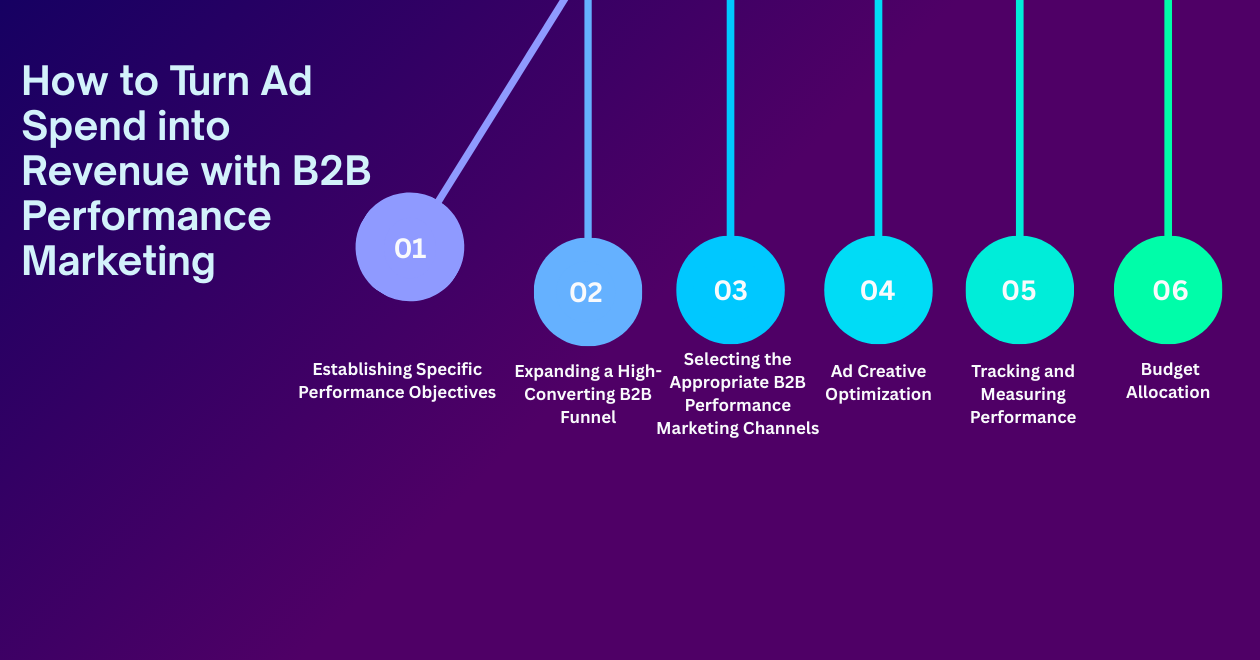
1. Establishing Specific Performance Objectives: Determine your dream customer type to prevent overspending or underselling b2b marketing services. Set CPL and CPA goals depending on the value of deals in order to determine the viability of the campaigns.
2. Expanding a High-Converting B2B Funnel: Converting B2B has 3 stages that are discussed below:
Awareness Stage: Utilize certain outreach and advertisements to create awareness and no sales.
Consideration Stage: provide valuable content (e.g., case studies, Web magazines) to develop trust.
Conversion Stage: Initiate activities like demos or consultation with a hassle-free process.
3. Selecting the Appropriate B2B Performance Marketing Channels: LinkedIn can be utilized in the niche, and Google in the demand capture, depending on your audience. Officially improve the ROI with the help of multi-channel strategies.
4. Ad Creative Optimization: Tailor-made communication to address the root cause of pain among your customers. Use industry-specific CTAs to do A/B testing and increase performance.
5. Tracking and Measuring Performance: Connect your CRM to track leadership. Use UTM tracking and KPI dashboards to analyze the b2b performance analytics.
6. Budget Allocation: Spend the budget strategically, that is, in the first stage, the budget is spent on awareness, then change to the conversion. Revise the budget depending on the performance of the campaign and save some money to test new strategies.
Where Most B2B Teams Go Wrong And How to Fix It
1. Prioritizing Vanity Metrics Above ROI.
Error: Most marketers are distracted by the number of clicks and followers, which do not translate to revenue.
Fix: Focus on the metrics that show the reality of the business, including the conversion rates and cost of acquiring a customer. Conduct periodic evaluations to determine whether your work is bearing any fruit.
2. Not Nurturing Leads Around the Sales Cycle.
Error: It is possible to make assumptions about leads being prepared to make purchases without much contact, which may result in lost chances.
Fix: A nurturing strategy with multiple touchpoints (follow-up emails, case studies, and webinars) should be implemented. This builds trust and helps steer the sales process through the funnel.
3. Neglecting Offline Conversion Tracking.
Error: Ignoring offline conversions may lead to a lack of complete comprehension of marketing.
Fix: Make CRM and offline conversion present to you the complete picture of what is actually paying off.
A Practical 2026 B2B Performance Marketing Playbook
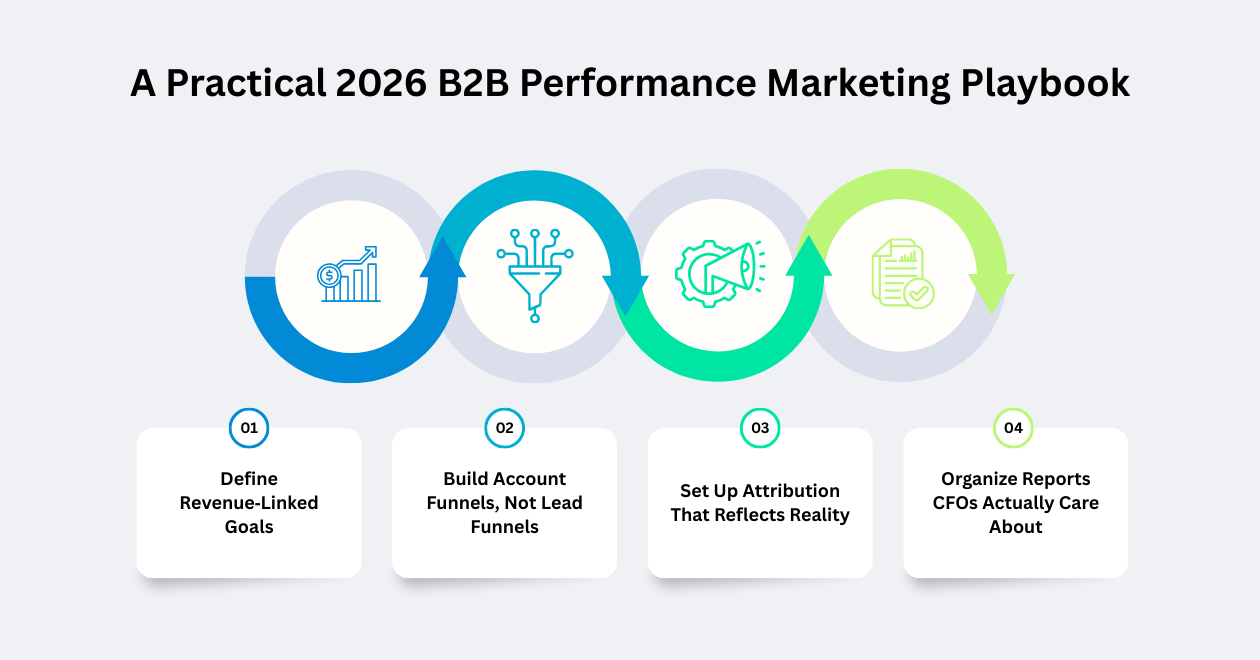
Step 1: Define Revenue‑Linked Goals
It is essential to create your perfect customer profile (with industries, company size, job titles, and regions) before launching an ad. The general strategy is wasteful of funds, whereas a specialized strategy restricts opportunities. After the profile is created, you should be able to set realistic CPL and CPA by considering your profit margins.
Step 2: Build Account Funnels, Not Lead Funnels
The marketing process is divided into three phases: Awareness, Consideration, and Conversion.
- The Awareness Stage focuses on raising awareness among potential customers about your existence through targeted outreach, LinkedIn content, and advertising.
- The Consideration Stage requires valuable resources, including case studies and webinars. It creates a sense of trust and allows the prospects to compare your offer to those of the competitors.
- Lastly, at the Conversion Stage, the goal is to stimulate warm leads to take action, such as booking a demo or a trial. It makes the process smooth and efficient so that they do not lose them to the competitors.
Step 3: Set Up Attribution That Reflects Reality
A B2B performance strategy cannot be implemented in one channel. Customers do not often buy after interacting. They interact in the emails, content, advertisements, and follow-up touchpoints. Strategies of performance that consider this fact work better than those built on individual tactics.
This is not about mastering one channel, but about creating integrated touchpoints that deliver the same message and value. Channels collaborating minimize performance reliance on one source and result in performance resiliency.
Step 4: Organize Reports CFOs Actually Care About
B2B buyers remain humans, only that they have larger budgets. What you say should not confuse them with jargon, but should instead appeal to their pain points. When dealing with CFOs, focus on savings and ROI. Assuming it is CTOs, discuss integration, security, or scalability.
Repeat industry-specific CTAs in a manner that they are part of the world of your prospect. When selling compliance software, you will beat the section called ‘contact us’ every time with ‘Book Your Compliance Audit’. And test – A/B test headlines, body copy, pictures. Even a minor change can have significant implications for the click-throughs and conversion rates.
Case study- B2B Performance Marketing
Matterport Scale Global B2B Demand Generation Campaigns with Blue Yarn Media
Overview:
Matterport, a technology giant in the 3D immersive experience, had issues with its lead quality as a result of its global B2B demand generation effort. As their online ad campaigns generated a large number of leads, most were non-qualified, resulting in inefficiencies for the sales team.
Problem:
The sales staff had to deal with bad leads where they had to expend time training possible customers who were not willing to purchase. This lack of efficiency was a problem in their capability to focus on good quality leads. This eventually affected their sales performance.
Solution:
Blue Yarn Media completed an intensive evaluation of the current campaigns of Matterport and cooperated with the sales team to collect information about the reasons for lead disqualification. They created a cohesive B2B campaign marketing strategy that incorporated demand generation strategies with an awareness strategy. Key strategies included:
- Reducing the Sales Cycle: By adopting the use of nurture in reaching out to the prospects and making them more willing to purchase.
- Added Soft Content Launch: Using longer videos and testimonials to educate prospective customers about Matterport and its value.
- Remarketing Strategies: Converted users should be served new offers to warm the up and drive conversion.
- Multi-Touchpoints: The display media is incorporated to have access to new contacts and to regain previous visitors.
- Refined Lead Forms and The Message: Optimizing lead forms and advertisement communications to be more sales-oriented and focusing on higher-quality social networks, like LinkedIn.
Results:
Alteration in the campaign was useful in boosting the quality of the leads. It converts the quality leads into better conversion rates. It is done with the help of the optimized landing page and refining the audience targeting.
The tactical changes resulted in an increase in the efficiency of their sales process that enabled Matterport to capitalize better on their demand-generating activities.
The Future of B2B Performance Marketing Beyond 2026
Artificial intelligence-based Bidding Algorithms.
The bidding b2b marketing automation apps on ad platforms are not only useful but terrifyingly good. They can figure out things about you that you would never do yourself, like which titles work best between 8 a.m. and 8 p.m. or when a competitor’s budget has suddenly been used up. You shouldn’t hand the algorithms the keys and leave them to do the work. Instead, you should let the algorithms do the work while you focus on creative and focusing.
Targeting and Predictive Lead Scoring.
We are no longer reacting to leads; we are predicting them.Today, there are tools that can look through CRM records, site visits, and third-party purpose data to figure out which accounts are likely to buy before they even fill out a form. This implies that sales team members can initiate warm conversations earlier and not spend time on those who do not sign any signature.
ABM Performance Meets Accounts.
B2B Account-Based Marketing focuses on the approach, but combining it with performance marketing takes it to the next level. Don’t blanket an industry, instead go after 20 dream accounts with message-crafted specifically to them – and only pay when those accounts become engaged. It is focused, quantifiable, and more fulfilling than spraying advertisements into the air.
Conclusion — No Activity Without Impact
B2B performance marketing does not require hustle; it requires revenue demonstration – adopt it to turn advertisement expenses into growth engines. Teams that don’t take this face will cut spending in 2026, and leaders will be able to scale well. Start with goals for income, account-based marketing (ABM), and multi-touch monitoring of groundbreaking results that get both CFOs and salespeople excited. Your funnel is waiting to be optimized- make it count the dollars.

Author: IDBS Global
Turning Data into Demand, Fueling B2B Growth with Precision and Purpose.