
CRM Automation for B2B Demand Generation: Smart Workflows That Scale
Follow us

CRM Automation introduces a reinvented demand generation concept to B2B by transforming an unorganized lead process into scalable demand generation machines. It allows teams to focus on high-value activities, with repetitive tasks being tackled smoothly.
What CRM automation means in demand gen
CRM Automation is the set of rules, workflows, and integrations that:
- Capture leads and account signals
- Clean and enrich data
- Score intent and fit
- Route to the right team and sequence
- Trigger personalized nurture across channels
- Measure what actually creates pipeline and revenue
In plain English, it’s marketing and sales working off the same nervous system, not two separate brains arguing over “lead quality.”
Why CRM Automation matters for B2B
B2B demand gen has three realities:
- Long buying cycles and multiple stakeholders
- Signals arrive in fragments across ads, web, email, events, chat, product, and outbound
- Speed wins, but only if accuracy doesn’t die on the way
- Automation lets you respond fast and consistently, without relying on one heroic SDR with 43 tabs open.
In B2B demand gen, manual processes kill speed and scale. CRM automation turns signals into revenue by making data flow, decisions instant, and actions inevitable. This isn’t about flashy tools; it’s about workflows that handle 10 leads or 10,000 without breaking.
The core automation building blocks
Build your stack on these seven pillars. Skip one, and your pipeline leaks.
1. Data entry and cleansing.
Goal: All valuable touches are accessible data.
Begin with web forms, webinar/event registration, LinkedIn lead gen forms, and chat. You can not prove ROI without capturing UTM parameters to attribute the source and campaign map. Normalize such fields as industry, employee size, region, and product interest immediately at the time of entry.
Best practice: Implement picklists and validation. FinTech should not give rise to 14 analogs of such a term as fintech, Fintech Co, or Financial Tech. Use dependent picklists (e.g., industry into sub-industry) on Salesforce or HubSpot to reduce cut-up. It is plug-and-play with such tools as Zapier or native form builders. Result? On day one, clean data, driving all the data downstream.
2. Enrichment and de-duplication.
Goal: Convert an incomplete record into an actionable profile.
Pull in firmographics (revenue), headcount, technographics (tech stack), role/seniority, and verified emails. Consolidate duplicates to avoid the fracturing of John S. at Acme into three records.
ZoomInfo, Clearbit, or Apollo Layer is enriched in real time through the API. Match on email, domain and fuzzy name logic: set rules. Practically, this increases the quality of leads by 40% because sales cease to pursue ghosts. Problem: Have nightly batch jobs on the existing records to get late bloomers.
3. ICP fit scoring and intent scoring.
Goal: Divide the good fit and active buying (you must have both).
Fit signals Industry, size, tech stack, region, job function score 0-100 vs. your ICP. Intent signals: Pricing page views, comparing with the competitors, high-intent keywords (e.g., your product vs. Competitor X), repeat visits, ad engagement.
Integrate Connect account intent platforms such as 6sense, Demandbase or Bombora, and drive scores into your CRM/MAP.
Example: Fit >80 + Intent >70 = MQL. This pair is anti-spray and pray and now focuses on buyers. Lift in practice: 25 higher SQL conversion.
4. Lead and account routing
Goal: No longer any I did not see it pipeline leakages.
By territory, segment, account ownership or product line. Add SLA timers: 5 minutes notification, 30 minutes escalation, and 2 hours reassignment. Inbound should be balanced using round-robin.
CRM applications such as Salesforce (with Assignment Rules) or HubSpot are good in this. Add Slack/Teams to allow immediate notifications. Goal: Speed-to-lead in less than 10 minutes, which is associated with 3x meeting rates.
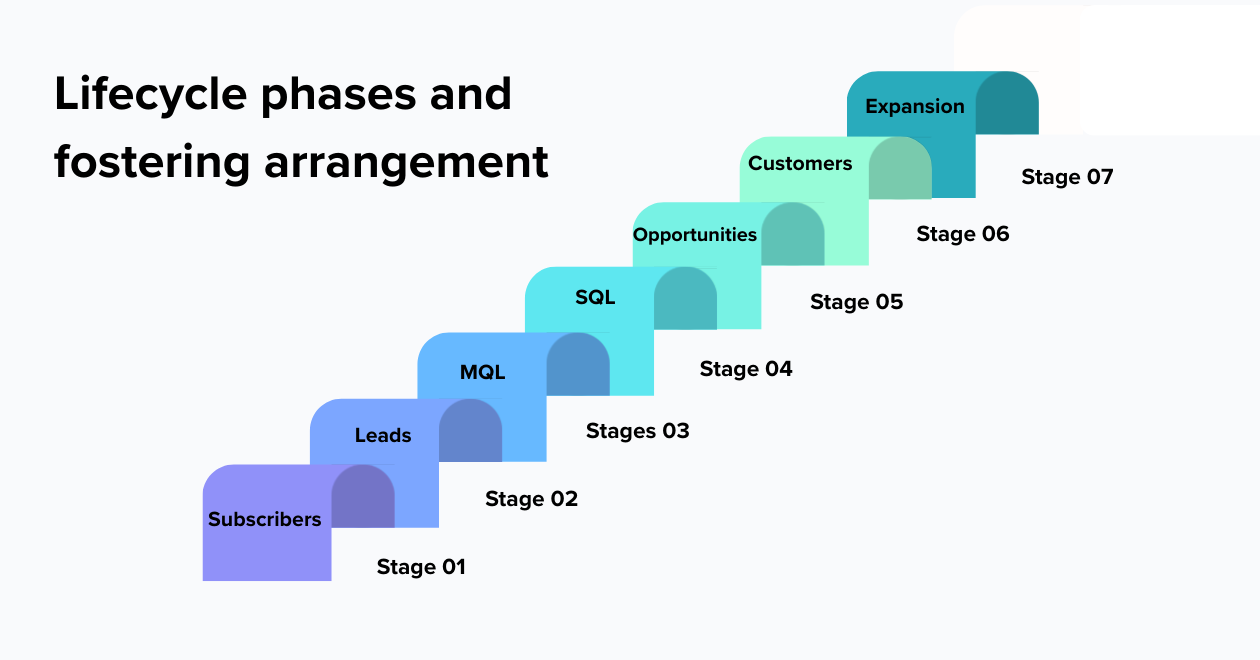
5. Lifecycle phases and fostering arrangement.
Goal: There is an optimal action associated with every stage.
Typical stages: Subscriber → Lead → MQL → SQL → Opportunity → Customer → Expansion.
Automation conditions: “Looked at price twice” > + SDR task + short email sequence. Downloaded technical guide” → solution-specific nurture. No reply within X days, then pivot message/channel.
This is orchestrated by platforms such as Marketo, Pardot, or HubSpot. Utilize engagement streams that update, e.g., binge-watching content, accelerate sales. This manages to keep 80% of leads cultivated without human effort.
6. Task automated and sales sequences.
Goal: Use follow-up as a necessity.
Automatic tasks are created after high intent. Find qualified leads outbound (calls, emails, LinkedIn touches). Record all this back to CRM where it can be reported. Outreach, Salesloft, or Groove. Example of sequence: Day 1 email, day 3 call task, day 5 video. Activities Attribution associates activities with results, which is a 2x pipeline of automated cadences.
7. Reporting of amounts related to revenue.
Goal: Quit maximizing vanity. Track dashboard. Compliance with speed-to-lead and SLA.
MQL to SQL conversion on a source/ segment basis. Pipeline created/influenced/won
Purchase in a group (not individual) account engagement. Make use of Looker, Tableau, or CRM in-house dashboards. Filter by tier: ABM accounts should be opposing creation upon broad leads.
A simple “golden flow” example
Target account visits the site. → reads comparison page. → downloads guide.
CRM Automation makes/updates accounts, enhances, and de-dups contacts. Fit + intent score thresholds were reached. SDR/AE + SLA timer is assigned by routing. SDR receives tasks; sequence of lead enters. Content-based nurture adjustments. Meeting booked? Stages update everywhere. Reporting credits the chain.
It is automation: signal action decision. A flow such as this is produced at the scale of the pipeline.
Best practices that keep it from becoming “automation soup”
- Have a single place of truth in lifecycle definitions (document in Notion/Google Doc, enforce via workflow).
- Separate fit and intent scoring; do not add them up into a single, indistinct score.
- Field governance: Fields that are mandated, formatting, and controlled vocabulary (e.g., NAICS codes of industry).
- Audit quarterly: Routing policies, scoring levels, unproductive routes.
- Build to purchase groups: Track a variety of contacts/ accounts, plot roles (champion, influencer), and combine the engagement.
- These, and your stack can go to 50k leads/year without insanity.
Common mistakes (aka how CRMs become haunted)
- Automating before fixing data quality, garbage in, garbage out at 10x speed.
- Too many lifecycle stages nobody follows (cap at 7-9).
- Scoring on weak signals (one page view = “hot lead”? Nope, needs recency/frequency).
- Not syncing sales activity back to CRM, nuking attribution.
Fix these, or your “automation” becomes a haunted house of stale leads.
If you want a practical rollout plan
- Week 1–2: Define ICP, lifecycle, routing logic, and SLA.
- Week 3–4: Data cleanup, enrichment, dedupe rules.
- Week 5–6: Scoring + basic nurtures + dashboards.
- Week 7–8: Refine with feedback, add intent + buying-group automation.
Test with 100 leads first. Expect pipeline lift in 1 month.
Make your CRM + MAP stack (Salesforce/Marketo? HubSpot?), and map exact workflows/fields for quick wins, no spaghetti.
The scalable workflow stack
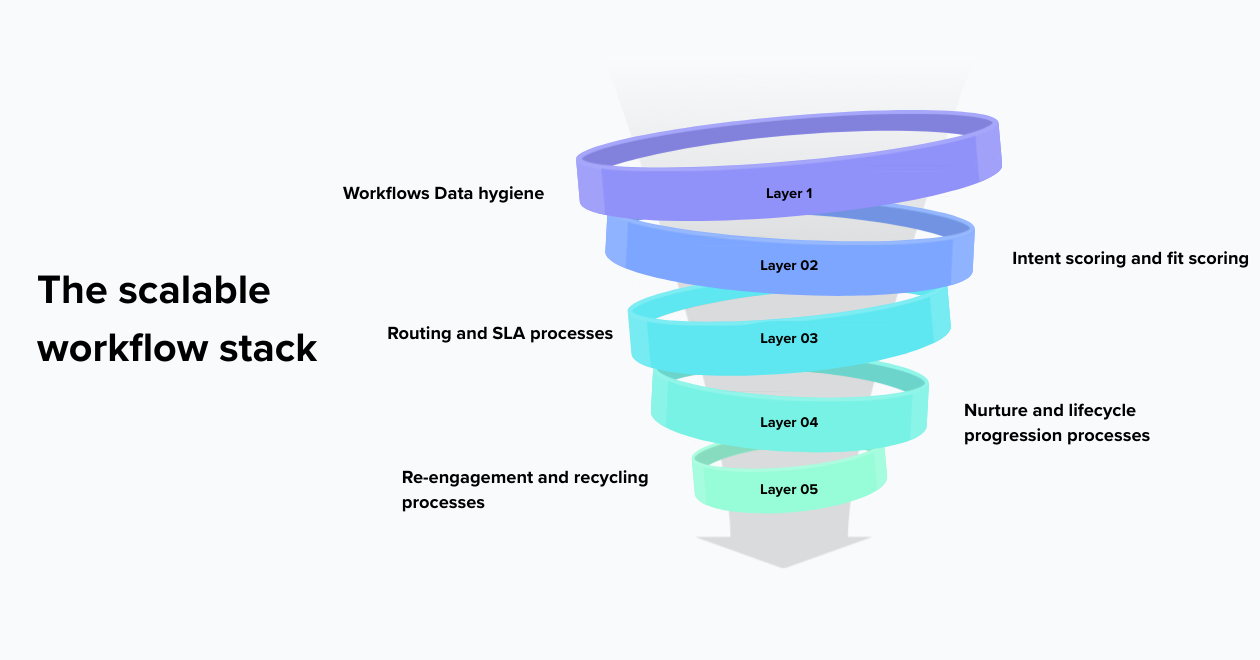
Layer 1: Workflows Data hygiene.
The first process, Workflow A, is concerned with the de-duplication and normalization of data. Whenever a new contact or lead is created, it is activated. In case the email domain of the new entry is found, the system identifies it with the relevant company and attaches the account. It also makes information country, state and industry comparable.
Workflow B entails the enrichment of data using particular guardrails anytime a new record or domain is formed. This involves the improvement of the firmographics and position.
Layer 2: Intent scoring and fit scoring.
Workflow C is in the evaluation of potential leads. The workflow is around the ICP (Ideal Customer Profile) fit score, which is activated due to the creation or modification of a company profile. The score will be used to evaluate industry, size, geography, technology, and segment in terms of A, B, and C.
Workflow D is devoted to the measuring of intent scores based on certain triggers, such the recurring visits and communication with pricing, demo, or competitor pages. The scoring system characterizes intent in three levels, namely Hot, Warm, and Cold. The following is a scaling tip: Two scores are better than one; combine sales/marketing fights.
Layer 3: Routing and SLA processes.
The workflow E in the routing of leads starts with an inbound high-intent demo request, triggering the process. In case of ownership, the lead is forwarded to the owner. Otherwise, the lead is allocated according to territory, segment, or it is allocated by way of a round-robin approach. The activities include the introduction of the Slack notification system and the Service Level Agreement (SLA) timer, which defines 30 minutes when issues can escalate. Also, Salesforce Assignment Rules are promising. An effective scaling tip is to apply a modular strategy like “Inbound Demo” and “Partner Leads” in place of mega flows.
layer 4: Nurture and lifecycle progression processes.
Scales will require SDR to be burned, and the nurturing is necessary to build relationships in the funnel according to Marketo. Intent F workflows are used to implement an always-on nurture strategy based on Fit A/B and Intent Cold criteria. Solutions may be introduced to the stream, and with a spike in the intent, a switch and sales signal is sent. Scaling tip: Use an objective and not a subjective approach.
Level 5: Re-engagement and recycling processes.
The Workflow H lays stress on time and not any magic elixirs in the workflow pipeline. It recommends that in case of no response, the workflow must be able to recycle. When one of the sequences ends without a response, then it is advisable to wait 30 to 45 days before adopting a light nurturing stance or venturing into a new angle.
Workflow I is activated when a deal is lost because of time or budget issues. It is activated for closed lost revival. In these situations, a task is developed in the future that is meant to develop the lead based on.
Workflows that scale without turning into spaghetti
- Modular workflows: One job per flow (routing ≠ enrichment).
- Naming/versioning: “DG-01-Inbound-Routing-v3.” Rollback easy.
- Guardrails/stop paths: Missing fields → review queue.
- Monitoring: SLA breaches, dupes, stuck leads, MQL-SQL by source must be monitored.
Limits matter, Marketo engagement programs cap subscriptions; architect smartly. HubSpot templates standardize.
A proven “starter set” of 8 workflows
Smallest scalable backbone:
- New lead normalization + de-dupe
- Enrichment w/ confidence
- ICP fit scoring
- Intent scoring
- Demo request routing + SLA
- High-intent alert + sequence
- Nurture by solution/stage
- Recycling (no-response/closed-lost)
Build this, refine later. Your demand gen just went pro.
Conclusion
CRM automation alters B2B demand generation by converting disjointed signals into scalable revenue machines via seven core pillars, namely data cleansing, data enrichment, dual scoring (ICP fit + intent), routing with SLAs, lifecycle nurturing, automated sequences, and revenue reporting. This integrated nervous system models marketing and sales, cutting manual insanity and increases pipeline at scale, thousands of leads annually. Avoid traps such as low data quality or excessive complexity; begin with a modular 8-workflow backbone to pro-level efficiency. Your demand gen is transformed into heroic SDRs to a win that is destined.

Author: IDBS Global
Turning Data into Demand, Fueling B2B Growth with Precision and Purpose.