
Dark Intent: What Happens Before a Buyer Fills Out a Form?
Follow us

In most B2B buying, there is no form completed before the purchase is decided. There is an unseen phase: silent snooping, interpersonal exchange of ideas, reading, writing, and content sharing where dark intent exists without leaving a name or email behind. By knowing what dark intent is, you can help your marketing and sales teams close more deals faster, engage better. You can customize their efforts to the buyers’ stage of the research process. Buyer signals can be detected early rather than after a form submission to act when there is high interest. In this post, you’ll see what dark intent is, you’ll find some of the signals and you’ll find how to turn invisible activity into real pipeline.
How the Dark Funnel Hides Early B2B Buying Activity
People are moving buying activities into this dark funnel. With those early B2B buying behaviors concealed behind people’s own horizons, not found in digital marketing’s prospect research, peer validation, and vendor shortlisting.
70-90% of B2B buyer journeys occur before a prospect visits a vendor’s site or completes a form. Just 17% of the buyers’ overall buying time is spent with prospective suppliers.
Explanation of how the Activity remains hidden.
- Private Communities: On Sagefrog recommended forums, Reddit, Slack groups, and Discord servers, Buyers converse with other Users about which tools are truly effective.
- Dark Social Sharing: Links, product feedback, or PDFs are sent through private messaging platforms such as WhatsApp, Signal, and Facebook Messenger. After which they are directly forwarded via email rather than traditional, public social buttons.
- AI Search Queries: Users use ChatGPT or similar AI to search for and compare software pricing, or compile lists of relevant vendors, generating no referrals for the vendors in question.
- Peer Reviews and Forums: Prospective uses reviewers and Forums on sites such as G2 or Gartner PE to get independent reviews that they post privately without raising the alarm to sales teams.
- Internal Team Chats: External software fails to monitor information shared in webinar platforms like internal Slack Team Chat or Microsoft Teams. These are the platforms where buying groups discuss issues and share vendor names.
Why Buyers Research Anonymously Before Engaging With Vendors
1. It’s where short lists are created: Buyers generally put together a short list of 2 to 4 vendors based on anonymous research before contacting them selectively. This is the deciding moment to whether a vendor is shortlisted or not, as it relates to being seen and being believable by a buyer during this point.
2. All tracked activity is downstream of anonymous research: The touchpoints that a CRM system tracks are all done before and result from the anonymous research. By submitting a demo request form, the buyer has done most of the work in completing the evaluation process anonymously.
3. It cannot be effected by inbound only strategies: Buyers who are window shopping are not researching the vendor’s content in any way. They want independent reliable information. Inbound marketing techniques that wait for the buyer to discover the seller’s created material obviously miss this stage.
4. It identifies the vendors that are coming into consideration prior to sales making outreach: If a vendor does not appear in the paths of anonymous research, then sales outreach efforts will be rendered futile at the bottom of the list.
Which Buying Signals Reveal Dark Intent?
Repeated Visits to High-Intent Website Pages
Frequent visits to pricing and/or demo or comparison pages indicate serious evaluation. Such behaviors can be early indicators of decreased decision making timelines prior to physical contact.
Increased Research Around a Specific Problem or Solution
Customer demonstrates active problem-solving intent when seeking solution-specific content, such as “best tools for X”. This research-oriented activity means that they are progressing to consideration.
Content Consumption Across Multiple Channels
Multi-touch intent is detected by the prospects who interact with your content on blogs, social media, emails and third-party review sites. This all-channel type of behaviour is typically associated with more in-depth research and increased conversion rate.
Competitor and Category Research as Early Buying Signals
Buyers compare competition on the pages, or on category comparisons, web pages where they are looking around — they’re evaluating their choices. Monitoring these actions with the help of third party intent data can help in identifying in-market accounts before they reach out.
Job Changes, Funding Events, and Other Business Triggers
For many, buying cycles are triggered by organizational transitions, such as a new leadership or capital raise, or a change in tech stack. These events are take place outside the organization and acquire a need that is appropriate to your solution’s value proposition.
Multiple People From the Same Account Showing Engagement
If a few people from the same company came to your content, it simply means that they all have a desire to buy. A powerful indication of B2B conversion that should ignite ABM outreach – this account level engagement.
How to Spot Buying Signals Before a Lead Ever Fills a Form
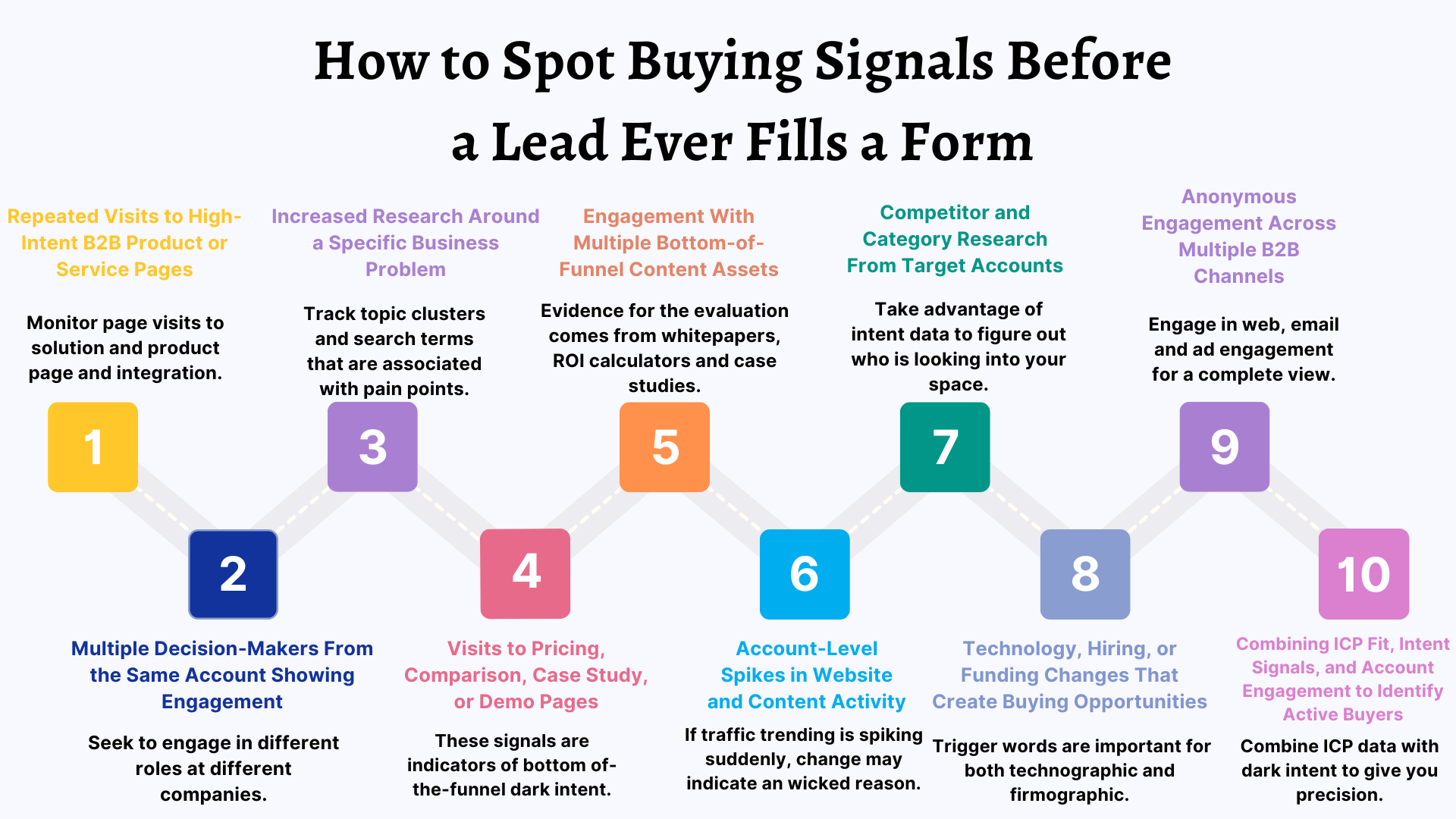
- Repeated Visits to High-Intent B2B Product or Service Pages: Monitor page visits to solution and product pages and integrations.
- Multiple Decision-Makers From the Same Account Showing Engagement: Seek to engage in different roles at different companies.
- Increased Research Around a Specific Business Problem: Track topic clusters and search terms that are associated with pain points.
- Visits to Pricing, Comparison, Case Study, or Demo Pages: These signals are indicators of bottom of-the-funnel dark intent.
- Engagement With Multiple Bottom-of-Funnel Content Assets: Evidence for the evaluation comes from whitepapers, ROI calculators, and case studies.
- Account-Level Spikes in Website and Content Activity: If traffic trending is spiking suddenly, change may indicate a wicked reason.
- Competitor and Category Research From Target Accounts: Take advantage of intent data to figure out who is looking into your space.
- Technology, Hiring, or Funding Changes That Create Buying Opportunities: Trigger words are important for both technographic and firmographic.
- Anonymous Engagement Across Multiple B2B Channels: Engage in web, email and ad engagement for a complete view.
- Combining ICP Fit, Intent Signals, and Account Engagement to Identify Active Buyers: Combine ICP data with dark intent to give you precision.
How Intent Data Makes Invisible Buyer Activity Visible
Intent data takes anonymous online searching and turns it into sales-ready information about who’s looking at what, even before they get on the phone with you.
Combining First-Party and Third-Party Intent Signals
Your in-market signals from your website (pricing page views, form fills) reveal accounts already in-market with you. And your third-party signals from your publisher partner networks show other accounts already researching your category elsewhere. By layering the two, you’ll gain end-to-end account visibility. You’ll see the accounts you already engaged and the ones still in-market looking for you.
Connecting Website Behavior With Account Intelligence
Match IP-to-organization. By mapping anonymous website traffic back to company accounts, you are turning page views into account- level insights. When an account returns to your solutions pages or case studies repeatedly, you know they’re writing requirements and looking for validation-critical context. This fuels early engagement.
Using Intent Scores to Separate Research From Active Buying
Developers can differentiate serious buyers from window-shoppers with the help of the following:
- Signal Score
- Date Range
- Audience Strength
High Scores paired with broad-timeframe visits across multiple publisher sites define active evaluation. Single spikes in Score may be used to tie spending to early awareness. It allows a tiered response.
Personalize Outbound and Advertising
Intent topics drive hyper relevant messaging: Use the exact solutions, competitors, or pain points the accounts are researching. ABM campaigns can be dynamically prioritized to focus on accounts exhibiting intent spikes, and ad targeting can reduce spend on accounts with no signals of research.
Ultimately, intent data merges first-party behavior on your website with third-party research signals to identify in-market accounts. Account intelligence associates anonymous traffic with organizations; intent scoring filters out the research traffic from the buying groups. This leads sales and marketing to engage with targeted outreach. Also, it boosts advertising that speaks directly to their interest in specific topics.
How to Turn Dark Intent Into Sales Opportunities
Prioritizing Accounts With Multiple High-Value Signals
All intent is not created equal. Identify those which have generated multiple similar signals, i.e.: repeated topic research, going to pricing pages, based on technographics- within a short time period (7-14 days). Use a composite intent scoring model based on strength of signals, recency and ICP fit, to surface your Tier 1 accounts.
Matching Outreach to the Buyer’s Current Intent
Custom-tailor your messaging to the topic that triggered outreach. If your prospect was searching something like “Build a GTM Strategy That Integrates an ABM Funnel to Drive Growth,” Therefore, target that intent with your discussion of it in the subject line and first line. This leads to a rise in reply rates. Lastly, it also signals that you understand their pain point.
Using Account-Based Outreach Before Form Conversion
No need to wait for web form submissions. Launch ABM campaigns-tactical ads, Direct Mail, or SDR programs-as soon as high-value accounts hit intent markers. Selling to accounts in the decision phase while buyers are still evaluating usually ahead of your competitors.
Triggering Sales Follow-Up When Buying Signals Intensify
Establish automated alerts for signal spikes. For example, if there are three or more engagements within 48 hours, automatically assign the accounts to reps with aggressive lead time requirements. It is recommended that first responsive contact must occur within four hours. Faster and more contextual outreach wins competitive sales cycles.
Nurturing Accounts That Show Interest but Are Not Sales-Ready
Build confidence with mid-tier accounts by providing nurture content and webinars that will keep their interest until they’re closer to buying. Reassess scoring based on what’s happening over time.
Common Mistakes When Acting on Dark Funnel Signals
| Common Mistake | What Goes Wrong | How to Avoid It |
| Treating Every Website Visit as Purchase Intent | Treating every website visit as a buying signal can lead to premature outreach and overload SDRs with low-intent accounts. | Use intent signals such as pricing-page visits, repeat visits, and page depth alongside firmographic data to identify accounts showing stronger buying intent. |
| Relying on a Single Buying Signal | Over-indexing on one signal, such as a demo request or content download, can trigger sales outreach before sufficient intent is established. | Combine multiple signals, including event attendance, content engagement, and ad responses, into a compound intent score to identify stronger buying signals. |
| Contacting Buyers Without Understanding Their Research Context | Reaching out without knowing what prospects are researching can result in irrelevant messaging and generic information. | Use topic-specific intent data, such as content clusters viewed and competitor-related content engagement, to make outreach more relevant. |
| Ignoring Account-Level Engagement Across the Buying Group | Focusing only on individual activity can overlook engagement from other members of the buying committee and provide an incomplete view of account intent. | Monitor engagement across the entire buying group using first- and third-party intent data to understand account-level interest and activity. |
| Focusing on Lead Volume Instead of Intent and Pipeline Quality | Prioritizing MQL volume can create large numbers of leads without meaningful buying intent or revenue potential. | Shift KPIs toward intent-weighted opportunities, pipeline quality, pipeline velocity, and measurable sales and revenue impact. |
Conclusion: From Dark Intent to Visible Demand: Building a Signal-Driven GTM Motion
Dark intent is the unseen majority of B2B buying—research, evaluation and decision-making that occurs prior to a prospect self-identifying. Acknowledge and respond to these subtle cues to connect with buyers earlier, personalize better, and cultivate a pipeline that aligns with genuine demand—not just form completions. To create a customer journey, focus more on market based data. Also, consider first-party data and third-party data. Whereas, capture account engagement and connect the dots with customers in the research phase. But if you make dark intent a fundamental part of your sales process, you can transform obscurity into opportunity, from waiting for leads to convincing and creating leads.

Author: IDBS Global
Turning Data into Demand, Fueling B2B Growth with Precision and Purpose.