
Data Science Meets Demand Gen in the AI Era
Follow us

In 2026, businesses are flourishing by merging data science with demand generation based on AI and transforming massive data into revenue-generating activities. This is transformed with the help of Data Science and AI, making marketing smarter and more efficient. This blog covers the way in which it provides growth, skills, use cases, and so on.
The Convergence of Data Science and AI: What It Really Means
Data Science with AI has become closely connected, as Data Science is the source of the necessary tools to process extensive datasets that prepare AI models. The stage related to data collection and preparation is critical because the quality of data has a direct influence on the work of AI. Once trained, AI algorithms, the machine learning and deep learning models are trained to learn patterns and make predictions. Also, Data Science implies the interpretation of analytical output to create customer insights, which may improve AI models. This continuous feedback scheme increases the robustness and precision of AI systems with time.
Why ‘Data Science with AI’ Is Essential for Business Growth in 2026
Turning Raw Data into Predictive Business Insights
Raw data to predictive business insights refers to the process of using data science to predict and analyze information over time. Automatic web scraping helps businesses spot new trends and understand customer behavior worldwide. Such a strategy helps improve the customer experience and gives the companies a chance to keep updated with all the information that is of interest as it advances.
Automation at Scale Across Marketing and Demand Generation
In 2026, AI will change the role of data scientists in a significant way, by automating the process of data cleaning and model training through AI-powered platforms. AutoML tools make work more efficient by running multiple models in a few seconds and finding the best settings. This lets data scientists focus on understanding the problem instead of doing the same things over and over again. This will make the raw data actionable insights faster, minimize human error, and increase the agility of the project. The data scientists will therefore be expected to know more about their domain. They will balance their technical expertise and familiarity with the business objectives and user behavior, which will help steer AI processes.
Enhancing Customer Intelligence and Personalization
The latest generation of demand is centered on intelligence rather than activity, and AI is used to generate more customer intelligence and enable personalization. AI helps predict those leads that become Sales-Qualified Leads (SQLs) by consolidating the information about the customer, recognizing the high-fit accounts, and identifying the indicators of intent. A case study B2B showed that the contribution to a pipeline went up by 27% after the focused segment with customized industry pain points. AI-based personalization works well throughout the entire marketing funnel, allowing for the creation of unique landing pages, emails, and creative content for each stakeholder, with a story-level approach that takes into account the particular challenges and situations of each market.
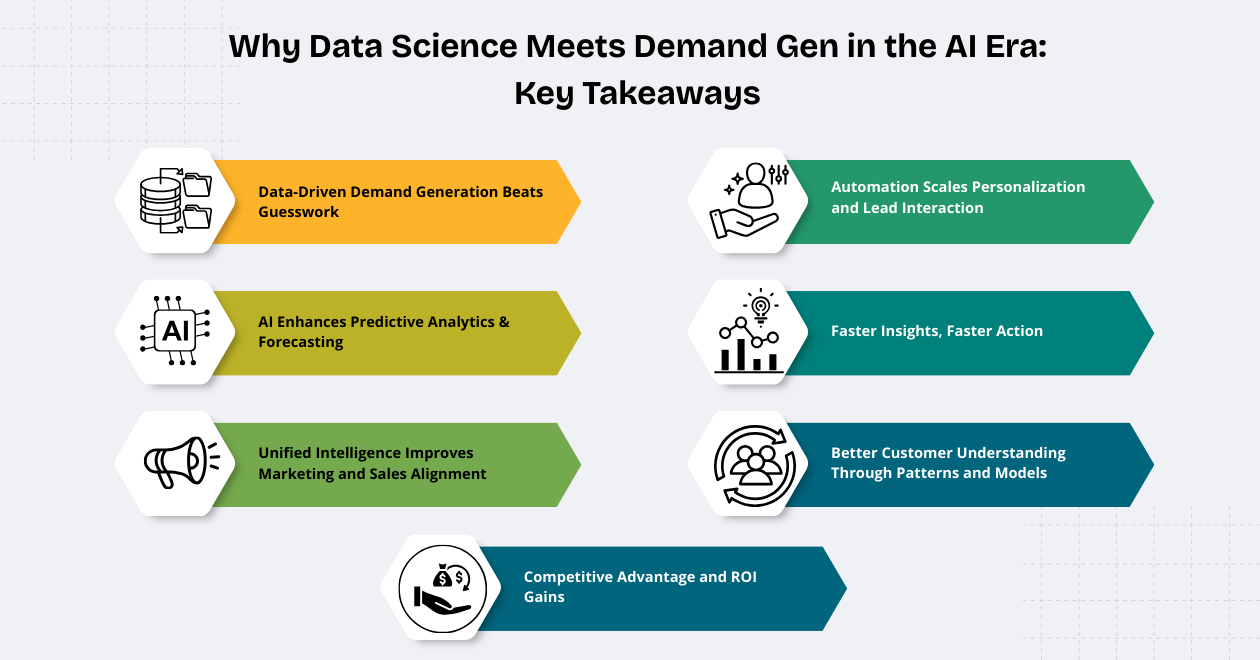
Why Data Science Meets Demand Gen in the AI Era: Key Takeaways
Data-Driven Demand Generation Beats Guesswork
Traditional demand gen is based on intuition, yet data science does reverse the tables. Using intent signals, buyer behavior and market trends, teams substitute hunches with accurate targeting. This raises the bar in B2B SaaS, where the quality of leads is even greater, in the case of CRM software such as Salesforce Einstein.
AI Enhances Predictive Analytics & Forecasting
AI-driven models accurately predict the health of the pipelines and customer churn with sick precision. AI tools such as Google Cloud AI or HubSpot’s predictive lead scoring forecast require spikes to be run, which enable proactive campaigns. This reduces forecast errors for Indian fintech companies, optimizing the expenditure of Ads on LinkedIn.
Unified Intelligence Improves Marketing and Sales Alignment
The integration of silos is done through the use of the same dashboard that is driven by data science. The intent data on 6sense and Bombora are matched to MQLs and SQLs and do not result in friction. When marketing and sales get access to real-time insights, there is a decrease in time devoted to sales.
Automation Scales Personalization and Lead Interaction
AI automates hyper-personalization. Marketo or Outreach applies personalized email engines that are dynamic and powered by behavioral data to boost their open rates. This scales ABM high-value accounts with no increase in headcount.
Faster Insights, Faster Action
Analytics dashboards can give you insights in minutes, not weeks. Tableau or Jupyter notebooks enhance the speed of iteration, which transforms change in the market, e.g., an update in RBI policies, into a prompt demand generation pivot.
Better Customer Understanding Through Patterns and Models
The first step is machine learning that identifies the patterns that are hidden in CRM data and reflects buyer journeys. Clustering models divide the audiences based on the propensity to buy and nurture the location-based businesses, which extend to the SMB loans.
Competitive Advantage and ROI Gains
There is 3x ROI when companies combine data science with demand gen. Innovators such as Zoho control the market due to the ability to leverage models to perform attribution, beating the competitors who are still in the spreadsheet.
How ‘Data Science with AI’ Is Reshaping Careers and Skills in 2026
Skills Modern Data Professionals Must Master
The current data professionals need to master a wide range of skills that combine technical skills with necessary soft skills. Those who get their Master’s in Data Science and AI learn the basics, like machine learning and neural networks, but they also focus on more useful, hands-on skills, like code and data visualization. The major technical skills include knowledge of programming languages such as Python, R, and SQL, and some of the frameworks and libraries such as PyTorch, TensorFlow, and Pandas.
Balancing Automation with Human Intelligence
The process of automation and human intelligence is a complex matter. It requires the analysis of data sets and algorithms to detect and remove unfair biases using efficient bias detection and reduction tactics. It also involves the execution of powerful mechanisms that guarantee the security of data, so that sensitive data is secured. Moreover, it is essential to create AI systems that could improve the decision-making of the executives. AI should be a helper by offering information and recommendations.
It is of significance to make complex models readable to users so that trust can be established.
Practical Use Cases: Data Science with AI Driving Business Outcomes
1. Healthcare
Data scientists refer to the records of the patient, genetic data, and clinical research to determine patterns that can potentially result in an early identification of disease. Models of AI, trained on such data, are able to infer patient outcomes and recommend treatment plans.
2. Finance
Financial sector Data analytics are applied to evaluate risk, identify fraud, and forecast market trends. Algorithms of AI are used in the automation of trading strategies and delivering customers with more individualized financial guidance.
3. Transportation
Autonomous vehicles make use of AI to navigate and make decisions, and data science is used to process data on the real-time traffic and optimization of routes and safety.
4. Manufacturing
Predictive maintenance ensures that the outages are minimized by using data-driven information to forecast the failure of equipment before it occurs. The insights are then used by AI systems to optimize the production process as well as enhance efficiency.
Challenges and Roadblocks: What Data Professionals Must Overcome
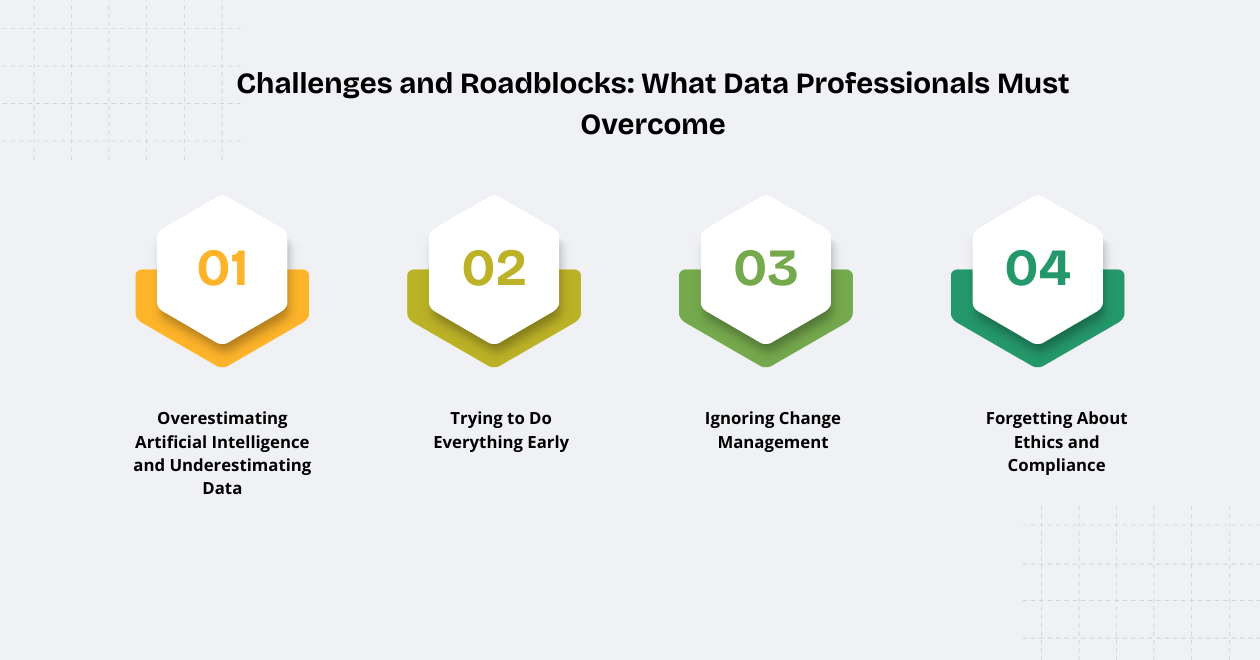
1. Overestimating Artificial Intelligence and Underestimating Data
Mistake: AI will only be as good as the data it is trained on. When your data is disorganized, haphazard, or unfinished, so will your AI.
Fix: Data hygiene should be fixed first, then AI.
2. Trying to Do Everything Early
Mistake: The idea of creating your own AI-based model to forecast all, including sales and employee turnover, in a month is a frustrating idea.
Fix: Begin with a single problem. Solve it. Then move towards aproblem.
3. Ignoring Change Management
Mistake: AI changes how people work. When your team does not understand or have trust in the system, they are going to ignore it.
Fix: Engage stakeholders, train, and communicate effectively.
4. Forgetting About Ethics and Compliance
Mistake: AI has the potential to bring bias, privacy threats, and regulation.
Fix: Construction of ethical and compliant AI. Whenever possible, use privacy-preserving methods and transparent models.
Case Study: How Euroflorist Used AI to Boost Conversions
Challenge
Euroflorist, an online flower delivery service, had to improve its user activity and conversion rates on its webpage, but was not able to do so with the old A/B testing.
Solutions
The team collaborated with Evolv AI, which applied the massively multivariate testing. It enables them to execute their hundreds of creative, layout, and CTA combinations at the same time. This AI-based solution made it possible to learn and optimize in real-time based on the live user data and redistribute the traffic in the most efficient variations.
Results
The project resulted in a tremendous amount of conversions and qualified for a quicker feedback cycle than conventional techniques. It was also helpful to understand the way users behave and what triggers them to buy, which is enhanced in general.
Conclusion: The Synergy Is the Strategy
In 2026, data science with AI has transformed demand generation into the demand engine. Thereby, instead of guesswork, this is based on a repeatable, revenue-driven engine where raw intent and behavioral signals are converted into accurate, timely action. When teams combine data, AI models, and human decision-making, they will have faster insights, stronger sales–marketing integration, and quantifiable improvement in pipeline and ROI. To data professionals and leaders of the GTM, the opportunity is also evident: invest in the current skills, trained AI behaviours, and/or experimentations, and you can create always-on, predictive growth engines that will keep your business at the forefront of evolving markets.

Author: IDBS Global
Turning Data into Demand, Fueling B2B Growth with Precision and Purpose.