
Why Your Demand Generation Campaign May Be Underperforming
Follow us

A Demand Generation Campaign can always get clicks, downloads and/or form fills but still not generate meaningful business results. The issue is seldom a simple one. Inconsistency with targeting, offer clarity, messaging, lead quality, follow-up, and measurement are all potential reasons for decreased campaign performance.
Within B2B teams, impressions or cost per impression, or the number of marketing qualified leads, are used to determine success. These numbers are important, but they don’t necessarily indicate real involvement in the purchasing process. Demand generation takes place over a longer journey, from initial brand awareness to sales conversations and revenue. Research, useful content, relevant distribution, engagement, nurturing and sales follow-up, are connected in a demand generation strategy. It also gives users the idea that people normally do their own research prior to filling in a form. So, marketers need to consider more than just visible conversions and tune their marketing programs for a qualified pipeline and not just activity. This article provides insight into your campaign’s results and steps you can take to make it better.
Is Your Demand Generation Campaign Actually Underperforming or Is It Being Measured Wrong?
Demand Generation Marketing vs. Lead Generation Strategy: Are You Expecting the Wrong Outcome?
| Category | Demand Generation | Lead Generation |
| Primary Objective | Build awareness, create buying intent, and establish trust throughout the buyer journey | Capture contact information from prospects who have demonstrated interest |
| Buyer Stage | Spans awareness, consideration, and decision stages | Primarily targets prospects in the mid-to-late buying journey |
| Core Approach | Build long-term relationships with buying groups and influence future demand | Convert existing interest into identifiable leads for sales follow-up |
| Key Tactics | ABX programs, intent-based advertising, dark-funnel content, thought leadership, targeted display, and industry events | Gated content, webinars, event registrations, conversational chatbots, landing pages, and CTAs |
| Primary Channels | Owned content hubs, industry publications, social amplification, targeted advertising, events, and peer communities | Landing pages, lead forms, live chat, event registration pages, and inbound calls |
| Key KPIs | Brand lift, engagement, account coverage, pipeline influence, and buying-group progression | MQLs, SQLs, form completions, lead conversion rates, and opportunities created |
| Value Focus | Prioritizes audience quality, relevance, engagement, and long-term pipeline impact over lead volume | Prioritizes efficient lead capture, conversion rates, and lead volume |
| Expected Outcome | Creates market demand and moves target accounts closer to becoming active buyers | Produces identifiable prospects that can be nurtured or followed up by sales |
Brand Awareness, Demand Creation, and Pipeline Don’t Move at the Same Speed
Awareness, demand and pipeline are being developed at dramatically different rates. Building trust via awareness can take marketers many months or years. Whereas getting someone interested enough to engage takes marketers weeks to months. But as for sales, it can convert a pipeline in minutes during actual buying modes. Expectations can be set to prevent faulty assumptions about the effect of marketing.
Why Low-Cost Leads Can Hide Poor Lead Quality
Low-cost leads might be attractive but usually they are unverified and old, causing sales and/or marketing teams to waste their time. Engaging in those leads can direct to high bounce rates due to bounces from the invalid email addresses and low engagements from the unengaged ones. This drives up cost of retargeting and nurturing the leads who did not respond. Rather, monitor the rate at which leads become opportunities, sales are accepted, wins are secured, and funds are generated from your sources. These metrics provide information about whether the Demand Generation Campaign appeals to valuable buyers.
The Difference Between Campaign Activity and Revenue Impact
High level of impressions and engagement are not a sign of commercial impact. It’s essential to benchmark campaign activity against qualified opportunities, pipeline value, sale velocity and customer acquisition cost. When reporting on their campaigns, it is also recommended by industry that you link them back to CRM contacts, accounts, opportunities, and revenue.
Why Your Demand Generation Campaign May Be Underperforming
The First Problem: Your Campaign May Be Targeting the Wrong Buyers
If your target audience definition includes a job title that has been discarded or a very general firmographic, you presumably target people who are not in-market. Modern buying groups have an average of 9–11 stakeholders, and they shortlist vendors before engaging sales. Target accounts with active research or buy intent data and account group mapping.
Your Offer Might Be the Real Reason the Campaign Isn’t Converting
The most common ebooks and “request a demo” CTAs are no longer effective. Buyers are looking for offers that address their specific pain points – such as interactive ROI calculators, benchmark reports, or pilot programs. Match what you say with what’s happening in the buyer’s process and which pain you’re solving.
Creative and Messaging Problems That Quietly Kill Demand
Negative elements like stock photos, sales-speak, and copy laden with features destroy trust. In this day and age, buyers travel virtually unknown and choose to validate the choices they make with peers rather than brand statements. Leverage customer proof, outcome-centric headlines & creative talking about business impact, not specs.
Budget and Bidding Issues Can Starve a Good Campaign
When top-of-funnel activity is underfunded, or allocation of spend is skewed across channels, it means fewer reach and frequency. Optimize budget for high-priority accounts, and biodiversity bidding strategies in line with pipeline needs rather than lead volume.
Your Campaign May Be Generating Leads but Not Enough Demand
If you are not focused on developing a brand image or awareness early on then optimize the form to fine-tune. Performance strategies must be deployed alongside a long-term and sustained investment in the brand.
Your Content Marketing Strategy May Not Match the Buyer’s Journey
No such thing is one-size-fits-all anymore when it comes to buying committees. Be aware of the content needed for each stage of the buying process (awareness, consideration, decision). Also, customize related messaging based on the persona of each member of the buying group.
The Landing Page Is Where Good Demand Gen Campaigns Often Break
However, clunky layouts, poor website load speed, and lackluster value proposition drive up bounce rates. Make sure your landing page is copy-matched, fast-loading and has one focused call to action.
Your Follow-Up System Could Be Wasting the Demand You Created
Follow-up investigations lose momentum when they don’t occur in the timely manner or customization. Automate customized and multi-channel nurturing sequences to maintain prospect engagement by playing to intent signals.
Are You Optimizing for Leads Instead of Pipeline?
Change marketing/sales from number of leads to pipeline velocity, opportunities created, and pipeline influenced. This creates more stability to results for sales and marketing and stability for branding.
Don’t Ignore the Dark Funnel
Buyers Research Before They Fill Out Your Form
The majority of prospects do a lot of “clop” research before they will ever fill out a lead form. They read industry pieces, view review videos, shop around on G2/Capterra, chat in private Slack/LinkedIn DMs. They also listen to podcasts without a trace of them in your attribution model. They typically have completed 70% of their decision making by the time they reach the end of your form. Optimizing for the last click is a case of underinvesting in content and channels that foster demand.
Track Anonymous Engagement and Account-Level Activity
Track which companies are visiting high intent pages, such as pricing, integrations, case studies, without names using IP-based visitor identification and account-level tracking. Pre-form fill tools, such as 6sense, Demandbase, or Clearbit, can show buying signals that happen on a person-by-person level. It ranges from page views, the time on site until content downloads. Use these on a proactive basis as leading indicators and send high engagement accounts to sales.
Use Buyer Intent Data to Identify Emerging Demand
Third party intent systems (Bombora, ZoomInfo, G2) monitor content consumption on the web to identify accounts that also study your solution type or challenger companies. Configure alerts when it senses an increase in research for a specific topic, comparisons of competitors, or specific category keywords. Use this information in your marketing automation and CRM system to more effectively prioritize accounts that are still to visit your site but have expressed some form of interest.
Connect Multiple Signals Instead of Relying on One Click
Dark funnel metrics best tracked are direct traffic to critical pages, branded search volume, self-reported “How did you find us” answers, social mentions or review-site activity. Create a basic dashboard to capture these proxy metrics with pipeline. As time goes on showing will reveal which of the darker funnel activities are associated with closed-won deals.
Give Sales Visibility Into What Happened Before the Lead Arrived
Intent signals that trigger a fire in the last 30-90 days, which pages visited and which case studies read from a specific website. This aids reps customize discovery questions, compile relevant content and speed up trust. If sales are aware of the dark funnel, they can close and give the marketing team feedback for more accurate attribution.
A Better Demand Generation Campaign Framework
Start With One Clear ICP and Business Problem
Rather than filtering by companies (such as SaaS companies), define ICP by situation. Examples include: “RevOps leaders from Series B SaaS companies that are trying to combine three+ data vendors. This specificity means that the messages are relevant, they do not have to spring a surprise on anyone. Leverage firmographic, technographic and intent data to target accounts that match this profile and verify against the sales and customer success teams, ensuring alignment.
Build an Offer That Creates Genuine Buyer Interest
Your offer needs to address a genuine, pressing problem; the answer cannot just be features. Build realistic arguments, including assessment of results (benchmark studies), customer teardown, or a public ROI calculator. For example, a demandgen system can give a free “Pipeline Health Audit”. It also shows a prospect where they’re losing leads in their marketing funnel, which gives them value and will build trust right away.
Match Content and Creative to the Buyer’s Stage
Match content types to buyer’s journey stage. Short videos that tackle specific issues without trying to sell something, industry reports and blogs focused on education, and early-stage videos, are all good options. Case studies, webinars, and demos are used in mid-funnel campaigns to explain what results buyers can expect to achieve. Late-stage copy should focus on comparison pages, implementation guides, and testimonials from customers, to lessen the risk of sale.
Distribute Through the Channels Your Buyers Actually Use
Track your budget to demand creation i.e LinkedIn, podcasts, communities. Also, track demand capture such as Search, retargeting, review sites. Focus on those channels where your ICP is looking for answers – usually LinkedIn groups for B2B, niche communities, and specific e-mail follow up series. Don’t scatter the resources amongst a host of not-so-strong channels — target two or three well-conceived channels that perform better than eight diluted ones.
Connect Engagement Data to CRM and Lead Nurturing
Create and enforce strong data infrastructure, starting with the requirements on data enrichment, deduplication, verified contacts, CRM routing rules – all while maintaining the attribution to the source. Monitor engagement efforts (content downloads, webinar attendance, internet interactions). Then input them into automated nurture efforts focused on a buyer’s interests. This means sales teams get contextually rich leads to ensure meaningful one-to-one outreach.
Optimize Toward Qualified Pipeline, Not Vanity Metrics
Think in terms of predictive metrics instead of MQLs and website traffic, such as qualified conversations, pipeline sourced (dollars), and pipeline influenced. You do not have a volume issue if less than 15% of your MQLs become qualified pipeline. Channel-specific payback window analysis and adjust your budget in a way to allocate funds to the most productive activities in the channel.
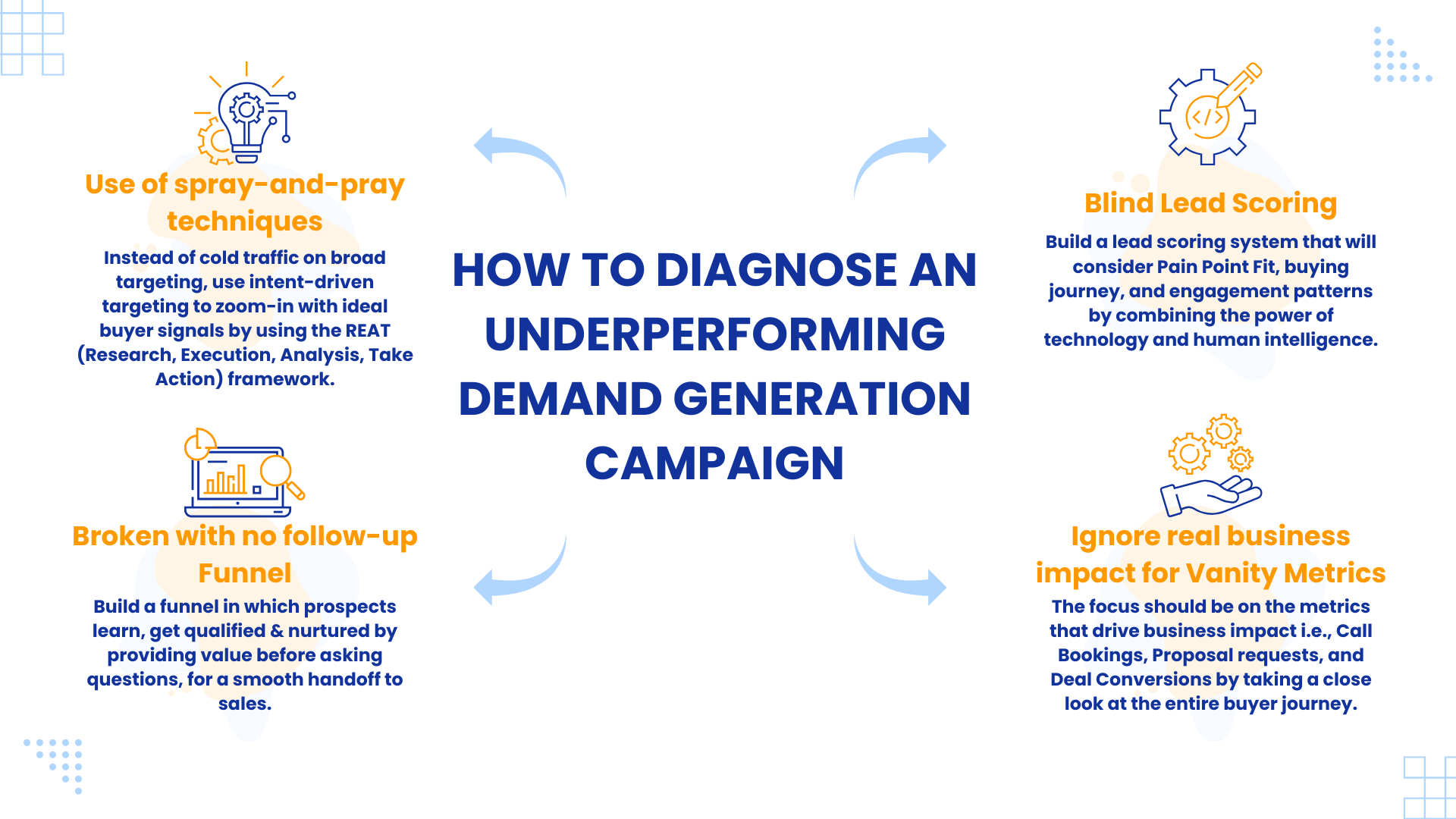
How to Diagnose an Underperforming Demand Generation Campaign
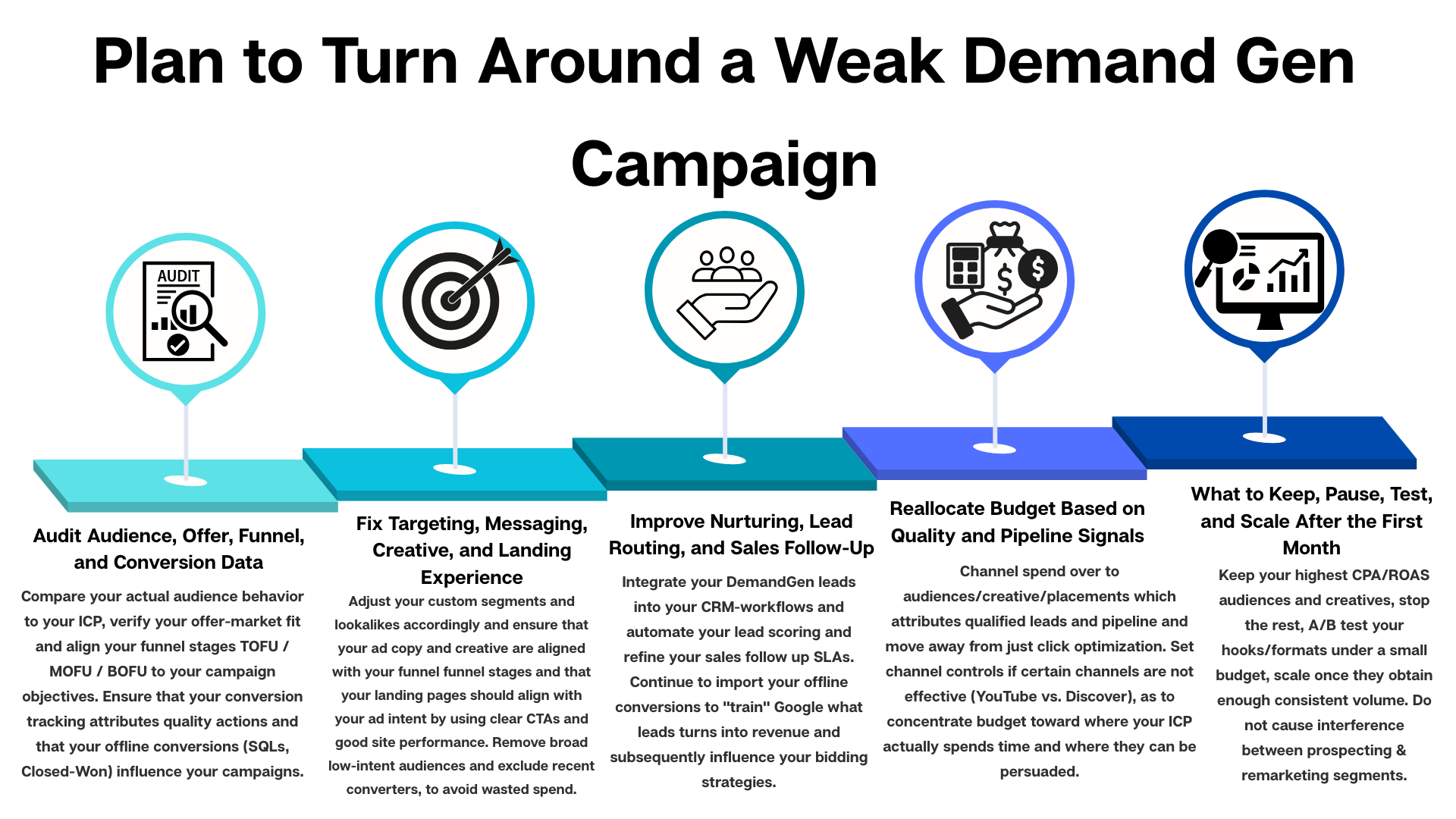
Plan to Turn Around a Weak Demand Gen Campaign
Case Study: What can negative advertising achieve in a DemandGen campaign?
Recently, Clickz tried out this advertising experiment on whether creatives which defied expectations were able to save some of the previously worst top-of-funnel(ToFu) account setup.
What’s the Problem?
Buying too much attention with standard banners that just shout “buy this” pushed acquisition cost higher & higher while delivering lackluster user interaction.
What’s the approach?
They tested what “negative” ads could do; running ads that said the opposite of a standard promotion. For example, “You don’t want soft hair? Then don’t use our shampoo.” into split ad groups targeting conversion rate optimization.
What results?
67k Unique Users, $0.07 CPC & positive ROAS.
Key lesson.
To improve this campaign or any other, use disruptive, unique messaging frameworks (not boring, creative with negative framing).
Conclusion
But a poor Demand Generation Campaign isn’t necessarily a failure. It can point to either the wrong audience, an unattractive offer, unclear messaging, derails mid-campaign and/or measures too early. One of the best ‘bonuses’ is looking at the entire buyer journey. Assess pipeline, revenue, opportunities, sales acceptance, lead quality, engagement and awareness all at once. Dark funnel signals help you gain understanding about pre-submission research and pass a bit of life and context on to sales to keep the process moving properly. Most importantly, never look at demand generation as just a funnel. If the it is successful, it sets up the proper audience to receive a valuable opportunity for problem-solving. It makes the content easily available via the right channels; it builds interest; and it integrates marketing with sales. Once you can fine-tune that complete system, you’re likely to generate fewer irrelevant leads and more quality business opportunities.

Author: IDBS Global
Turning Data into Demand, Fueling B2B Growth with Precision and Purpose.