

How B2B Companies Can Compete in Saturated Markets
Follow us

In saturated markets, B2B companies face intense competition, but smart positioning and execution will help them succeed. This guide contains effective tips on how B2B businesses could become more memorable, increase their B2B revenue growth, and achieve sustainable benefits.
Why Competing in a Crowded B2B Market Is Different
A B2B market is saturated, and integrating into the mass may be the doom of a business in the short and long term. The consumers of today can compare features, pricing, and case studies within a few minutes, hence making it difficult to compete in specifications alone.
B2B companies should stop the product contests and focus on value-based positioning. Buyers put more emphasis on results, such as efficiencies or reducing risks, than specifications. This attitude contributes to the expansion of the B2B companies addressing the unmet demands in the saturated spheres.
Crafting a Unique Market Position
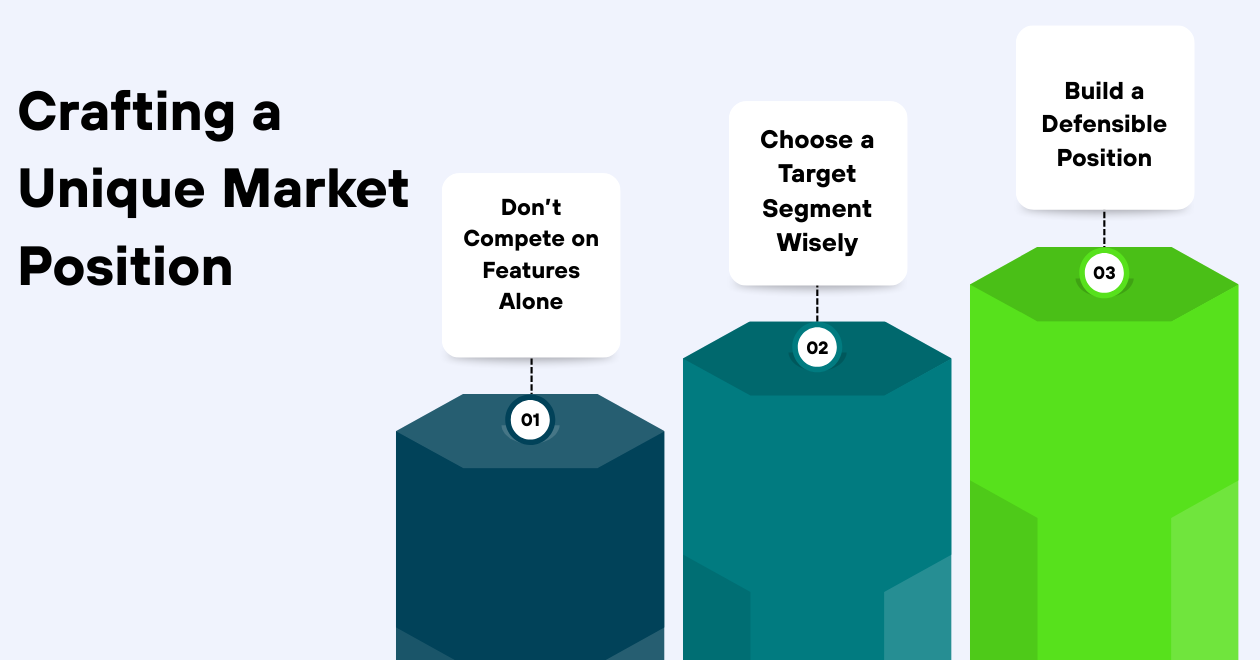
Don’t Compete on Features Alone
B2B marketing a product can be achieved by focusing on how each of the features can solve certain problems that the audience has. In the B2B approach, connecting technical issues to real-life issues and showing empathy helps build a stronger connection with potential customers, exceeding just comparing features.
Choose a Target Segment Wisely
The key to creating value and winning consistently is identifying a specific target audience. A defined market consists of firmographic, behavioral, and psychographic variables. Developing unique customer profiles helps to gain insight into the problems of their customers. It can be purchasing triggers, sources of information, and factors that influence their decision-making process. This helps businesses develop strategies effectively to meet the requirements of their ideal customers.
Build a Defensible Position
Powerful positioning offers defensive benefits to brands such as CHAGEE, which has positioned itself as a brand synonymous with high-end Chinese tea culture. This presents a challenge to their competitors who attempt to have the same positioning. Brand equity builds on the fact that success gives credence to original positioning. In cases of such fast growth, brands need to focus on ensuring stability in operations by following standard procedures, ingraining their position within the organization’s culture, and committing to constant innovation to stay ahead of the competition.
Knowing Your Target Customer Inside Out
Intense customer insight is what makes B2B winning companies different. Track pain points and decision triggers through surveys, interviews, and behavioral data collection. Perceptual mapping identifies the gaps where the competitors are weak.
B2B corporations ought to examine customer experiences and their level of advocacy awareness. Such tools as CRM trace the communication, revealing what actually contributes to high-value deals. Always keep this knowledge up to date, as the behavior of saturated markets changes.
Target areas where your solution is the best. Companies that are obsessed with a single ideal customer profile also convert better and stay longer, since it is B2B.
How B2B Companies Can Compete in Saturated Markets
Identify and Target High-Value Niches
Your niche market category should be clear to customers before they even connect with your business. You can become a star in this niche, which is CRM for real estate teams, by focusing on a specific audience. Goetzen says that narrowing down turns the category strategy into an attacking strategy that aims to create category leadership.
Differentiate Your Value Proposition
A unique value proposition is the reason customers should prefer your product or service to others. It must be concrete, in relation to the issues of your target market, and contrasted with others. Whereas a tagline is a catchphrase that highlights what the product is all about, this is the real truth of your brand. Furthermore, it should govern product development, B2B sales, and customer interactions.
Strengthen B2B Branding and Credibility
Surfacing your proprietary data with the information your audience can’t access elsewhere. B2B companies must convert the internal trends into the externally facing thought leadership is credibility and demonstrates that you are not one of the vendors; you are the one who can provide.
Align Sales and Marketing for Maximum Impact
Positioning will only work if every contact with a customer sends the same message. This includes coordinating sales conversations and content, helping customers and getting them involved in the product, letting them try out the product and getting them started with it, marketing communication and content, the look, feel, and voice of the brand, as well as the price and package of the product.
Unity among all the marketing touchpoints can be used to boost revenue by 23%. However, a lack of consistency kills credibility; customer experience should align with the positioning promise.
Leverage Technology and Automation
The modern sales landscape is highly sensitive to time, and customers wait for a reply in a matter of hours, or even minutes, particularly in the business. Marketing automation is necessary because maintaining fast response rates is difficult, given the number of leads. The most important tools for effective sales processes are CRM systems, sales prospecting software, content management systems, and B2B email marketing platforms. Regular lead follow-up will be a critical practice, as responding first increases the chances of securing new deals.
Invest in Customer Success and Retention
This investment proves to be particularly significant in the case of a company that sells as-a-service solutions, products, or services at a high price. Customer success engages directly and proactively with customers to achieve high satisfaction with their products or services.
Optimize B2B Digital and Ecommerce Channels
Consumers today are more about the experience rather than the price and quality, of which 86% are ready to pay more to get a better experience. The tactics brands should adopt to boost the buyer experience include:
- Personalization
- Omnichannel interactions
- High-value content
- User-friendly communication/B2B ecommerce channels
- Excellent sales interactions
- High-quality customer support (both during the buying process and afterward).
The strategies can significantly boost customer satisfaction and loyalty.
Continuously Monitor Competitors and Market Trends
SaaS startups have the ability to distinguish themselves in competitive markets by adjusting to the changing trends.
For example, Doorbell is a good example as it specializes in the co-living trend in the competitive property management industry. The platform not only helps the property managers in their logistics, such as rent collection and repairs, but also creates a community among people living in the same area. The platform allows users to organize events, deliver B2B services, and engage in one-on-one communication. Moreover, Doorbell connects local businesses and residents and offers unique discounts. It is a complex solution that makes the living experience better, which makes Doorbell stand out from the conventional property management solutions.
Test, Iterate, and Improve Campaigns
The stakeholders’ responses or a potential customer’s feedback can be used to refine the messages. Value mapping is a cyclical exercise, and each variant must bring you nearer to what the audience is most interested in.
Focus on Long-Term Relationships Over Quick Wins
Nurture supports customized touchpoints. B2B companies establish trust by delivering value over time. Thereby, by making a one-off into a long-term relationship with partners.
Branding and Positioning for B2B Companies
B2B branding and positioning entail creating an exclusive, reliable presence in the minds of customers through emphasizing specialized value as compared to others. The strategies to be effective are in clear communications, thorough audience understanding, and proving ROI to the risk-averse consumers. Where, in the long term, the brand competes not on price but on brand equity. Key elements include:
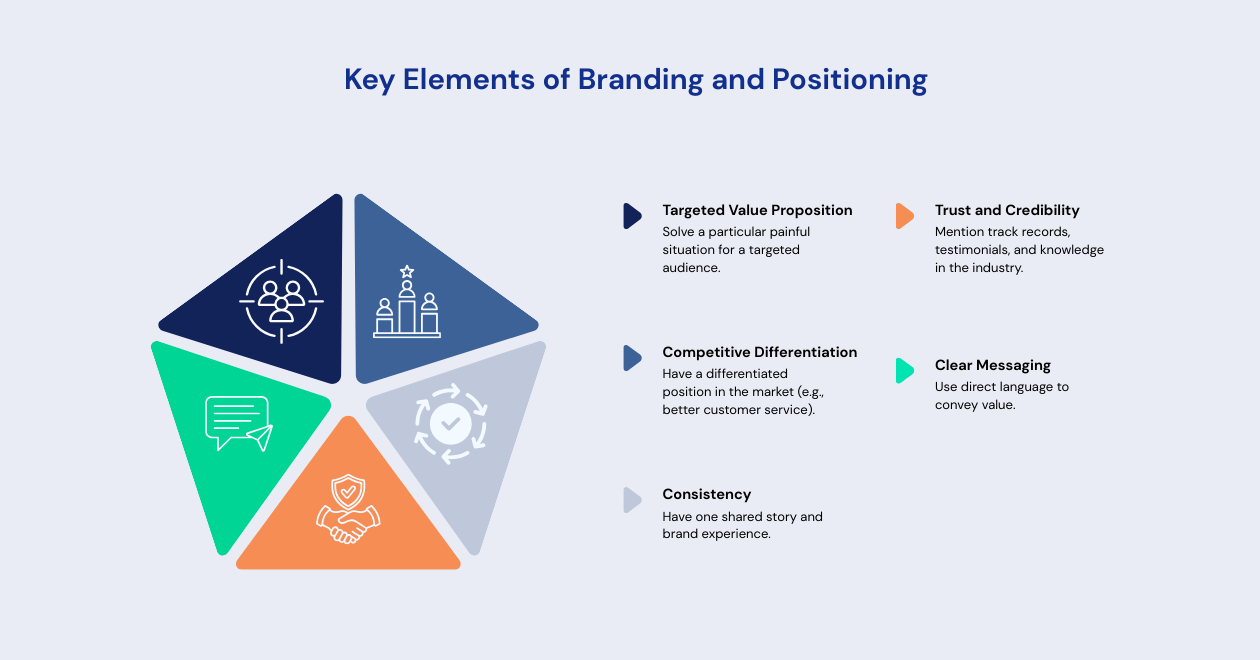
- Targeted Value Proposition: Solve a particular painful situation for a targeted audience.
- Trust and Credibility: Mention track records, testimonials, and knowledge in the industry.
- Competitive Differentiation: Have a differentiated position in the market (e.g., better customer service).
- Clear Messaging: Use direct language to convey value.
- Consistency: Have one shared story and brand experience.
Avoiding Common Pitfalls
Pitfall 1: Positioning Too Generally
You should not be trying to be everything to everybody.
How to Avoid Them
Target a narrower audience and make sure that your positioning is unique and focused on the needs of the target audience. Be specific to become unique among the competitors.
Pitfall 2: Mixing Features with Benefits
Selling the technical features of your product can lead down the path of forgetting the real worth of your product.
How to Avoid Them
To avoid this, focus on the value and results that your product provides to the customers. State clearly the issues it addresses and the outcomes it attains.
Pitfall 3: Overlooking Competitor Positioning
Your positioning needs to be relevant to competitors.
How to Avoid Them
Not possessing strong differentiation to say it is the same as the existing brands. Conduct extensive market research to define your differentiated value proposition.
Pitfall 4: Poor Consistency
The effectiveness of the great positioning plan may be undermined when customers do not experience what you say they should.
How to Avoid Them
All the touchpoints, including marketing campaigns, customer service, and the product per se, should support the same positioning. Even your launch campaign has to be on track.
Case Study: Increasing Sales at Fama Technologies using a Perfect Customer Profile
Problem
Fama Technologies wanted to develop a better understanding of its ideal customer profile (ICP) to tailor the message and simplify the purchasing process. They had to find the areas of customer pain and sell the value of their solution.
Strategy
In an effort to address this, Famo Technologies conducted an extensive quality and quantitative survey of its ICP. The insights gained enabled them to rebrand their message, create specific content to address specific pains, reshape their sales materials, and digitalize their campaigns to align them with this new message.
Results
- The effort resulted in a 400% increase in their sales pipeline over 18 months of applying the new messaging.
- Their quarter-to-quarter pipeline growth exceeded 25% over the long term, proving that data-driven, customer-oriented communication works.
- Not only did this help fill the pipeline, but it also led to the establishment of more connected relationships with potential customers and to increased revenue faster.
Conclusion
B2B companies are highly successful because they niche, differentiate, and make their teams customer-focused. Saturation is transformed into opportunity through innovation, data, and relationships. These measures can be implemented in order to increase revenues in a sustainable manner. Start with one niche today.

Author: IDBS Global
Turning Data into Demand, Fueling B2B Growth with Precision and Purpose.