

Programmatic for B2B Demand Generation: Audit to Cut Waste & Drive Growth
Follow us

With programmatic for B2B DemandGen, automated systems are used to buy and show ads to business accounts in real time, based on the data that is available. It advances in 2026 with complete funnel plans involving AI, intent-based measurements, and account based pipeline expansion. The strategy helps B2B marketers cut down on waste caused by poor targeting and attribution and encourages qualified engagement. Programmatic now focuses on first-party data and buying group attention to provide a measured ROI with B2B DemandGen. This is because privacy is changing and cookies are becoming less useful.
Why Programmatic Is More Than Just Display Ads in B2B
Programmatic for B2B DemandGen automates the purchase of digitally targeted ad space that is aimed directly at workers and people who make decisions. Such campaigns conduct a good targeting of niche audiences, based on detailed data, which may rely on many factors, such as job positions and browsing patterns. B2B marketers use a demand-side platform (DSP) to automate the process of purchasing ads in numerous online platforms, including:
- Video
- Native
- Display advertising
- Connected TV
This method is very important in the long and complex B2B sales process. It helps with building brand recognition, getting leads, and persuading decision-makers at every stage of the buyer journey.
The Hidden Cost of Waste in Programmatic Campaigns
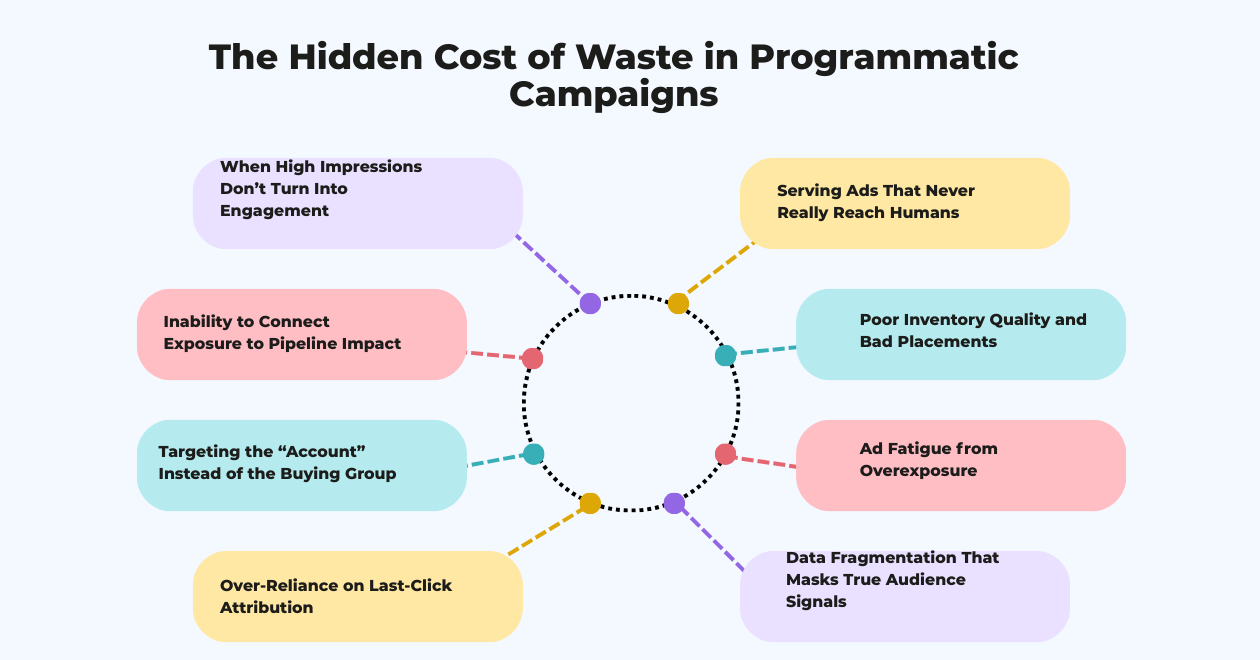
When High Impressions Don’t Turn Into Engagement
Big impressions are a good indicator of generous, crude targeting in Programmatic of B2B DemandGen. Without clicks or views, bots or casual scrollers inflate numbers. Audit viewability score; objective organic views. Polish using contextual cues to enhance interest. This eliminates vanity metrics and allocates expenditure towards prospects.
Inability to Connect Exposure to Pipeline Impact
Programmatic for B2B DemandGen performs badly when ad exposure is not linked to CRM pipeline steps. Multi-touch influence is concealed by siloed tools. Monitor account-level progression with the help of UTM parameters and reverse ETL. This will see real attribution of revenue, thus minimizing wasted mid-funnel expenditure.
Targeting the “Account” Instead of the Buying Group
Single-account targeting Programmatic for B2B DemandGen doesn’t reach the buying group of 6 to 10 people. The lack of interest by one contact holds deals. Combine the firmographic, technographic, and intent with group coverage. This uplifts interest since it tackles shared pains.
Over-Reliance on Last-Click Attribution
Programmatic bottom-funnel tactics are unfairly attributed to Programmatic last-click models of B2B DemandGen. Awareness at the upper-funnel is ignored. Change to multi-touch, such as W-shaped attribution. This shifts the budget to an upward trend in order to expand in a sustainable way.
Serving Ads That Never Really Reach Humans
Bot traffic consumes inventory based on Programmatic for B2B DemandGen. Invalid traffic (IVT) verification tools like TAG-certified DSPs filter fakes. Demand 100% viewable, human-verified impressions to protect ROI.
Poor Inventory Quality and Bad Placements
Poor site drains down Programmatic for B2B DemandGen impact. B2B Ads in inappropriate placements negatively affect the safety of the brand. Premium publishers should be blocked and targeted with contextual targeting. This enhances conversion and quality scores.
Ad Fatigue from Overexposure
If Programmatic for B2B DemandGen has a drop-off of 12 or more views, it is due to repetition. As it is not bouncing, it is often limited to 5-7 weeks. To turnaround this situation, design captivating and attractive creatives.
Data Fragmentation That Masks True Audience Signals
Programmatic for B2B DemandGen utilizes siloed data, which hides intent. CDP integration unites signals to aim precisely. This shows in-market hidden records, waste reduction.
How to Audit Your Programmatic Demand Gen Strategy (Step-by-Step)
Step 1: Map & Document Your Current Targeting Logic
Programmatic B2B DemandGen List firmographics, intent, and lookalikes. Poor buying roles are examples of missing. Review the collaborative sheet document logic. This benchmark reflects differences.
Step 2: Break Down Audience Composition
B2B DemandGen audiences through segment Programmatic. These are 1st-party, intent, retargeting. Determine overlap and quality through conversion rates. Cut off low-performers to re-allocate expenditures.
Step 3: Evaluate Engagement Across Channels
Video Completion CTR, dwell time Programmatic for B2B DemandGen channels. Not only clicks, but weights by pipeline. Top channels such as display advertising should be used in the budget.
Step 4: Rethink Attribution Beyond Last-Click
Apply Programmatic data-driven attribution on B2B DemandGen platforms. Model uplift from exposure. Do not forget to balance conversions, which are usually missed.
Step 5: Isolate Truly In-Market Accounts
Filter Programmatic to B2B DemandGen signal of high-intent, such as search or page view. Intersectional CRM of purchasing preparedness. These are the most important to be efficient.
From Audit to Action: Strategic Next Steps
Quick Fixes: Low-hanging Wins
Programmatic under B2B DemandGen lets you try new creatives, set limits on frequency, and block bad placements.
Aim for a reduction in waste within weeks. These stabilize campaigns in a hurry.
Medium-Term Improvements for Demand Creation
Construct Programmatic B2B DemandGen buying group segments and content of the full funnel. Incorporate intent data to do dynamic targeting and increase engagement every quarter.
Long-Term Growth: Full-Funnel Programmatic Activation
Use AI-based bidding and cross-channel coordination in Programmatic B2B DemandGen. Account heat scoring, scale, and drive growth of the pipeline annually.
Designing Programmatic Campaigns for B2B Demand Gen Success
Audience Targeting That Works: Account & Buying Group Focus
When you use Programmatic B2B DemandGen, use whole units of decision-making instead of people, which is how B2B buyers normally buy. Apply ABM overlays to provide a 360-degree image. This accelerates consensus.
Content Build-Out for Progressive Discovery
Programmatic demand gen is based on the education of buyers. It implies the availability of the right content, both problem framing and product proof, at all levels.
Smart Retargeting That Nurtures, Not Harasses
The smartest advertisers do not repeat; they reinforce. If you use audience segmentation, get creative, and change your messages based on the user’s behavior, you can make your retargeting strategy more successful and appealing.
Account-Level Scoring & Engagement Signals
Your lead scoring model must aid in prioritizing sales outreach. Take a look at the way of lead scoring. You can provide sufficient firmographic fit or use behavioral indicators (such as downloads, webinar attendance, and frequent visits).
KPIs That Matter: From Impressions to Pipeline Growth
| Metric | Definition |
| Marketing-sourced pipeline and revenue | Value of deals influenced or sourced by marketing efforts. |
| Opportunity creation rate | The percentage of engaged accounts that turn into sales opportunities. |
| Sales cycle length | How long it takes for marketing-sourced leads to become closed-won deals. |
| Win rate by source | The conversion rate of marketing-sourced opportunities versus other sources. |
| Account engagement score | Aggregate engagement across buying committees within target accounts. |
| Brand search volume | Changes in branded keyword searches showing increased market awareness. |
| Content-assisted deals | Number of closed deals that engaged with specific content pieces along the journey. |
| Customer acquisition cost (CAC) | Total spend to acquire a new customer, including marketing and sales costs. |
| Customer lifetime value (CLV) | Long-term revenue from acquired customers, showing quality of acquisition. |
Case Studies: Programmatic for B2B Demand Gen
Case Study of JacobTyler
As an example, they worked with a mid-market tech business that had trouble with brand recognition, even though their products were better (see case study). Jacob Tyler has found that their technical messaging made sense, but it didn’t communicate worth in a way that their target audience could understand.
Problem
There was a lot of technical language on their website and in their marketing materials, which is why they only got a 12% conversion rate of qualified leads and a low brand recognition score in market research polls.
Strategy
With JacobTyler, a new messaging hierarchy prioritized the business benefits with technical points of proof. The elements of visual identity were fine-tuned to deliver innovation and have credibility at the same time.
Solution
Their conversion rates went up to 28 within six months, and their brand preferences among the target market went up by 45%. The company was able to get three big contracts because its brand placement and clarity were improved.
This change explains the ability of strategic brand audits to convert insights into measurable business results.
Future Trends: Programmatic Demand Gen in the Evolving B2B Landscape
- Contact-Level Accuracy: The development of account-based marketing (ABM) is shifting the focus to individual contacts in an account, not the entire account. The results are more relevant messages and shorter sales processes. This is because the people who make the decisions know what they’re doing and the problems they face.
- Automated campaign management with AI will soon be a reality: AI will be essential in campaign management by 2026, scheduled in real-time, and budgets and creative variants will be optimized according to live data signals. While marketers will still come up with big-picture plans, AI will make their work easier, so they can spend more time coming up with new ideas and less time managing data.
- Micro-Moment Content: B2B customers want to consume short content rather than long content. As time goes on, marketers need to learn how to make modular content that gives information in a variety of forms, like short movies and infographics, so that it can be easily understood and used right away.
- Inclusive Consumer-Like Marketing: As the impact of the younger demographic of decision-makers entering the workforce, the landscape of B2B marketing is shifting to place a premium on impressive, professional-grade, and engaging content. This change is based on the old, jargon-heavy formats and a more human way of telling stories, which has been shown to work in customer marketing.
- Beyond MQLs: The marketing metrics are moving away from established metrics such as Marketing Qualified Leads (MQLs) to gauging the influence of the pipeline and revenue impact. The change facilitates accountability and sales alignment, focusing on the need to create qualified conversations that result in actual business deliverables.
Conclusion: Activate with Intention, Not Just Impressions
Programmatic B2B DemandGen thrives on audits that identify waste and prioritize actions in the pipeline. Success will hinge on account-centric targeting, comprehensive funnel writing, and impactful KPIs like revenue influenced. These strategies will be crucial for achieving goals in 2026. There are 2-3x ROI lifts on teams that audit quarterly. Switch impressions to intention: map buying groups, score accounts, and automate intelligently. Your development will be willfully triggered.
FAQs: Practical Concerns About Programmatic for B2B Demand Gen
Audit frequency varies depending on the type of the audit, regulation, and the organization’s risk profile, but it commonly ranges from quarterly to annual.
The approach to purchasing is programmatic, whereas the targeting is audience-based.
Demand creation contributes to long-term brand exposure and educates potential clients who are not actively seeking a solution. In contrast to lead capture (or demand capture), where the intent is ignored, the prospects are focused, captured, and converted. It is often utilized to engage high-intent prospects who are already seeking solutions, usually via gated content or PPC.

Author: IDBS Global
Turning Data into Demand, Fueling B2B Growth with Precision and Purpose.