

Revenue Operations Blueprint for Pipeline & Profit
Follow us

In the current highly competitive B2B environment, revenue operations has become the strategic driver, credited to sales alignment with marketing operations. Also, customer success teams work together to facilitate predictable growth. This blueprint will discuss how Revenue Operations is changing disjointed efforts into a single revenue engine, accelerating velocity on the pipeline, and profitability. Businesses will be able to achieve scalable results in 2026 with the help of the RevOps strategy guide, which is based on automating the sales process, technology, and people.
What Revenue Operations Really Means for Your Business
Revenue operations (or RevOps) refers to a strategic approach that combines all activities within an organization that involve revenue. This includes better coordination between financial, marketing, sales, and customer success under one roof to speed up the growth of the business. With RevOps, all teams in the path of making money are working together toward the same goal, using the same tools and methods.
Why Revenue Operations Is the Game-Changer for 2026
RevOps is essential to businesses as it coordinates different departments in the same direction to improve the marketing and sales strategies. RevOps enables the organization to gather information across the organization to make informed decisions that drive growth. It offers real-time data on the performance of sales and the market trends. It enable teams to achieve targets and even enhance their work. Moreover, RevOps supports uninterrupted data examination to derive patterns and inefficiencies with proactive amendments to the plan that will be capable of promoting long-term growth and success.
Understanding the RevOps Ecosystem
Core Pillars of RevOps
People
RevOps centres on people. An effective structure entails multi-functional teams with well-defined functions. Whereas conventional silos divide marketing, sales, and customer success, RevOps ties them together with the same level of responsibility.
Assign RevOps leaders who serve as the interface between departments.
Specify job roles that are results-oriented, rather than task-oriented.
Make it a tradition to work in teams.
Process
Processes define the ease with which leads flow through the funnel. An unsteady workflow may result in time- and revenue-wasting bottlenecks.
- Standardize lead qualification between teams.
- Design the customer onboarding and retention workflows.
- Set up document procedures to make sure they can be used again and again and can be expanded.
Technology
RevOps is based on technology, and a lot of tools can make things hard to understand. The goal is to build a tech stack that works together to provide an experience.
- Invest in CRM as the hub of all the revenue activities.
- Combine marketing automation, sales engagement, and customer success solutions.
- Use AI and analytics to deliver predictive forecasting and real-time insights.
Data
The data is what binds RevOps. In its absence, decision-making will involve guesswork.
- Have a single system of truth by centralizing data across several systems.
- Use data governance rules to make sure that accuracy and compliance are maintained.
- Use analytics to quantify the ROI at each rev funnel stage.
RevOps vs Traditional Operations
| Aspects | Traditional Operations | Revenue Operations |
| Focus | Departmental KPIs (e.g., MQLs, SQLs, Churn Rate) | Full-funnel revenue growth and customer lifetime value |
| Structure | Disconnected teams (Sales Ops, Mktg Ops, and CS Ops) | A single, centralized team overseeing the entire revenue engine |
| Data | Multiple sources of truth, often conflicting | A single source of truth, centralized and trusted data |
| Process | Handoffs between teams create friction and data loss | A seamless, end-to-end process from first touch to renewal |
| Technology | Disparate tech stacks for each department | An integrated, unified tech stack for the entire GTM team |
| Go-to-Market | Annual, static planning with slow execution | Continuous, agile GTM planning that adapts to market changes |
Revenue Operations Blueprint for Pipeline & Profit
Understand Revenue Operations Fundamentals
Begin by understanding the basics of Revenue Operations, such as aligning sales, marketing, and customer success to predictable growth. Assign similar objectives, for instance, the pipeline coverage and win rates, to eliminate silos.
Map Your End-to-End Revenue Process
The E2E revenue process consists of actions that take clients from prospecting to purchase, with an emphasis on internal GTM operations. What you will do is create a plan for integrating cross-functional processes, identifying productive revenue sources, establishing paper handoff procedures and SLAs, and gaining access to additional revenue cycle technologies.
Set Clear Roles and Responsibilities Across Teams
This includes the description of the different roles that will be needed on the RevOps team. The example of outlining all the end-to-end GTM roles and processes will be required to identify functional gaps, so you can get the best structure for your organization.
RevOps Co-Op indicates that an organization with a high structure post-implementation of Revenue operations would probably be structured as below on a B2B basis:
Align Sales, Marketing, and Customer Success Goals
The implementation of a RevOps system will involve the sales, marketing, customer success, and finance departments, necessitating the approval of departmental executives. To get their support, ask them about their challenges and ways to help, keep your speech brief, highlight personal gains, and focus on ROI with expected increase in increments. Offer current examples of successful organizations to show the possibilities of revenue operations. This is aimed at enabling leaders to understand the role that they have in the revenue pipeline and the opportunities for the future.
Leverage Technology and Automation
A modern RevOps stack helps in the improvement of linking revenue-generating teams with the implementation of essential technology integrations. Key elements include CRM software like Salesforce for customer data, Marketing Automation Platforms like Marketo for lead interaction, Customer Success Platforms like Gainsight for tracking retention, Revenue Intelligence Tools like Gong for performance analysis, Collaboration Platforms like Slack for team communication, and Data Integration Solutions like Snowflake for smooth data flow.
Implement Revenue Process Analytics
Monitor pipeline performance, forecast accuracy, and revenue. Data is RevOps’ lifeblood. Keep track of stage conversion rates and the velocity of sales. Tableau data can be used to disclose trends using dashboards and CRM-native tools. Monthly reviews identify issues like low win rates showing low lead quality. One corporation enhanced the predictions through predictive analytics, which makes it certain to scale.
Identify and Resolve Bottlenecks
Data bottlenecks are concealed data, long sales cycles or high churn. Spot them using funnel analysis: e.g., 50% MQL drop-off? Refine scoring. Go to the root cause with team feedback, then correct through an A/B test or training. Quick wins, such as sales playbooks, helped a client overcome a 15-day delay that would otherwise have brought in revenue.
Optimize Revenue Continuously
RevOps should be a dynamic process. Evaluate the performance of your strategy and use feedback on it through your staff and clients.
Think of establishing a semi-regular review process, monthly or quarterly, in which you delve into the sales pipeline info, conversion patterns, and KPIs in the operational sales process. Revenue optimization is a must in order to remain responsive to changes in the market.
Scale Revenue Operations Across Teams
Grow and do not become inefficient. Scaling requires replicated playbooks and information technology infrastructure. Deploy new team to RevOps academies, globalise processes. Outsource RevOps professionals to manage growth.
Overcoming Common Revenue Operations Challenges
Data Silos and Integration Issues
Guaranteeing seamless data integration across platforms is not limited to one challenge. It may negatively impact decision-making, since without data governance, inconsistency and errors can arise. Having the centralized decision approach to data will make sure that all the teams operate off the same single reliable source of information.
Resistance to Change Across Teams
Changing the thinking to RevOps would involve breaking down organizational resistance to change.
Maintaining Consistency During Scaling
Change management is a common challenge when adopting a RevOps strategy. Getting executive and departmental buy-in is one of the methods of preventing the stalls. It also reduces the risk of the departmental changes/evolutions.
Choosing the Right RevOps Tech Stack
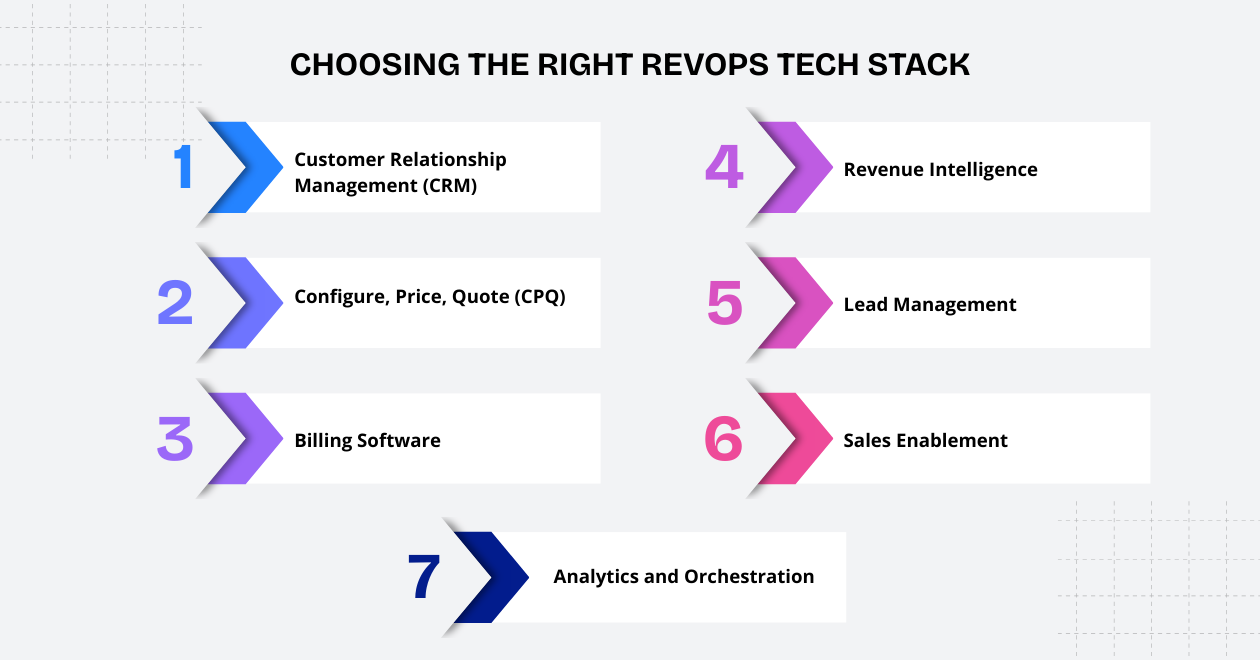
- Customer Relationship Management (CRM): Organizes all customer information in one place that is used by all go-to-market tasks; includes managing contacts, keeping track of leads, automating marketing and sales, and keeping an eye on performance.
- Configure, Price, Quote (CPQ): Quotes, invoices, and orders with complicated B2B pricing can be automatically generated. It also connects to CRM so that full purchase information can be looked at.
- Billing Software: This is to ensure a smooth transition between CPQ-billing and different kinds of price models, and provides detailed reporting, avoiding any revenue leakage.
- Revenue Intelligence: Analyzes various kinds of data (CRM, CPQ, billing, and countless others) to foresee a rise in revenue and opportunities to increase it to the maximum.
- Lead Management: This is an endeavor to capture, score, route, and schedule the lead as much as possible to enhance the conversion rates and lower attrition.
- Sales Enablement: Offers sales reps products such as email tracking, email templates, and automated workflow to help close deals.
- Analytics and Orchestration: Gathers the data centrally and makes processes more automated across platforms to reduce errors and lost revenues.
From Fragmented CRM to Revenue Engine: How Arthur Online Scaled with RevQore
Business Overview:
Arthur Online is a fast-developing company that provides property managers, landlords, and tenants with a set of tools used to manage various properties. As the business grew, problems with data control, marketing attribution, and customer success slowed it down. This is why the company worked with RevQore to make its business processes and technology systems better.
Problem:
The CRM, which was in use by Arthur Online, was a patchy system that was not scalable, and this caused inefficiencies in its operations. Among the problems were exact duplicate records, a lack of data hygiene, a lack of marketing information, a long sales quote process, and an inability to onboard customers since there was no specific success platform.
Solution:
RevQore has moved Arthur Online to Salesforce to purify and clean data to have a trusted CRM. Business connection with the back office systems formed a common source of data. HubSpot was used to improve the marketing attribution, and Salesloft and Chilipiper were used to make the scheduling and messaging automatic. Planhat was also added to improve client onboarding and monitor client health.
Results:
The efforts have brought about clean and reliable data, increased operational efficiency, greater marketing influence, and the sales strategy that is data-driven. Customer onboarding was made easier. It minimized churn and outlined upsell opportunities. Eventually resulted in a smooth experience for customers and prospects.
Scaling Revenue Operations Across Teams
Forming Cross-Functional RevOps Pods
Companies that do well will have started using a single RevOps group by 2026. This group will include finance, sales, marketing, customer success measures, and more. At the departmental level, this change will make it easier for people to work together, improve the accuracy of data collection, and make matching tactics better. To make sure teams work together, the best companies use revenue stand-ups, shared dashboards, and cross-functional rewards.
Continuous Enablement & Training
Introducing RevOps will require changes in the culture of companies, which consultants will facilitate with the help of training courses, workshops, and constant support. Companies building RevOps in-house must be more oriented towards long-term education and retention, while those using ROaaS can acquire continuous expertise at lower overhead.
Future of Revenue Operations
Many companies are switching to digital-first strategies, which means that Revenue Operations will no longer be a choice but a strategic necessity. RevOps will also grow with the help of new technologies like AI, machine learning, predictive analytics, and more. These technologies will automate all the tasks that need to be done over and over again and help businesses better understand how buyers act.
Companies investing in RevOps now are not only going to accelerate revenue growth but also create a competitive advantage that differentiates them in the market.
Revenue Operations provides the roadmap to the future growth of revenue generation to serve as the key to sustainable revenue. Organizations will be able to develop predictable streams of revenue and provide outstanding customer experiences by coalescing people, processes, technology, and data.
Conclusion — Revenue Operations
Revenue blueprints help people, technologies, and data work together to build strong pipelines and make money. Adopting Revenue operations in 2026 is linked to speed, accuracy, and size, all of which are important for B2B success. Start process mapping to grow in a way that changes everything. Leaders who put it first keep seeing income growth. Leaders who don’t care about it let silos stay in place.

Author: IDBS Global
Turning Data into Demand, Fueling B2B Growth with Precision and Purpose.