
High-Value SQLs: Strategy for Winning Complex B2B Deals
Follow us

Sales Qualified Leads (SQLs) power the B2B sales tools we have now. These high-quality prospects clearly want to buy and fit your ideal customer image. They are also ready to be sold directly to, which makes complicated deals easier to close and turns them into steady streams of income. In a business-to-business (B2B) setting with long cycles and many stakeholders, learning SQLs means putting in more effort to make sure efforts have an impact, boost efficiency, and increase the rate of closing. This guide breaks down the methods used to find Sales Qualified Leads, qualify them, and turn them into wins.
Why Sales Qualified Leads Are the Lifeblood of Modern B2B Growth
Sales Qualified Leads are like the lifeblood of modern B2B growth. They help bridge the gap between marketing interest and income, making sure that sales teams only work with people who are most likely to buy the product. SQLs offer the validation required by B2B buyers to complete the deal cycles in a competitive environment where they develop 67% of the research on their own.
The Anatomy of a True Sales Qualified Leads
Behavioral and Intent Signals That Tell You Everything
The process of lead scoring turns lead qualification into a data-based process because it ranks leads according to how well they match your Ideal Customer Profile (ICP). It increases the ROI of lead generation and increases the qualification efficiency. Key signals include:
- Behavioral behaviors (e.g., demo requests)
- Demographic (e.g., size of the companies)
- Forecasting analytics using past data.
Setting scoring cutoffs will help businesses to make priorities on follow-ups, personal communications, or automated nurturing, so that they focus on the opportunities that are the most promising to convert.
Firmographic Fit: The ICP Checkpoint
The ICP Checkpoint provides strong points of the importance of firmographic segmentation in the B2B marketing that includes the industry, company size, revenue, and location. With the use of behavioral data and technographic information, organizations are able to optimize their targeting. You can use advanced segmentation to find the most valuable leads and create personalized marketing messages that will meet their specific needs. This will help you get the most out of your resources and increase conversions.
SQL Criteria That Actually Predict Conversion
Behavioral intent and ICP fit. High-conversion SQL criteria use is based on behavioral intent and ICP fit, though not a strict-conversion demographic. The most important predictors are multi-stakeholder engagement, consumption of specific contents (e.g., pricing page views), active involvement in discovery, and high intent sources, such as organic search.
From MQL to SQL: The Qualification Journey
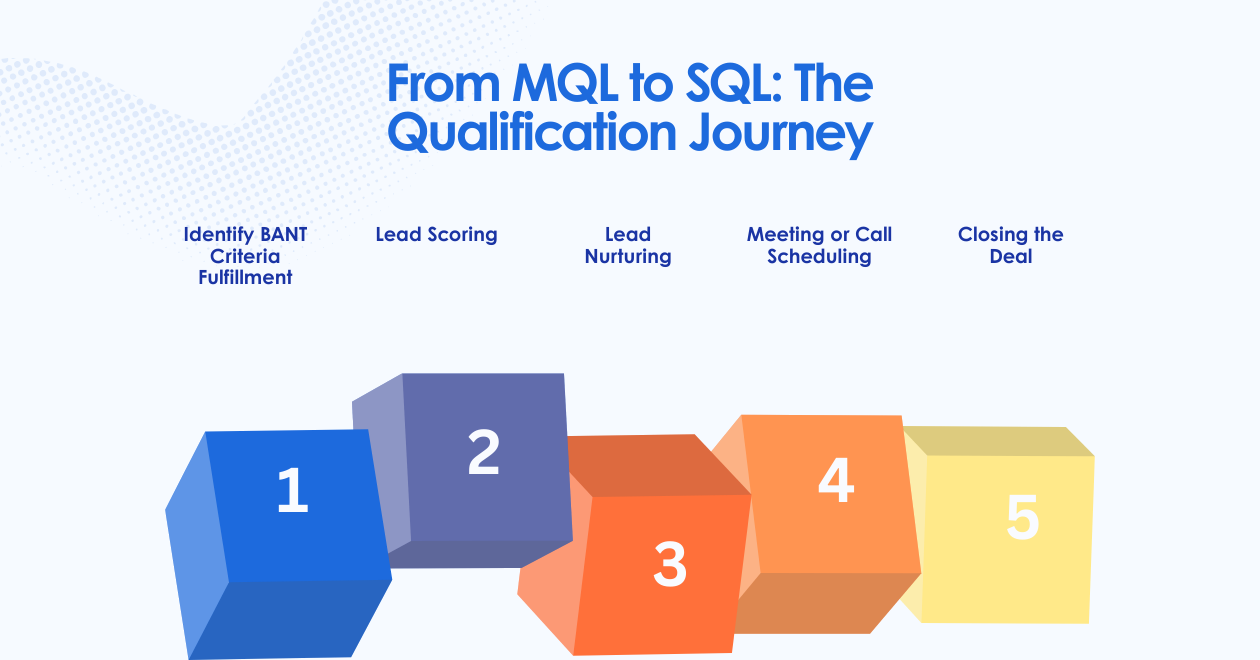
1. Identify BANT Criteria Fulfillment: Evaluate whether the lead satisfies the Budget, Authority, Need, and Timeline (BANT) criteria in order to be qualified as a strong candidate.
2. Lead Scoring: Grade MQLs by attaching numbers to attributes such as industry, company size, and level of engagement, and determine the ones that are most likely to become customers.
3. Lead Nurturing: Use personalized campaigns, webinars, and content marketing to gain trust and credibility with MQLs.
4. Meeting or Call Scheduling: Schedule the meeting in cases where the MQL is highly interested, and it is possible to learn more about their needs and problems.
5. Closing the Deal: Nobody should argue; only finalize the conversion by negotiating the terms and moving the lead through the purchasing process.
Through these measures, the sales teams would be able to convert MQLs into SQLs to improve the conversion rates and make the sales increase.
What Happens Before Sales Ever Picks Up the Phone
Examples Leads begin at the point of origin: organic search, paid ads, webinars, or selecting some content to download, creating a trail of the behavior, such as page views, email openings, and requests to have a demo. They are graded against thresholds like MQLs to engage and SQLs when intent signals reach prescribed marks like a series of high value interactions.
Sales and marketing criteria need to be co-defined to establish the SQL criteria to be on the same page about fit, including demographics, buying signs, budget readiness to eliminate handoff tension and increase close rates.
Discovery Conversations That Reveal Buying Readiness
Questions to ask during Early calls probe include:
- What Objectives Underlie this initiative?
- Are there difficulties in the way?
- Who’s involved in decisions?
- When do you aim to implement Account Based Marketing?
Real need gets proven by discovery, such as measurement of ROI gaps or stakeholder buy-in, a transition of curiosity into commitment.
The Golden Handoff: SAL as Transition from Interest to Intent
A Service Level Agreement (SLA) is required to provide an effective transition from MQL to Sales Accepted Leads (SAL). Such an SLA must include six essentials:
- Shared Definitions: MQL, SAL, and SQL must be clearly defined to avoid confusion between marketing and sales representatives.
- Handoff Process: Have an organized lead-to-lead transfer process that specifies what is being transferred, when, and by which system, to avoid an informal process for conveying such a message.
- Responsibilities: Determine the tasks for both teams; marketing to provide more enriched data, and sales to commit to responding.
- Feedback loop: Acquire sales feedback on the quality of leads. Furthermore, receive feedback weekly. Not quarterly.
- Shared goals: The pipeline and revenue targets are shared by both teams, not only their stage-specific target.
Tried-and-Tested Lead Qualification Frameworks for SQLs (with Practical Examples)
| Framework | Best For | Breaks When |
| BANT | Transactional SMB (Small-Medium Businesses) | Multi-stakeholder enterprise |
| MEDDIC | Enterprise, long cycles | No internal champion exists |
| MEDDPICC | Complex enterprise with procurement | Overkill for SMB (Small-Medium Businesses) |
| CHAMP | Consultative sales | Buyer can’t articulate challenges |
BANT — Time-Tested but Still Worth Using When Correctly Interpreted
The BANT framework: Budget, Authority, Need, Timeline, is also a useful tool when used to measure leads.
- Budget: To find out if a prospect has the money to spend in your business, you should look at their financial situation. Businesses that use budget as an important part of their SQL criteria have high conversion rates.
- Authority: This is necessary to identify whether the prospect is a decision-maker or an influencer in the purchasing process.
- Need: Not only is it important that a qualified lead recognize his or her need, but it is important that he or she realizes how your solution will specifically solve his or her problems.
- Time: It is important to put a reasonable time frame on the purchase and create urgency by showing that the prospect is ready to act.
MEDDICC — Built for Complex Enterprise Sales
The MEDDPICC model adds the paper process to the well-known MEDDIC model. This lets the sales teams know about the customer’s legal and purchasing actions. This will let the sales reps negotiate in the complicated process of making a sale, whether it’s dealing with legal reviews or keeping an eye on problems during the buying process.
The competition part also lets salespeople know about other companies that are in the same market, which helps them properly place their own products and services.
By putting these things together, MEDDPICC provides a many-level method for handling the complicated nature of sales in business lead creation, which ultimately results in success.
CHAMP and SPICED — Qualifying With Human Insights
Challenges, Authority, Money, and Prioritization (CHAMP)
CHAMP is a sales technique to enable sales representatives to successfully filter the leads that are really ready to buy the product. The perspective focuses on the buyer and focuses on understanding the issues faced by the prospect, his/her decision-making powers, as well as their budget and the urgency of his/her needs.
Situation, Pain, Impact, Critical Event and Decision (SPICED)
SPICED is a lead qualification model that puts emphasis on human considerations based on the current situation of the prospect as opposed to budget and authority only. It concerns the deficiencies of the conventional approaches, such as BANT, as they produce natural discussions that create rapport. Every aspect naturally serves as the next. As a result, it is ideal for founders who need to protect their values while also retaining the power to influence the purchase decision-making process and pass through the qualification paradigm.
Operationalizing SQLs in Your B2B Sales Funnel
Aligning Marketing, SDR, and Sales for Seamless Qualification
It is important to align the marketing, SDR, and sales teams in order to optimize sales strategies and enhance lead qualification process. When such teams work together, they simplify the flow of data, narrow down on lead targeting, and reduce the sales cycles. The marketing insights obtained can enable the salespeople to target high quality leads, increase the conversion rate, and maximize resources. The major alignment points of concern would be to create a mutual ideal customer profile (ICP). Also, other points are establishing shared objectives, co-creating a buyer-focused strategy, and developing relevant content that resonates with the target audience.
Automation and Workflow Strategies That Empower Sellers
The adoption of technology in B2B sales helps increase productivity and efficiency in the activities of sales and marketing teams. Key technologies include:
- Automation of marketing is used in campaign management.
- Customer Relationship Management (CRM) systems provide access to lead information.
- Sales Intelligence tools, amid AI, to detect leads with interest.
Moreover, marketing activities can be accelerated through AI tools that are capable of creating content ideas, making predictions, projecting sales, pipelines, and interacting with leads. All in all, the use of these technologies can greatly enhance the level of B2B prospecting strategies, sales, and coordinate the team activities.
Feedback Loops That Continuously Improve Qualification
Constant feedback loops that involve ever-refining qualification are associated with integrating different viewpoints between sales, marketing, and enablement. Through AI agents, the teams are able to provide analysis of the interactions along the B2B sales funnel and detect trends and information that could be missed otherwise. The combination of human and machine learning optimizes the lead management, reveals the hidden mights related to the buyers, and addresses the persona fit gaps, which ultimately uses less time and makes it more efficient.
How to Keep SQLs Engaged Before They Buy
B2B Nurturing That Respects Intent
Setting clear lead nurturing objectives is key to successful B2B interactions. The most practical way to start the process of formulating realistic purposes is to first obtain related industry information, including email performance rates. The study will inform your way of planning so that you can customize your nurturing activities according to the needs and actions of your audience. You can nurture your leads better by acknowledging the purpose of your leads and using data-driven insights.
Tailored Outreach That Converts Decision-Makers
Good outreach will also be required to keep in touch with potential clients. Use varying channels like phone messages, texts, emails, face-to-face programs, and the Internet via LinkedIn. Every client is different and should be approached accordingly, and what speaks to one client will not arouse the interest of another decision-maker. With a personalized outreach strategy, you will be able to build better relationships and, through this, raise the chances of.
Timing Matters — When to Push, When to Educate
Making a sale is important, but it is important not to disobey the busy schedule of your prospect. They should not visit the house or call without notice because this could be upsetting. Get used to keeping appointments on the phone and meetings. Do not forget to take follow-ups from them. But still be so amenable to be able to change whenever you need to meet your prospect. There should be no compromise in either persistence or consideration of their time, but more successful interactions can be achieved.
Measuring Your SQL Engine — KPIs That Tell the Real Story
Conversion Rates: MQL → SAL → SQL → Opportunity
Not all leads are equal. To check quality control, consider the Marketing Qualified Leads (MQLs) to SQLs and the Conversion Rate. It is a ratio of the number of MQLs that are accepted as legitimate opportunities by the sales team.
The math is straightforward:
MQL/SQL Rate = (Number of SQLs/ Number of MQLs) x 100
This is among the most crucial lead gen KPI to balance sales and marketing. A small figure normally indicates that the teams possess varying meanings of a good lead.
Best Practice: To correct this, call together the two separate teams to create a clear and common definition of a qualified lead and reduce it to a formal Service Level Agreement (SLA).
Velocity Metrics: Speeding Up Quality Decisions
Effective B2B lead generation KPIs play the role of giving a strategic direction for decision-making in marketing and sales. Organizations can become more effective by emphasizing those metrics that are based on outcomes and not on hard work. Consider the following when asking queries:
- The expenses of purchasing qualified leads.
- Those leads can be converted into sales meetings, and the revenue made on particular campaigns.
The KPI system must not just examine the past but also provide some insight into the future revenue, as a forecasting tool and not a representation of the past. Such a change of attitude is the key to the maximization of lead-generating strategies.
Revenue Impact and Predictability
Financial return needs to be measured. The main parameters used in this last step are:
- Pipeline Value Generated: It measures the dollar value of all SQLs that might be generated by your outbound activities. It is an effective predictor of future earnings.
- Customer Acquisition Cost (CAC): The ultimate profitability test sentiment. It provides the question of utmost importance: is your outbound engine making money?
- Sales Cycle Length: This is the duration of time taken to turn a lead into a decision that closes a deal. The long sales cycle can be an indication of a long or difficult time in the process of closing.
SQL Mistakes That Still Kill Deals After Qualification
- Unqualified leads are a waste of time and resources. It diminishes the sales capacity and augments acquisition expenses.
- Instead, salespeople pursue a lead that does not have a high likelihood of coming to pass as a sale. This distracts attention from the high-potential accounts and reduces the quality of the pipeline.
- Until you qualify leads within a short time, the sales process is going to be more lengthy and have a poor conversion rate. Thus, the leads that are not prepared will delay the process.
- When you do not prioritize in the right way, then you are simply wasting opportunities. This method will result in the targeting of less valuable leads.
- It is of high priority to make sure the best leads are given first priority, and the SQL to Opportunity Rate will be maintained.
Case Study: How LinkedIn used their Account Prioritizer to Maximize ROI
As a leader in the professional networking and B2B platforms, LinkedIn provides several solutions, such as marketing solutions and talent acquisition. Given its growth pace, the company was confronted with the problem of how it could effectively focus on thousands of potential accounts to maximize sales.
Challenge
At LinkedIn, salespeople did not have an effective way of prioritizing accounts; they relied on intuition and piecemeal data, and this resulted in inefficiencies. They wasted much time in the analysis rather than working on the clients and failed to reach opportunities and provide uniform contacts to the high-potential accounts.
Solution
As a solution to this, LinkedIn developed an in-house AI, the Account Prioritizer, that uses machine learning to measure past data, account activity, and future ROI. This automation enabled sales departments to work on high-impact accounts with ease. It had a distinctive characteristic of having an explainable AI with clear reasons why accounts were given priority, and this contributed to trust and acceptance amongst its sales personnel.
Results
Account Prioritizer proved to be a great way to achieve higher results, as an A/B test with a 8.08% increment in the number of renewal bookings increased revenue. Sales reps would be able to put more attention on priority accounts. Thereby increasing the productivity and the sales performance.
Conclusion: SQLs Are Not Just a Label, They Are a Strategy
The art of Sales Qualified Leads is not a trick, but it is the main generator of predictable B2B revenue in a long-cycle, smart-buyer world. By synchronizing teams in terms of ICP fit, integrating solutions such as BANT and MEDDPICC, workflow automation, and KPI monitoring, such as MQL-to-SQL turnover, you turn a turbulent flow into a high-speed funnel. The Account Prioritizer of LinkedIn tells us that: ROI of prioritization increased by 8% by AI. Always prefer quality to quantity, cultivate will with accuracy, and observe unbelievable leads develop into bona fide deals. These are some of the strategies that can be implemented today, and your pipeline will be grateful.

Author: IDBS Global
Turning Data into Demand, Fueling B2B Growth with Precision and Purpose.