
Self-Healing Databases for Seamless B2B Customer Data Management
Follow us

In the modern-day business world that is largely B2B, the prioritization of customer data strategy enables the achievement of revenue and customer satisfaction. Self-healing databases are a disruptive technology in the world of managing B2B customer data management. They automate solutions to bugs and data decay to ensure that the information is timely and usable.
Why B2B Customer Data Management Is the Foundation of Growth, Not Just Storage
The management of customer data is fundamental to growth as it is possible to approach customers individually and target B2B customers effectively. Quality data will allow marketing more accurately segmenting prospects, reducing sales cycles, and increasing conversion rates with quality information on customized approaches. Since organizations may collect data through a plethora of data collection methods, such as IoT, applications, and CRM, scalable storage and processing capacity will become essential. The platforms should be able to facilitate real-time expansion, as well as long-term storage to comfortably handle and use this growing volume of data.
The Evolution of B2B Customer Data Management in 2026
From Manual Spreadsheets to Automated Data Integration Platforms
B2B customer data management had begun with cumbersome spreadsheets that were likely to create errors and different versions. Automated services such as cloud CRM and data lakes will replace this by 2026 and ingest data in real-time, including emails, events, and web interactions.
B2B data platforms utilized APIs to scrape from a variety of disparate sources, and formats were automatically standardized. The transition does away with manual input. Thus, it reduces mistakes and allows the management of B2B and B2C customers in teams that can scale internationally.
The rise of unified customer profiles across teams
Unified profiles combine sales, marketing, and support data into individual 360-degree displays. This standard will be made by graph databases and identity resolution technology in 2026, where every group will have the same up-to-date information.
This development helps in handling data of B2B customers at the enterprise level, where profiles are updated dynamically based on intent signaling and firmographics. Management Teams work more effectively and identify opportunities more quickly without being slowed down by data silos.
What “Self-Healing” Really Means in B2B Customer Data Management
Automated data cleansing and validation workflows
These workflows scan entries at ingestion, marking invalid emails or phone numbers through APIs. They normalize structures, such as standardizing the New York abbreviation, but rather than putting in the New York state, they put in New York so that there are no errors in the data management of customer B2B.
Continuous data enrichment services for accuracy
Enrichment drags firmographics (company size, revenue) and technographics externally, actively putting brackets in blank cells. This makes the B2B customer data management a lively one, with match rates on the target campaign.
AI-driven duplicate detection and record merging
AI applies fuzzy matching and ML to identify duplicates during variations (e.g., John Doe vs. J. Doe). It is an intelligent convergence of history in the process of simplifying this management.
Smart decay monitoring and contact refresh cycles
The decay of contacts continues every year; self-healing systems track bounces and renew through verification services every 3 months. This maintains its hygiene, which keeps outreach effective.
Architecting Self-Healing Data Infrastructure for Seamless B2B Customer Management
1. Unified Customer Data Across Silos
Many businesses still have data in silos. The modern solutions need to incorporate data from different systems. This consists of cloud applications, internal applications, and third-party feeds, thus making them discoverable, ready to be used, and up to date.
It only takes time to get a customer record centralized or a product SKU, and you would have made all the difference in the day-to-day decisions.
2. Continuous Data Cleansing and Validation
A clean data implies an increase in errors and decisions made more informed. New data quality management functions and applications should provide de-duplication, normalization and cross-platform validation capabilities. These aren’t “nice-to-haves”. They’re critical.
3. Real-Time Data Updates and Activation
With the combination of cloud and on-premise systems, businesses are able to have a single overview of their operations. The process of the real-time syncing means that the latest and most accurate data should be used to make a decision. This makes instant personalization easy when used in B2B customer data management. For example, demos can be changed based on recent funding acquisitions.
4. Automated Enrichment and Intelligence
During the creation of your database, pay attention to the aspect of data enrichment of all records, such as job titles and company details, with the assistance of such services as Clearbit or Lusha. This makes segmentation and targeting better and lets you filter specifics. For example, you can filter out CTOs of fintech companies with more than 500 workers. Take advantage of CRM to automatically enrich, and use tags and custom fields to organize your database in a way that takes segmentation into account. Also, make a difference between high-priority accounts and cold prospects to make reaching out to them easier. Use intent and technographic data to target more accurately.
5. Improved Data Governance and Compliance
Customer data management goes hand in hand with data governance framework, which ensures that there are guidelines on the collection and handling of the data. A powerful plan encompasses coherence to each consistency, certification to each validity and policing to each correct usage. The end result is the completed tracking plan or data dictionary, which lists the types of data, who is responsible for collecting them, how they will be used, and who is responsible for what. This way, every employee knows how the company handles data.
6. Predictive and Proactive Insights
It is believed that AI-based cloud data integration will be a revolution in B2B operations, with all data mapping and real-time anomaly detection being automated. It will be possible to tell when integration will fail with predictive algorithms, and it will be easier to normalize data and match fields with the help of adaptive powers. This kind of proactive approach raises the accuracy rate, speeds up processing, and lowers operational risks. This gives forward-thinking companies an edge when it comes to handling large amounts of data quickly.
7. Operational Efficiency for Sales and Marketing
Sales and marketing of products is an activity that requires an investment in employee training to reduce the number of costly mistakes and streamline data management. An experienced team understands the needs of customers, converting company policies into working practices. It is very important for businesses that have BYOD policies, and they need to have explicit guidelines on how to keep sensitive information safe. Through simplicity of policies and laying a lot of emphasis on training, organizations would be able to strengthen data security, optimize operations, and encourage sustainable growth.
Data Quality Tools That Prevent Pipeline Leakage
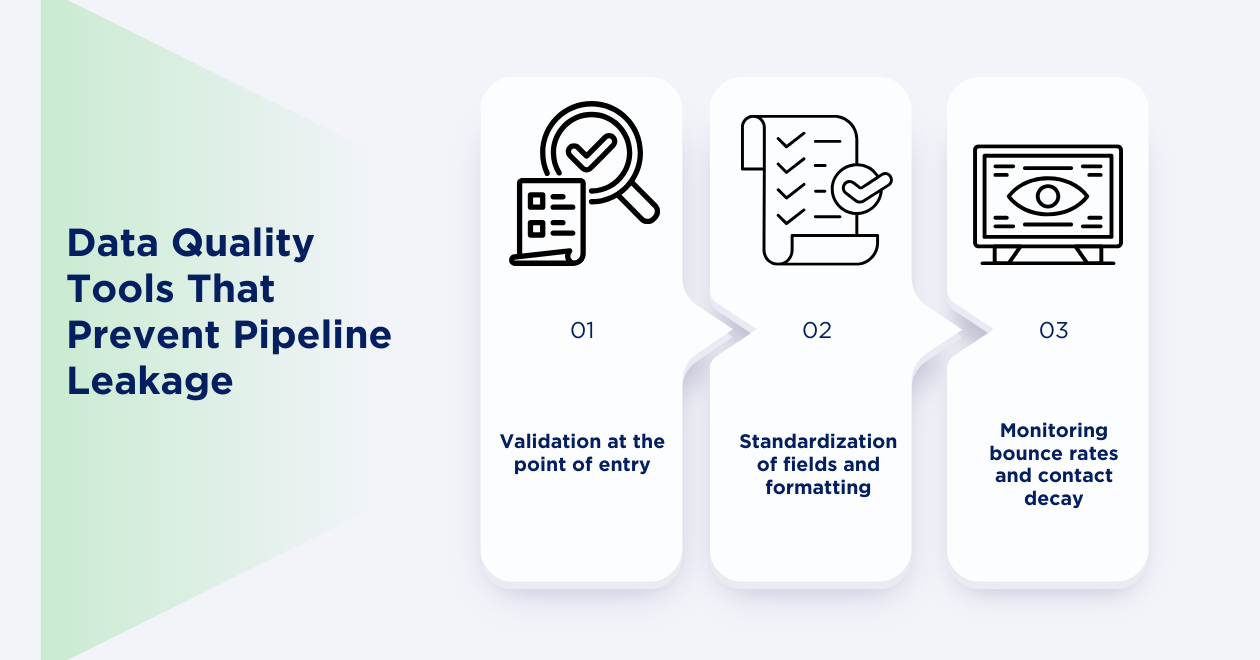
1. Validation at the point of entry
Cross-check data through the pipeline to identify problems that may not be detected by single-stage monitoring. Submission of data at entry point, transformations, and source-to-destination to ensure that there is no loss or corruption.
2. Standardization of fields and formatting
Similar fields (e.g., all dates in YYYY-MM-DD form) can be easily queried across multiple customer data management systems in B2B.
3. Monitoring bounce rates and contact decay
Visualization tools can be improved to monitor both bounce rates and decay of contacts, as they will turn complex data into useful recommendations. Powerful dashboards will allow real-time status views, historical trend analysis, definition of bespoke metrics, and different access controls by roles so that technical as well as business teams will be able to understand the health of pipelines and make informed decisions.
Turning Customer Data Into Actionable Insights
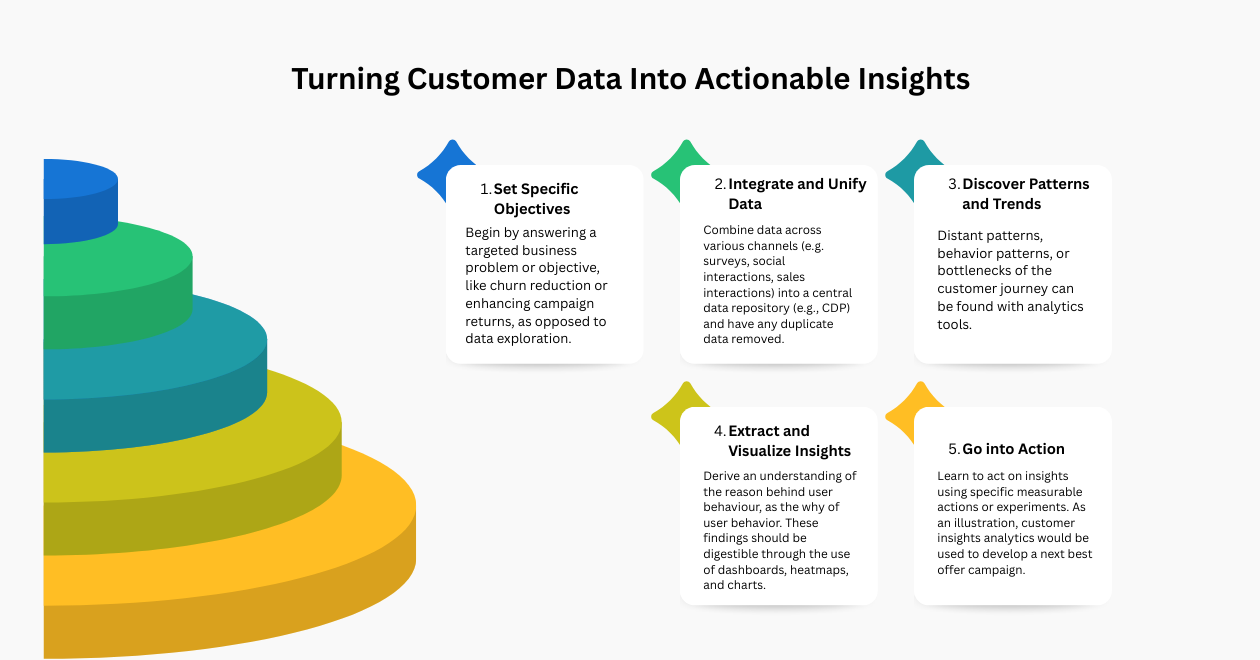
- Set Specific Objectives: Begin by answering a targeted business problem or objective, like churn reduction or enhancing campaign returns, as opposed to data exploration.
- Integrate and Unify Data: Combine data across various channels (e.g. surveys, social interactions, sales interactions) into a central data repository (e.g., CDP) and have any duplicate data removed.
- Discover Patterns and Trends: Distant patterns, behavior patterns, or bottlenecks of the customer journey can be found with analytics tools.
- Extract and Visualize Insights: Derive an understanding of the reason behind user behaviour, as the why of user behavior. These findings should be digestible through the use of dashboards, heatmaps, and charts.
- Go into Action: Learn to act on insights using specific measurable actions or experiments. As an illustration, customer insights analytics would be used to develop a next best offer campaign.
Common Mistakes That Undermine B2B Customer Data Management
Mistake 1: Selecting an Ineffective CRM System.
Choosing a CRM when it is not suitable for your business will hamper effectiveness.
Avoid It
Figure out what you need and consider solutions such as Pipedrive because the simplicity or HubSpot because of its built-in functions. Demo or test various solutions.
Mistake 2: Inadequate User Training.
An effective CRM can do nothing without proper training of the users.
Avoid It
Provide full onboarding and frequent training drills. Appoint your own CRM champions, and even contract external specialists to do specific training.
Mistake 3: Poor Data Quality
Inappropriate timing of opportunities might come up as a result of inaccurate data.
Avoid It
Implement strict data integrity requirements, perform frequent audits, and provide data validation with automation requirements.
Mistake 4: Overlooking the Customization Capabilities.
Standardized configurations can be incompatible with workflows.
Avoid It
Automate your CRM to your sales process and keep them updated periodically with your business changes.
Mistake 5: Lack of Integration
Isolated systems decrease productivity.
Avoid It
Combine your CRM with the already existing apps, such as email and accounting packages, to facilitate operations.
Mistake 6: The failure to monitor important metrics.
Effectiveness can not be measured without analytics.
Avoid It
Measuring and tracking key measurements, as well as looking at reports regularly to make decisions.
Case Study: Toyota Motor implemented a groundbreaking self-healing data pipeline solution
Problem
Toyota Motor Corporation had a major issue in the quality of data that was involved in their global manufacturing network, which affected their objective, which is zero defects, zero waste, and zero delays. New technological aspects of modern vehicles, as a result of thousands of parts and suppliers (more than 10,000), mean that old concepts of quality control were insufficient.
Solution
Toyota introduced a self-healing data pipeline in 2021, as part and parcel of the digital transformation initiative. This artificially intelligent system was implemented with the application of high-level machine learning algorithms and the TNGA data platform, combined with Apache Spark and PyTorch, to track real-time quality, coordinate supplier data, and verify predictive maintenance data. The process itself was automated, and the production parameters were being altered by the system to meet quality standards.
Result
This rollout resulted in a 42% reduction in the rate of manufacturing defects and a higher supplier data accuracy (94 to 99.2). The delay caused by data problems dropped during production by 28%, and the general equipment performance increased by 15%. In terms of finances, Toyota saved Y=12 billion worth of money annually in terms of finances and chewed up development of new models at a ratio of 20%, and this contributed positively to their competitive advantage.
Final Thoughts: From Data Chaos to Revenue Clarity
By 2026, self-healing databases will convert B2B customer data management into a revenue driver. Improving personalized strategies by automating cleansing, enrichment, and real-time updates eliminates silos, reduces errors, fortifies personalized plans, and optimizes sales cycles, as well as enhancing conversions. The stakes are proven by Toyota reducing its defects by 42 percent: clean data leads to efficiency and a competitive advantage. Data decay will not build your future and will only hurt your growth: invest in self-healing infrastructure today. Motivate integrated profiles, AI insight, and governance to transform customer information into intelligence that provides scalable success in the data-driven B2B environment.

Author: IDBS Global
Turning Data into Demand, Fueling B2B Growth with Precision and Purpose.