

Website Visitor Resolution: Understanding Account, Persona, and Contact-Level Identification
Follow us

Website traffic is capable of offering more than page views, referral origins, and session counts. It can give insight right into the company, employees, and buying teams that are evaluating the product/solution for the webpage and past. And yet, most site visitors that work in B2B websites leave those websites without finishing a form, scheduling a demo or providing details concerning what team. That hole can hinder the difference between Web traffic and sales intelligence.
Website Visitor Resolution fills up that gap by giving you the capacity to associate unnamed visitor actions with an account. These are one of your likely personas, or where appropriately permitted. Individual contact identification provides your marketing and sales groups with a far better understanding of who is considering a purchase. It also onsiders what they might be discovering online. But, identifying is only half of the journey. Marketers need to incorporate site behavior, account-firmness, visitor intent data, and also sound judgment with your visitor’s identification. The privacy as well as the ethical use of cookies, IP addresses, and even personal data ought to be carefully complied with as needed by your business.
What Is Website Visitor Resolution and Why Does Anonymous Traffic Matter?
Site Visitor Resolution allows you to identify who your website visitors are (before they log in to their accounts). It verifies the link between your 1st-party identifier and your hashed email address, and website visitor tracking. Lastly, it reconciles online and offline identifiers to have a single view of your audiences.
Anonymous website visitors are not un-engaged visitors. Often the highest value buyers spend days and weeks browsing in the background before they are ready to speak with sales. If you let them remain anonymous to you, you’re forfeiting the bulk of your in-market demand.
Typically, only 2-3% of B2B website traffic is captured in the pipeline through forms. While 97% either self-identify later (slow and expensive), or not at all (lost).
Bringing a few anonymous visitors through can create 3-10 marketing-sourced pipeline.
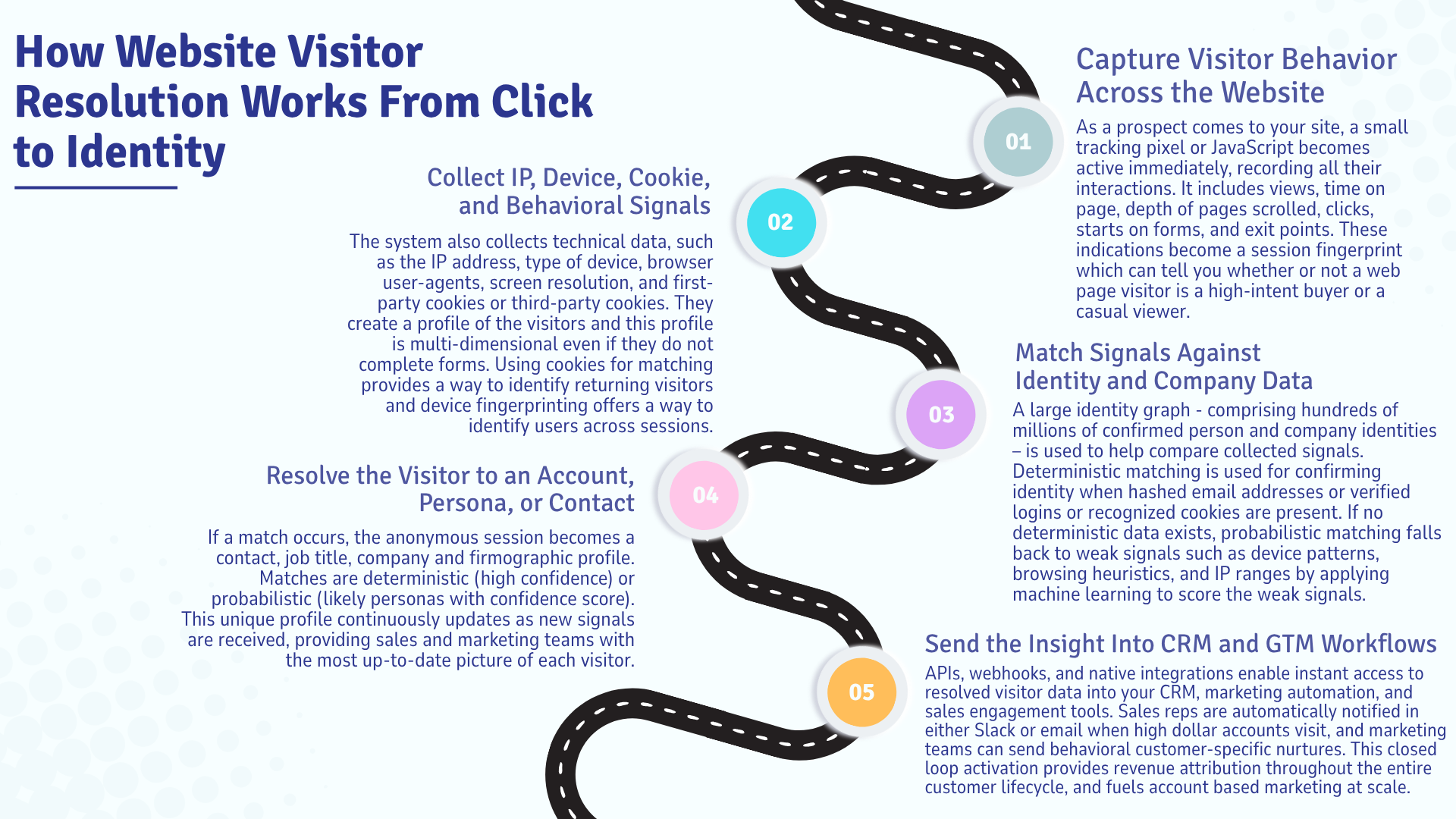
How Website Visitor Resolution Works From Click to Identity
The 3 Levels of Website Visitor Identification
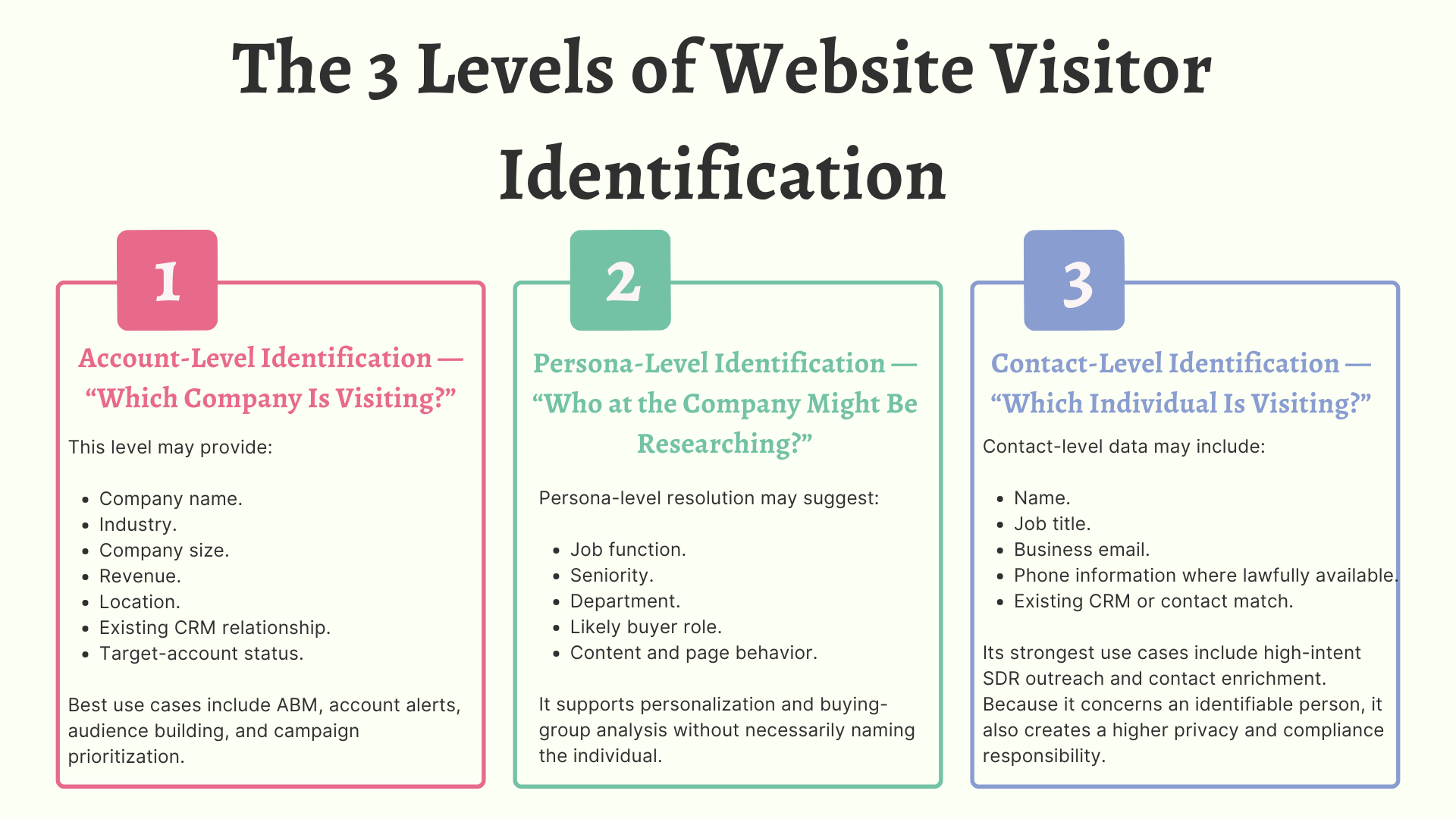
Account-Level Resolution: Turning Website Traffic Into Target Accounts
How IP and Company Matching Reveal Visiting Organizations
Visitor identification tools rely on a reverse IP lookup to match anonymous website sessions with company info in B2B databases. This resolution, at the account level, shows an organization that has been browing your site, which pages they’ve seen, and how often they’ve come back – without being able to track individuals.
Which Firmographic Signals Make an Identified Account Valuable?
Not all visiting companies are the same. Firmographic matches for high value accounts are Ideal Customer Profile (ICP) attributes such as employee size, industry vertical, annual revenue, geography, technology stack, etc. These signals assist you with differentiating enterprise traffic from random traffic from other segments of your core market.
Using Account Identification to Activate ABM Campaigns
Once you’ve been able to define the optimal accounts that are visiting your website, add intent information to create targeted ABM plays. Match identified visitors with your name lists; then create individualized ads, email sequences, or sales outreach depending on page views and engagement.
Why One Company Visit Isn’t Enough to Trigger Sales Outreach
The first visit is an indication of curiosity, not purchasing. Engage sales for a repeat visit or high intent pages (pricing or demos) or page visits because of some firmographic fit. This helps to avoid reaching out prematurely and enables the targeting of resources for those accounts that are seen to be interested for the long term.
Combining Account Visits With ICP Fit and Intent Data
The best pipeline indicators include the combination of firmographic match, account visits and intent data. Accounts that are similar to your ICP, that come back more than once and engage in bottom-funnel content is ready to convert. They are predictable revenue from your anonymous traffic source.
Persona-Level Resolution: Understanding Who Is Behind the Account
Why Knowing the Company Isn’t Enough for B2B Sales
When it comes to B2B, it’s not enough to just target the accounts—grow the revenue. Each purchase has a number of stakeholders who have their own priorities. In-person identity resolution tracks who’s really engaging. Thereby eliminating wasted ad spend on existing customers or opted-out users. After which it provides accurate exclusions cross-channel or across device.
Using Job Function and Seniority to Understand Visitor Intent
Job titles and seniority are better indicators of buying intent and less susceptible to manipulate than company details. A VP of Marketing thinks about solutions in a different way than a Marketing Manager. Identity resolution links user behavior with the specific role so marketers can focus on high-intent visitors and target their outreach.
Connecting Page Behavior With Likely Buyer Roles
Each persona is interested in different content. Case studies are read by the technical evaluators, executives look at the integration docs. Assigning persona profiles to pages helps give a sense of where each stakeholder is in their journey to enable timely & relevant follow-up to advance deals.
Mapping Multiple Personas to the Same Account
B2B transactions are influenced by the buy committee made up of 5 to 16 individuals. Identity resolution enables you to distinguish situations where many personas from a single account interact, building strength for consensus. This visibility enables a consistent message be delivered across the entire buying group instead of siloed, ineffective touches.
Turning Persona Insights Into More Relevant Messaging
Sequential messaging can be accomplished if you can get the right persona information. Awareness page content works for new visitors, consideration page content for engaged page evaluators and conversion sales funnel content for people in decision mode. This storytelling strategy creates more sense of relevance, lowers level of ad fatigue and boosts accurate attributions throughout the entire buyer’s journey.
Contact-Level Resolution: When Website Activity Becomes Sales-Ready Intelligence
How Identity Graphs Connect Web Signals to Individual Contacts
Identity graphs are used to tie social media signals to business data containing professional information, such as databases, professional emails, CRM records, and more. The prospect of these matches is still likely, and validation is required.
Why High-Intent Pages Create Stronger Outreach Signals
If the user is a named contact (not anonymous) that is visiting a demo, pricing, product or implementation page, then they might require more attention than someone who is reading a single article.
Pricing, Demo, and Product Pages vs. General Blog Visits
A blog visit could be an awareness or research visit. A pricing-page visit and/or product comparison and/or a demos request always indicates further investigation but it doesn’t mean that the audience is prepared to purchase a product.
Connecting Identified Contacts to Existing CRM Records
CRM matching can also provide previous conversations, opportunities in the open, previous objections, Customer status, etc., and the representatives assigned to the person. This is to avoid duplicate or untimely outreach.
Using Contact Intelligence Without Losing the Context of the Visit
Salespeople need to identify the business issue as shown in the visit and not propose the sale of a cross-selling opportunity due to visitor tracking. At the same time, sales personnel should remember to speak about the business issue as exhibited during the visit. Also, avoid announcing any sale or a cross-sale as a result of tracking. Outreach should be useful and not uncomfortable in the context.
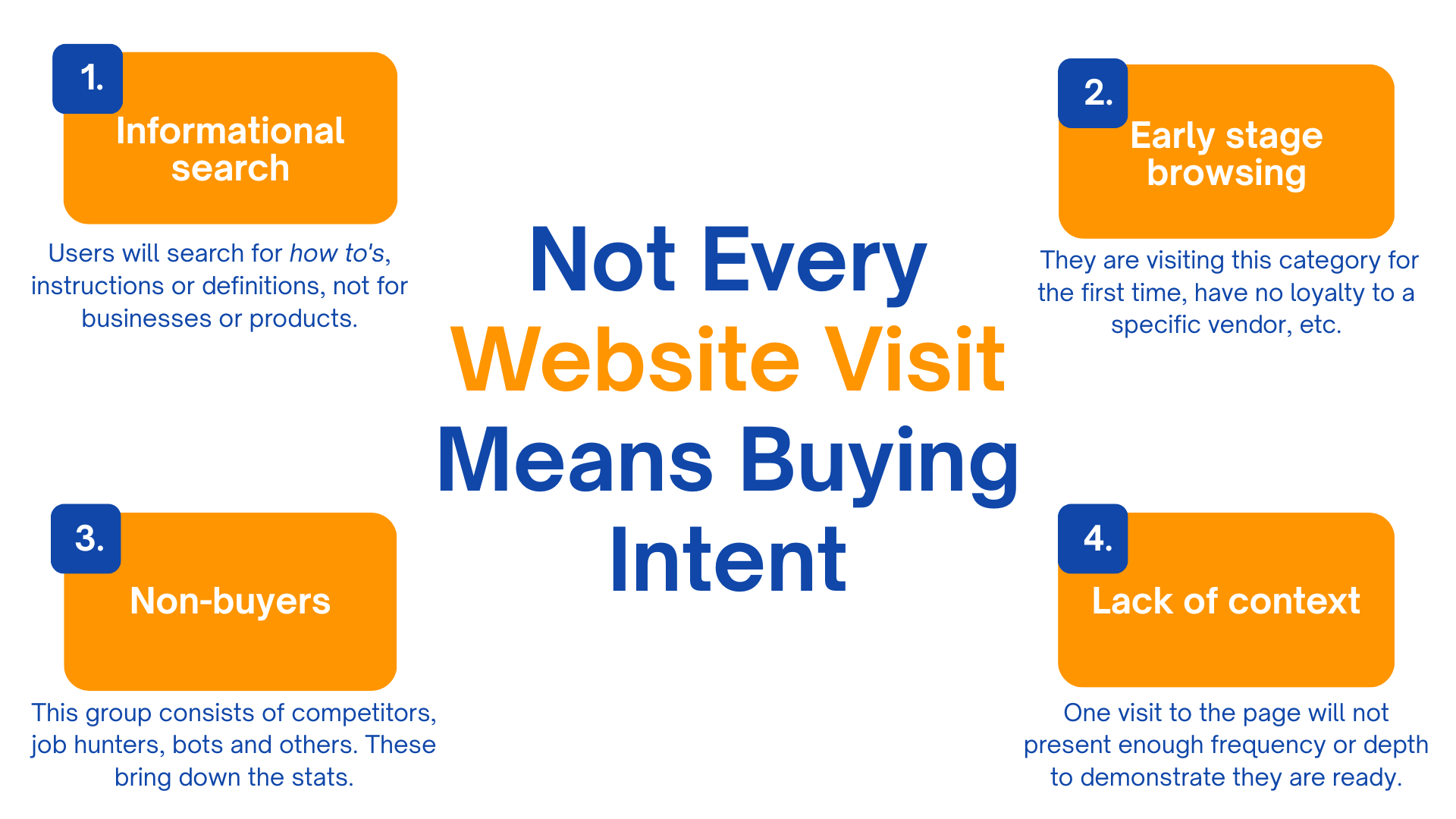
Not Every Website Visit Means Buying Intent
Website Visitor Resolution + Buyer Intent Data: The Stronger Combination
Website Visitor Resolution lets you know who is interacting with your website. Buyer intent data provides additional data to confirm if that account is actively researching a category, solution or business problem. These signals, combined, can assist teams to:
- Focus on repeat engagement and ICP fits.
- Don’t depend on one contact to bring in repeat business – find buying groups.
- Coordinate marketing, content and SDR efforts.
- Use outreach when several independent signals are there to trigger action.
- Track engagement of the right accounts.
This combination is more powerful since identity is the “who“, and intent and behaviour are the “why now’s“.
What Website Visitor Resolution Can and Cannot Tell You
| What Website Visitor Resolution Can Tell You | What Website Visitor Resolution Cannot Tell You |
| Company-level data: Identifies around 30–65% of B2B website traffic through reverse IP lookup, including company name, industry, company size, location, and related firmographic details. | Complete traffic de-anonymization: Not every visitor can be identified with 100% accuracy. Remote workers, mobile users, VPN users, and visitors with strict privacy settings may remain anonymous. |
| Person-level identification: Can match some website visitors to individuals and provide details such as names, job titles, and business email addresses, typically for around 5–20% of traffic. | Purchase motivation: Cannot determine exactly why someone visited the website, what problem they are trying to solve, or what is driving their purchase decision. |
| Behavioral context: Shows pages and content visitors viewed during high-intent sessions, such as product pages, product sheets, pricing pages, or case studies. | Guaranteed contact accuracy: Person-level matches may contain outdated job titles or incorrect personal details, particularly for visitors outside the United States. |
| Cross-touchpoint history: When integrated with a Customer Data Platform (CDP), anonymous browsing activity can be connected with known customer profiles to create a more complete view of engagement. | Internal or confidential data: Cannot access a company’s proprietary metrics, confidential information, internal systems, or private competitor data. |
Privacy and Compliance: The Part You Can’t Ignore
Support Global Privacy Control (GPC)
GPC is a browser setting that gives the user a way to express privacy preferences globally. For instance, by opting out of data selling or sharing. GPC is essential for a company’s adherence to the regulations of the states where it does business. User agents should recognize and honor this signal, rather than asking users to click on the same type of banner over and over. By introducing GPC, the website is promoting the visitor’s preferences for privacy, which adds value to the overall experience.
Cookies, Pixels, IP Addresses, and Personal Data
Consistent data scans for cookies, pixels, IP addresses and the storage of personal information are necessary about the data of the visitors, to be able to manage it in the most efficient way. These scans locate and sort types of cookies from different origins. These include tools for analysis and social embedding – into groups: functional, analytical and marketing. The process involves the understanding of what is currently happening on your website. It ensures that your policies are in compliance by giving clear information as to what each cookie is used for. Regular scans ensure your cookie list is always current and can help you and your team save time by uncovering unauthorized scripts in the process.
When Consent Requirements Can Apply
If consent is required, it’s crucial to not only communicate a cookie banner but also to have an audit trail demonstrating interaction with the banner. Records will be required to show that consent was given, and which options were selected to make it. Having these logs with anonymous identifiers reduces the privacy risk and gives comfort. This can be achieved through the use of a strong consent management tool, making it easier and complier to do the task without additional effort.
GDPR, CCPA, and Regional Privacy Considerations
Within GDPR and UK GDPR, IP addresses and cookies can be considered personal data, and thus require consent for non-essential tracking. There are extra responsibilities associated with named-person resolution.
Likewise, laws such as the CCPA in the United States might also consider online identifiers as personal identifying information and therefore stipulate opt-out and disclosure options. It is best to begin by identifying the company, record the legal bases and reduce retention of identifiers as far as it is possible to comply with regional legislation.
Data Retention, Opt-Outs, and Vendor Transparency
“Your privacy policy should be clear and easy to understand, outlining the information that you collect, how it is used, for how long and where it is shared. Be sure that it is easy to find — preferably in the footer. Keep it up to date for any changes made and add a revision date. If necessary use a policy generator to help you. Be clear about all third-party services to which data are transferred and describe how users can have their data deleted.
Why Legal Review Matters Before Person-Level Identification
Legal review is important before person-level identification. It will ensure adherence to privacy legislation, create a valid basis for processing of personal data, avoid illegal surveillance or profiling obligations. It safeguard the constitution or the legislation or against the exposure or misuse of sensitive personal data.
Conclusion: Website Visitor Resolution
You can have the best B2B visitor identification resolution to create insights that enhance your knowledge of accounts and personas. It assists you in qualifying and personalizing efforts. It also fuels your sales activity, but with a caveat. Lead identification is a tool-but the true worth comes only from “interpretation”: The true worth comes from how you put identification into perspective by relating this insight. It gives it meaning with page views, pages viewed, visit frequency, ICP match score, intent data, past CRM interaction. It includes how many visitors are doing activity from a given account as well. A single visit doesn’t warrant an immediate outreach call to an “anonymous visitor”. But it can justify your visitor in lead score and the opportunity to move it across B2B functions. It happens when they meet your program qualification criteria for sales outreach. It’s an interpretation-you have the value in your Website Visitor Resolution. Once you are focused on and prioritize which prospects get attention first, can do your analysis. It ensure you do send the correct targeted marketing messaging in real time, and do implement appropriate consent management policies. These policies must legally review notices, deletion policies and opt-out features as per applicable data protection authorities and regulations.

Author: IDBS Global
Turning Data into Demand, Fueling B2B Growth with Precision and Purpose.