

Why Modern Teams Choose a Powerful database CRM
Follow us

The modern teams are resorting to the strength of the database CRMs in order to organize operations and enhance growth in competitive markets. A database CRM benefits you in consolidating customer information, which is used to make smarter sales, marketing, and support decisions.
What Is a Database CRM and Why Data Matters
CRM database management is the heart of a customer-oriented business. It is not merely the retention of the names and emails but the organization and retention of the customer data in such a way that it reveals to your client what he/she really desires and how he/she behaves. This information can be an effective tool for enhancing all communications, refining your marketing, and expanding your company.
A clean, well-organized database CRM can be a game-changer for a solopreneur and a small business. You have a superpower in terms of having quick access to the preferences of a client and purchase history when you are running a lean team. When you enter your tiny shop, and you get to remember what your regulars like, that is precisely what a smart CRM management can assist you in doing.
- Ensure that you keep all of your consumer information.
- Arrange data in a manner that can be easily used.
- Make wiser business choices on actual insights.
Automation of processes and reduction of manual work will help prevent such errors as duplicated information or the loss of contacts. This is a precursor not only to technical efficiency but also to a more critical strategy that helps in your development.
Core Benefits of a Modern Database CRM
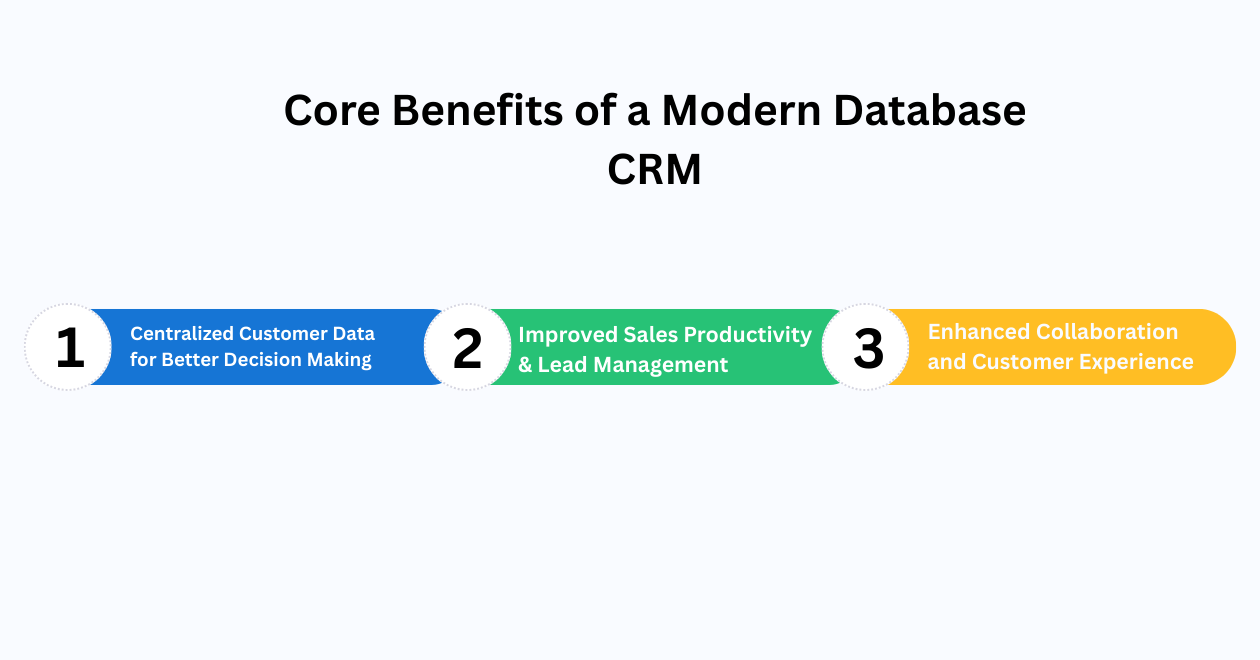
Centralized Customer Data for Better Decision Making
Modern teams choose a powerful database CRM because it consolidates all customer details—emails, calls, meetings, and support tickets—into one unified view. This eliminates duplicate entries and miscommunication, giving leaders real-time insights for strategic choices.
With this database, analytics dashboards reveal patterns in sales performance and customer preferences, speeding up responses to market shifts.
Improved Sales Productivity & Lead Management
CRM systems contribute greatly to increased efficiency and productivity because they reduce a monotonous workforce and gather information in a central place. They automate data entry, follow-up reminders, and scheduling, eliminating manual entry and errors. Options such as:
- Task handling and automation of workflows assist in prioritizing work.
- It enables the employees to work on strategic tasks.
- Having centralized access to the customer data will enhance the decision-making process.
- Reporting and analytics tools will help the businesses to see the results of the performance metrics and make the decisions based on the data to achieve higher results.
Enhanced Collaboration and Customer Experience
CRM databases are repositories of customer data that help enhance collaboration within your team. CRM databases make companies work in a more effective way since they enable centralizing customer data and accessing that data in all your silos and teams get to cooperate within the collaboration culture.
The CRM databases have enabled businesses to develop personalized experiences by providing a 360-degree view of each individual customer. Through such understanding, you will be able to develop focused marketing messages. Therefore, providing more specific service to your customers and establishing more personal relationships with them.
How Database CRM Drives Revenue Across Teams
Sales: Faster Conversions with Data-Driven Follow-Ups
Provide your sales personnel with a profile of your customers, as well as assist yourself in determining emerging business prospects. It must also provide alternatives that can assist you:
- Disclose share sales performance and key measurements to your employees.
- Find and connect with the appropriate buyers to expand the sales relationships.
- Sales automation should be used to assist you in knowing what actions to undertake at each phase in the sales process.
Marketing: Targeted Campaigns That Convert
Conduct multi-channel marketing and elevate marketing returns. CRM marketing capabilities in addition:
- Find out what type of customer messages you will need to send and at what time you should send them.
- Easily blend with sales and analytics to identify, grow, and transform leads.
- Assist in writing and sending messages through the preferred channel of your customer.
Customer Support: Context-Aware Service
Make your brand shine and fit the service expectations of the clients. They will desire to do business with you, and in an ideal scenario, put their trust in you. These systems support you in many ways like:
- Interact with the customers on the platform or device of their choice.
- Learn to deliver better service and save costs by using data and intelligence.
- Provide a 360-degree perspective of your customer and enable your agents to provide personalized service.
Key Reasons Modern Teams Choose a Powerful Database CRM
Centralized Customer Data
The CRM databases facilitate cooperation by centralizing customer contacts, developing a sense of joint ownership, and multiplexing the customer relationships picture. Data integration helps departments work together. Marketing can track campaign interest, sales can close deals with customer insights, and support teams understand customer backgrounds.
The most significant advantages of its operations are:
- Enhanced coordination between sales and marketing
- Smooth flow of information across teams
- Enhanced coordination of support teams to deal with problems efficiently.
In general, CRM systems simplify operations and improve customer service within the organization.
Enhanced Customer Insights and Personalization
Customization is another critical aspect of CRM systems that makes them invaluable. Every business is unique, with different processes, workflows, and customer engagement strategies. A good CRM system allows you to tailor its features to meet the needs of customers as per customer insights. This customization may include the development of custom fields and modules, up to the development of specific workflows and automating certain operations.
Better Collaboration Across Departments
A CRM brings your teams together by sharing info that makes tasks easier for all. CRM helps marketers manage campaigns and direct customer journeys using data. CRM software helps you see how to convert inquiries into sales by showing all your leads and opportunities. The commerce teams can show personalized offers on your site when a customer service rep knows the customer’s background and they reach out with questions.
Improved Contact and Interaction Management
You can store and organize business, contacts, and other related records. You can group them based on the segment, region, industry, deal stage, or any other custom field that is needed. Records can be matched, and contacts may be attached to a number of other projects or deals.
Actionable Analytics and Data-Driven Decision Making
CRM tools are required to develop comprehensive reports about such measurements as sales volumes and campaign success, and tailor-made selections of personal interests. Their data analysis services enable businesses to know trends in customer behavior and preferences, hence coming up with refined strategies. The state-of-the-art analytics capabilities, such as dashboards and visualizations, provide the data in an easy-to-read form, which facilitates the interpretation. Moreover, predictive analytics are the forecasts of future trends based on the past data. This allows the business to predict the needs of customers and market changes and eventually enhance customer retention and sales.
Improved Customer Satisfaction and Retention
A CRM system helps build good customer relationships. It serves as a central database for storing customer information like contact details, purchase history, and preferences. This helps businesses offer individualized experiences and allows them to reach customers based on the interests. Customer journeys can be monitored, and customer teams can respond appropriately through features such as comprehensive records of the customers and their engagements.
CRM leads to increased loyalty and retention by predicting customer needs, such as customized messages for special occasions. This eventually leads to business success in the long run.
Targeted Marketing and Segment-Level Engagement
The CRM systems play a very crucial role in ensuring that the marketing activities are increased by availing the tools to organize and maximize marketing campaigns. They will provide the opportunity to segment the audience by demographics and behavior, and conduct personalized marketing and increase engagement. Moreover, CRM platforms support campaign management, execution, and monitoring as well as the delivery of marketing activities on time. With built-in analytics and reporting capabilities, businesses can monitor key performance indicators, including ROI and conversion rates. This can then be used to make data-driven decisions to refine and improve future marketing efforts.
Scalability and Secure Data Management
Scalability can be defined as the capability of a CRM system to process larger amounts of data, users, and complexity as your business grows. However, a scalable CRM system will perform well as you grow your business, hire more people, attract more clients, and collect more data. Such flexibility is important in the businesses that expect expansion and desire to have systems that are capable of keeping up.
Common CRM Database Challenges (and How to Solve Them)
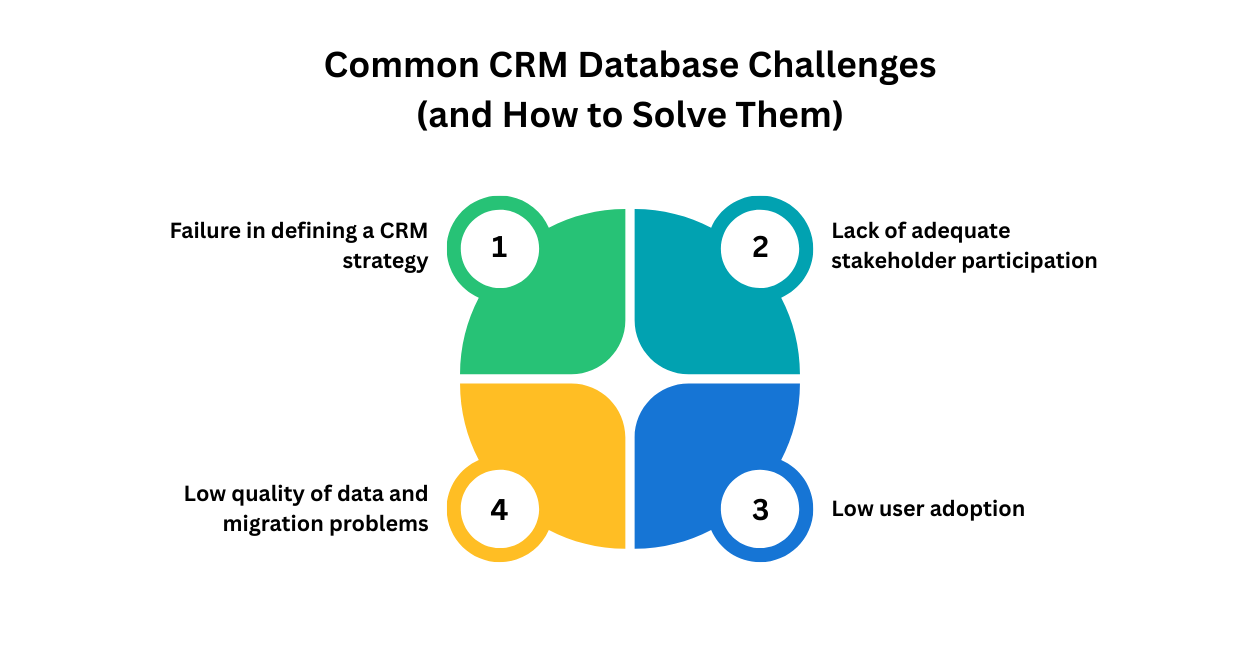
1. Failure in defining a CRM strategy
Lack of a clear strategy is one of the most important issues in CRM implementation. Companies tend to go into implementation without setting goals and KPIs or the vision of the CRM becoming part of the business processes.
What are the strategies for addressing this challenge?
- Establish your CRM goals: retention of customers, tracking leads, sales, etc.
- Make the CRM fit your overall business strategy.
- Formulate success measures to determine CRM performance.
2. Lack of adequate stakeholder participation
The participation of the leadership, departmental heads, and end users is key to the success of CRM. The implementation process fails to be guided and supported internally when stakeholders are not involved.
What are the strategies for addressing this challenge?
- Engage major stakeholders during the implementation.
- Regular alignment of IT, sales, marketing, and customer service.
- Select a CRM champion or steering committee.
3. Low user adoption
No one can use the strongest CRM software if it is of no use. It can be prevented by resistance to change, the absence of training, or the interface that is too complicated.
What are the strategies for addressing this challenge?
- Select convenient CRM software.
- Provide practical training and life-long learning.
- Create value for CRM to communicate with each user role.
- Get feedback and make changes to the system.
4. Low quality of data and migration problems
Bad data in, bad data out. One of the most ignored areas of implementation of CRM is migrating incomplete, outdated, and inconsistent customer data.
What are the strategies for addressing this challenge?
- Information audit before migration.
- Sanitize and normalize data.
- Standardize data entry standards.
- Think about the automation of data verification in CRM.
Case Study: How Zoho CRM Improved FIDGI Communications Data Tracking and Operations
What issues were FIDGI Communications facing?
FIDGI Communications had an issue in keeping track of its leads because it was a private car sales business. They used Google Sheets and other manual methods, but these didn’t scale as the company grew.
Which strategies did Zoho CRM implement?
The company chose to adopt Zoho CRM by hiring the services of a professional partner to improve the data tracking and simplify their operations.
The results achieved by employing these strategies.
Since the implementation of Zoho CRM, FIDGI has seen a great increase in its solution, such as a decrease in the number of documents created and a reduction in the number of emails. This automaton enabled their agents to sell more. Moreover, their weekly sales increased by two to three times, from 5-6 deals a week to far higher. It took place because no leads were left and no duties were assigned due to a lack thereof.
Conclusion: Database CRM as a Strategic Business Asset
Strong database CRMs are no longer luxuries, but necessities to a modern-day team in pursuit of expansion. Through centralization of data, automation of workflows, and provision of insights, they increase sales and productivity. With increasing scale, a strong database CRM is the assurance of secure, actionable customer views that align and enhance retention. You can invest in one today to transform data into your competitive advantage, create loyalty, and revenue in a data-first world.

Author: IDBS Global
Turning Data into Demand, Fueling B2B Growth with Precision and Purpose.