
Full-Funnel B2B Marketing Strategy for Revenue Growth
Follow us

B2B marketing approaches involve full-funnel plans to direct the prospects in their initial awareness, purchase, and post-purchase stages, with the direct result of driving revenue. This will harmonize marketing, sales, and customer success to a predictable pipeline and increased conversions.
Why Full-Funnel Marketing Is the Revenue Engine Modern B2B Needs
Today’s B2B buyers face longer sales cycles with multiple stakeholders involved, making fragmented tactics ineffective. Full-funnel marketing addresses this by nurturing leads across every stage, shortening cycles, and boosting win rates through consistent engagement. Companies using full-funnel marketing see higher conversion rates and increased customer lifetime value, turning one-time deals into recurring revenue.
Pipeline predictability becomes reality when marketing owns the entire journey, not just top-of-funnel leads. Revenue pressure demands unified teams focused on outcomes like pipeline coverage ratios over vanity metrics.
What Full-Funnel Marketing Really Means in B2B
Full-funnel marketing means reaching potential customers at every stage of the buying process, from recognizing their problem to evaluating options to preparing to make a purchase. It is just about being at the right time and at the right place when your prospects need you.
The customer lifecycle means they tend to go through the stages again and again, rather than in a linear direction, as they gather information and balance their choices. It is your task to lead the potential customers through the funnel and into your loving arms.
Full-funnel marketing vs traditional demand generation models
| Aspect | Full-Funnel Marketing | Traditional Demand Generation Models | Key Implications for B2B Growth |
| Core Focus | Holistic journey from awareness to retention; nurtures leads across TOFU, MOFU, BOFU. | Primarily top/middle-funnel: lead volume at TOFU/MOFU; sales closes BOFU. | Full-funnel drives 30-50% higher LTV via retention. |
| Strategy Approach | Integrated, account-based (ABM); uses intent data, AI personalization, omnichannel. | Siloed campaigns: events, ads, cold outreach for quick leads. | Enables programmatic scaling; reduces CAC by 20-40%. |
| Key Tactics | Content clusters (e.g., blogs → webinars → demos); CRM automation (HubSpot/Salesforce); retargeting + loyalty loops. | Paid search, email blasts, trade shows; minimal post-conversion nurturing. | Full-funnel boosts conversion rates 2-3x with continuity. |
| Metrics Tracked | Pipeline velocity, LTV:CAC ratio, engagement score, churn rate, multi-touch attribution. | MQLs, lead volume, cost-per-lead (CPL), SQL conversion rate. | Shifts from vanity metrics to revenue attribution. |
| Technology Stack | AI/LLM CRM (e.g., Marketo with intent signals), analytics (GA4 + Mixpanel), CDP for personalization. | Basic tools: Google Ads, Mailchimp, spreadsheets for tracking. | Leverages data science for predictive scoring. |
| Customer Journey | Continuous loop: attract → engage → convert → expand → advocate. | Linear: generate → qualify → handoff; ignores post-sale. | Builds sticky relationships in SaaS/finance sectors. |
| Strengths | Higher ROI ; aligns marketing/sales; data-driven optimization. | Fast lead gen; low initial setup; proven for volume plays. | Full-funnel wins long-term in competitive markets. |
| Weaknesses | Resource-intensive; needs cross-team alignment. | High churn (40-60% MQL drop-off); ignores brand/lower funnel. | Traditional suits bootstrapped startups short-term. |
| Best For | Mature B2B SaaS/finance firms targeting ABM, revenue ops (e.g., Indian loan providers). | Early-stage or volume-focused teams with limited budget/tech. | Hybrid models optimize for India’s diverse SMB landscape. |
Full-Funnel B2B Marketing Strategy for Revenue Growth
Align Goals and Define Your Revenue Funnel
List some of the goals in relation to business objectives that align with the level of each of the funnel stages. It can be growing brand awareness, participation, or more bottom funnel conversion, either, and it is no secret what marketing success would look like.
Drive Intent-Led Awareness (Top of Funnel)
The awareness stage is at the top of the sales funnel, and it is full of potential audiences who are merely starting to learn about your brand. These are people who have just read about your business and your products in the market, but are yet to be regarded as potential. They might be aware of the existence of your brand, yet they have a lot to learn about what you have to offer.
Qualify and Nurture Leads (Mid-Funnel)
Multi-Touch Engagement & Lead Scoring
Good multi-touch interaction and scoring of leads imply taking people through the process of decision-making in an efficient manner. Restrict on educating and qualifying leads using customized email messages, retargeting advertisements, webinars, and useful sales interactions. Answer such key questions as the cost of inaction and present successful implementations.
Coordinate marketing and sales on fit tests in order to make sure that they adhere to the optimal customer profile. Take into account the various functions of the buying committee and give specific content to enable internal champions. An effective nurture-and-assessment system hastens deals and rejects inappropriate opportunities, keeping the sales pipeline healthy.
MQL to SQL Transition
MQL-to-SQL conversion is important to synchronize the marketing and sales activities. MQL represents inbound marketing, which means a buyer who is highly interested in making a purchase and shown by viewing valuable content or asking to demo. When verified by sale, this prospect becomes an SQL, which means that he is ready to directly interact. This is a well-organized transition of hand-off whereby the efforts of marketing translate to qualified sales opportunities, which ultimately lead to increased revenue. This process of nurturing leads can help organizations optimize.
Confirm Qualification with Frameworks (BANT & Beyond)
Apply BANT and MEDDIC models to verify qualification through evaluation of Budget, Authority, Need, and Timing, and finding Economic Buyers, Decision Criteria, and Pain Points. Customize these structures to the needs of the industry, such as compliance and integration needs.
Sales-Ready Lead Processes
Appointment Generation
Book meetings with clear agendas, which are related to the issues that are to be resolved, and address decision-makers with intent data. Quality is what matters most; a single verified demo will be better than ten cold calls.
Confirmed Callbacks
Use a timed drip: the first email should be sent, a follow-up letter should be made three days after, and a reminder letter should be sent a week later. Change the message: instead of simply poking someone to make them do something, follow-up can be a value-added statement. For example, I thought you might find this guide helpful.
Bottom-Funnel Conversion Enablement
Post-Sale Expansion and Retention
It aims at maximizing the value of the existing customers. As soon as the value is created, the business is able to increase usage, launch new products, and use satisfied customers as testimonials and promoters. Through the proper application of these strategies, the sales funnel turns into a flywheel with new customers producing positive case studies, enhancing brand demand, and solidifying the market position of the brand.
Revenue Operations & Measurement
Periodically review and examine key performance indicators (KPI) related to funnels. Such can be analyzed using some marketing funnel measures, such as:
1. Conversion rates: It is used to determine the ratio of the number of users who complete a desired action. For example, purchase, sign-up, or click, to the total audience.
Formula
The conversion rate = (Total Conversions / Total Visitors or Interactions)
2. Click-through rates: A marketing metric used to measure the number of people who have clicked on a given link, ad, or email after viewing it is the click-through rate (CTR) of a certain item.
Formula
CTR = (Number of Clicks/Number of Impression) x 100
3. Return on investment (ROI): ROI is a financial indicator to determine profitability, and it converts the monetary worth of an investment and divides it by the monetary expenses. It is a significant device used to assess the sustainability of business projects.
Formula
ROI = (Net Income / Total Cost) x 100
These measures would offer you an insight into the success or failure of your marketing endeavor.
Continuous Pipeline Optimization with AI and Data Signals
Predictive analytics will enable forecasting customer behavior and identifying strong leads, and will also increase demand generation. For success, you need a good plan. AI handles repetitive tasks, such as sending follow-up emails and managing social media posts. It also sends personalized texts to each user based on the past behavior. It will allow real-time monitoring of how well the efforts are doing, which will keep improving and boosting the conversion optimization.
Why B2B Companies Are Rebuilding Around Full-Funnel Growth
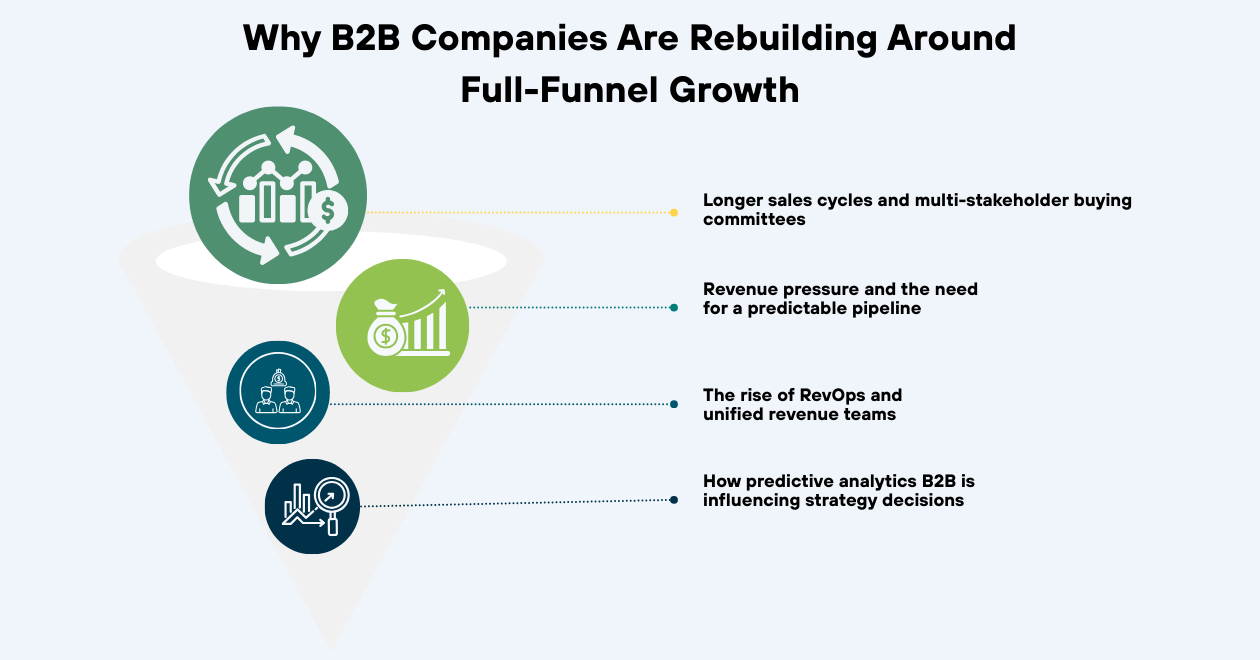
Longer sales cycles and multi-stakeholder buying committees
The current state of sales cycles in B2B is shorter, at 60-120 days, with 6-10 or more people on the buying committee. These groups require unanimity among various functions such as executives, end-users, and procurement, and this makes the evaluations prolonged and decision gates augmented. To map and multi-thread these committees at the start of the process, companies rebuild funnels to shorten cycles with specific engagement.
Revenue pressure and the need for a predictable pipeline
Unpredictable pipelines are dangerous to predictions due to economic uncertainty and lean budgets, which put great pressure on revenue. B2B companies experience the lack of quality leads and invisible purchasers, which drives the transition towards a pipeline-based first. Full-funnel strategies rely on ICP-focused campaigns and coordinated sales-marketing activities through platforms such as Salesforce to create quality and consistent high-value opportunities.
The rise of RevOps and unified revenue teams
RevOps brings marketing, sales, and customer success together to work as one, silo-busting common measures and workflows. This would increase the sales productivity and online ROI as revenue is considered as one process. B2B businesses that have adopted RevOps experience accelerated growth in an integrated tech stack and shared objectives.
How predictive analytics B2B is influencing strategy decisions
Predictive analytics can predict buyer behavior, allowing accurate lead scoring, segmentation, and pipeline prioritization. In B2B, it reduces sales cycles, enhances the quality of leads, and increases the engagement 3.2 times through AI insights. The strategies now emphasize high-potential accounts and optimizing the budgets and influencing the GTM are based on the data-driven decisions, such as the 2.3x increase in Snowflake.
Case study on Full-Funnel Marketing
FullFunnel Doubles The Revenue of the Client By 300%.
Client Background:
The client is an emerging B2B contact and data management solution provider located in Europe and looking to grow quickly in a competitive market. They serve sales and marketing executives with specific lists of B2B prospects.
Problem:
The client also experienced slow growth, especially in the profitable U.S. market, despite the steady sales internationally. They had a poor sales and marketing infrastructure that impeded the fulfillment of contracts and sales. Their product is transactional in nature, which did not allow it to build recurring revenue and instead restored their revenue to 0 monthly, making it challenging to predict growth, as well as making growth risks higher.
Full-funnel strategy:
- FullFunnel was consulted to resolve these issues by increasing the sales and marketing infrastructure of the client. They reorganized the product offering to a tiered subscription model, which helped with the recurring revenue and favored customers.
- Another strategy that FullFunnel undertook to create leads efficiently was the application of an integrated digital marketing program, which encompassed organic and paid search, content, and email marketing automation.
- The qualification and closing processes were also taken into account by them and would provide a comprehensive outsourced solution.
Results:
- The collaboration paid off: the number of monthly qualified opportunities increased 4 times.
- The cost per opportunity was scaled to less than $100
- Its average close rate was astonishing at 40%.
- The client realized more than threefold returns on invested capital.
Common Full-Funnel Marketing Mistakes to Avoid in 2026
Funnel Fail #1: Multiple sources represent industry responses.
Pitfall: Teams will tend to work with splintered information, and this will result in false credits and lost opportunities. This creates incomplete -based strategies.
Fix: Enhance attribution using Conversion APIs (CAPI) to provide quality server-side conversion information to the ad platforms. Map customer journeys and find points of friction through unified data.
Funnel Fail #2: Taking Tests that are as Misleading as Educating.
Pitfall: The testing models and data quality are not good; they bring false outcomes. False measures and attribution may alter wisdom.
Fix: Check results with clean connected data and with proper segmentation. Apply CRO tools to perform tests and combine data to make correct business-level decisions.
Funnel Fail #3: Chasing Vanity Metrics.
Pitfall: Focusing on the superficial metrics (pageviews, open rates, etc.) as opposed to meaningful KPIs that create business impact.
Fix: Measure performance with alignment of KPIs to the business objectives at every funnel stage to make sure the metrics are reflecting real performance.
Funnel Fail #4: One-Channel Insights.
Pitfall: When basing on the insights of one channel there is a possibility of an error of attribution and wastage of budget due to a fragmented view of performance.
Fix: Adopt more advanced measurement tools including marketing mix modeling (MMM) and multi-touch attribution (MTA) to gain the view of the entire channel performance.
Funnel Fail #5: The single-time optimization.
Pitfall: Optimization is perceived as a checkbox activity, thereby resulting in obsolete strategies that are not flexible to the changing behaviors and market environments.
Fix: Be constantly driven by a steady stream of information. Measure quantitative and qualitative indicators to determine and deal with friction points on a regular basis.
Conclusion: Designing a Predictable Revenue Engine With Full-Funnel Marketing
By 2026, B2B full-funnel marketing is the revenue powerhouse that requires the integration of marketing, sales, and RevOps to overcome the hurdles of longer cycles and multi-stakeholder decision-making. Through the use of AI-driven intent data, predictive analytics, and nurturing across the different channels, teams experience 15-20% ROI, 2-3x conversion lift, and 30-50% LTV improvement as compared to traditional models. Do not fall into such traps as vanity metrics and compartmentalized information – adopt unified attribution and ongoing enhancement. In the case of Indian SaaS and finance companies, this hybrid ABM – demand gen model develops a predictable pipeline and flywheel growth. Begin today and rebuild to have scalable hegemony.

Author: IDBS Global
Turning Data into Demand, Fueling B2B Growth with Precision and Purpose.