
The Rise of Multi-Channel B2B Engagement in 2026
Follow us

By 2026, Multi-Channel B2B will be necessary in reaching advanced buyers who move through advanced ways along physical and B2B digital touchpoints. Companies that do not take this change seriously will be out of sight in a market where consumers require smooth dealings. This blog will discuss the idea of Multi-channel B2B strategies as a way of generating more income, trust, and alignment with the new trends, such as AI and privacy laws.
What “Multi-Channel B2B” Really Means in 2026
In 2026, multi channel marketing does more than single-channel marketing. It is frequently performed manually on the channel-by-channel basis. Such B2B sales channels are not often integrated, though, which can lead to unrelated, generic, inconsistent, and clumpy experiences for the customer.
Defining Multi-Channel Marketing vs. Omnichannel Experience
| Feature | Omnichannel marketing | Multichannel marketing |
| Customer focus | Prioritizes the customer experience across all touchpoints. | Primarily focuses on products or services. |
| Channel integration | Seamlessly unifies all B2B omni-channels for a cohesive experience. | Channels are managed separately with looser integration. |
| Adaptability | Adapts to customer’s preferred device, location, and behavior. | Offers a static experience per channel. |
| Promotional consistency | Delivers consistent promotions across all channels simultaneously. | Promotions may vary by channel. |
| Channel strategy | Includes all relevant channels, creating a unified journey. | Selects multiple — but not all — channels based on performance. |
| Experience design | Creates a harmonious and personalized experience. | Offers distinct experiences per channel. |
| Information delivery | Focuses on delivering seamless messaging throughout the journey. | Excels at targeted messaging per channel. |
| Resource allocation | Balances effort across all touchpoints to support the full customer journey. | Prioritizes resources for high-performing or preferred channels. |
Why B2B Buyers Expect Multi-Channel Interactions
B2B customers have a demand for multi-channel communication because the decision entity requires multiple committees to make the purchase decision. Every member has preferences, and they have to focus on different platforms, as such content should be personalized. CMOs must use a multi-channel approach that integrates business goals and marketing activities into the process of achieving growth. According to Forrester, 67% of the buyer journey is conducted online. As per Google’s study, customer lifetime value increases by 30% in companies with strong strategies. A wide-based marketing strategy is the best way to reach and engage the maximum number of buyers.
The Strategic Value of Multi-Channel B2B in Today’s Buying Landscape
Building Visibility Across Long, Complex Buyer Journeys
The multi-channel marketing concept improves visibility because customers who might be interested in the product are reached through a number of lead nurturing channels. This will make it more likely that people will recognize your brand because they can see it on search engines, social media, and email newsletters. This is a good marketing approach because it increases the number of times prospects interact with your brand, which increases brand recognition and the chance that they will buy something.
Strengthening Brand Credibility and Trust Across Touchpoints
To develop a powerful brand, consistency is important. A multi-channel marketing strategy will allow you to have a consistent brand image across all the channels. This gives the customers a smooth experience, no matter how they communicate with your brand. Trust and reliability that are developed through consistency are what is needed to earn long-term customer loyalty.
Capturing and Interpreting Buyer Signals Across Channels
Intercepting and deciphering buyer signals through channels is important in a successful multi-channel marketing process. Measures used to measure performance or business growth include the analytics tool(s), determining the number of click-throughs, and conversion rates. This information would help the organizations to celebrate the achievements and areas that can be improved, allocate resources efficiently, and generate more leads on different platforms.
Core Multi-Channel B2B Engagement Channels That Still Matter
Content Marketing as the Foundation of Multi-Channel Outreach
Businesses can use the content marketing strategy to make material that is useful and informative and to establish themselves as thought leaders and experts in their field. With this marketing strategy, the venture will be able to support the generation of leads through relevant content delivery in the purchasing process of the prospect.
Organic & Paid Search to Capture Intent at Scale
In B2B online advertising, it is essential to have the ability to target decision-makers, and websites such as LinkedIn, Google Ads, and programmatic networks have a notable benefit. These tools enable the targeted recruit to be identified without error by company, role, industry, and intent indicators. This targeted approach is a surefire way to get the advertising budget to work, reaching a very specific group and getting them to know about, consider, and buy. This makes the most of the effects of both organic and paid search.
Email and Social Platforms for Nurture & Engagement
Email marketing is the best multi-channel lead generation strategy. Email marketing is regarded as a goldmine of good prospects, with the industry expected to reach 17.9 billion dollars by 2027.
Through effective email marketing, organizations can deliver personal, targeted messages that are both appealing and educational. It helps to capture the attention of potential prospects and motivate them to make the decisions they desire.
Interactive Touchpoints: Webinars, Events & Virtual Experiences
B2B buyers can learn and connect with your brand in real time during online events and webinars, which are two-way and interactive. These outlets let you show thought leadership on the spot and turn weeks of fostering sales into meetings with real value. They give you useful details about your prospects, like how often they attend and how much they participate, which you can use to send a relevant follow-up email campaign that is tailored to each one. By putting together panels with customers and leaders in your field, you can build relationships and make your brand a big player in important conversations about marketing and community building.
Designing a Cohesive Multi-Channel B2B Strategy
1. Start with Clear, Measurable Objectives
All businesses have their own different goals. It may be to increase brand awareness and visibility, generate lucrative leads, or increase the company’s sales. It is therefore necessary that the organizations are aware of the places where they should do multichannel prospecting.
The organizations must be able to develop a roadmap to plan and measure marketing strategies. It guarantees the motivation and accountability, and they estimate the contribution of each channel to the success.
2. Map Your Buyer Journey to Align Channels to Stages
A specific channel that will appeal to the prospects in their buyer persona might not be worth targeting for the business goal. They shall have to apply a combination of various marketing tools where the target prospects are predominant. This will be able to maximize the B2B engagement strategies and aid in turning leads into conversions.
Also, the companies should ensure that their marketing strategy is aligned with the preferences of the prospect and the business objectives.
3. Choose Channels Based on Buyer Preferences & Impact
The businesses should combine different marketing channels based on buyer profiles instead of depending on one channel to advertise to potential customers. This will improve the level of engagement and increase the rates of lead conversions. Businesses must integrate their marketing techniques with target audience interests and corporate goals to create a comprehensive, effective cross-channel outreach strategy. Through this, they will be able to maximize their marketing and perform even better.
4. Maintain Consistent Messaging and Brand Voice Across Channels
The most important factor for successful outcomes in a multi-channel marketing campaign is standardizing messaging and branding across all marketing channels. Development of a brand value that makes an indelible memory impression is also required, so that the prospects recognize the brand over time. It also creates a stronger credibility aspect to the business, and the clients can easily associate with the brand, thus enhancing the lead conversions.
5 .Centralize and Unify Data for a Single View of Engagement
A combination of CRM, marketing automation, analytics, and ad platforms is a common solution that provides a single, unified view of the buyer across marketing, sales, and RevOps teams. Such connectivity allows one to see prospect interactions across channels more clearly than before and determine what works and what does not. It breaks down silos by providing marketing insights into the channels that drive pipelines and sales, as well as identifying key accounts to focus on. Additionally, it offers RevOps an understanding of the buyer points of friction.
6. Define Shared Goals and Reporting with Sales & RevOps
An effective multi-channel marketing plan involves coordination of the sales and marketing departments with specific emphasis on common pipeline indicators. Accountability and collaboration are encouraged by the use of joint KPIs like pipeline influence and revenue contribution. The correspondence creates a feedback loop where marketing identifies successful campaigns. Meanwhile, sales shares insights on buyer behavior to enhance the overall strategy’s effectiveness.
7. Set Channel-Specific KPIs That Feed Into Overall Goals
1. Engagement metrics: Monitor the interaction of the prospects with your campaign channels. These metrics can be based on:
- Clicks
- Time on page
- Video watch rate
- Webinar attendance
They gauge the interest and resonance levels, revealing what content and types of content are being attracted to.
2. Conversion measures: Measure activities that bring leads closer to revenue. Examples include downloads, requests to get demos, event registration, or fill-ins. This aims to determine which combinations of touchpoints build momentum.
3. Pipeline influence: Determine which channels create, influence, and accelerate opportunities.
4. Account engagement score: In account-based marketing motions, the account-level engagements will have to be measured. It is a combination of advertisements, email, visits to the site, and events to show which of the accounts are warm and which are freezing.
5. ROI and cost effectiveness: Measure expenditure versus effectiveness. What was the influence that each channel had on the growth of the pipeline or revenue against its cost? This would put budgets back on track in areas that achieve meaningful returns.
6. Retaining and growing customers: Track the retention, upsell ticket, and use of the success channels (emails, webinars, customer communities) to make sure that the customer lifetime value increases.
8. Sequence Channel Activities to Orchestrate the Buyer Experience
Communication needs to be done properly in order to organize the buyer experience. A well-written email will be futile if it is sent at the wrong time. With the help of behavioral analytics, intent signals, and engagement data, businesses can find out when and what potential buyers are interested in studying. By knowing this, ads can be strategically placed so that they are sent at the best time for the audience, which increases interaction and increases the chances of a sale.
9. Integrate Marketing Automation for Scale and Consistency
Personalize outreach using the data gathered through multiple sources, such as firmographics and history of engagement. This may include making industry-specific ads, creating email-based sequences for specific jobs, and changing the website content depending on visitor activity. Personalized strategies should be implemented to enhance efficiency. This allows for the automation of repetitive tasks like lead routing and email campaigns, enabling teams to focus on more valuable projects.
10. Monitor, Test, and Optimize Continuously
Implement a measurement mechanism to check channel performance and cross-channel alignment, prioritizing the channel engagement rates, conversion, pipeline influence, account engagement, ROI, and retention. Multitouch Attribution was used to establish the links between initial awareness and subsequent conversions to determine the key touchpoints to apply buyer behavior. This prevents marked wastages in the allocation of the budget and focuses on those channels that produce valuable returns in the sales funnel.
Overcoming Common Multi-Channel B2B Challenges
Mistake 1: Delays in Manual Quoting and Approval.
Using spreadsheets will cause mistakes and time wastage.
Solution
Adopt a CPQ application such as Subskribe that will computerize the creation of quotes and simplify the process of approvals, minimize errors, and reduce response time.
Mistake 2: Inconsistent Proposals
Branding and pricing inconsistency can be caused by custom proposals.
Solution
Standard templates and centrally store proposal metrics to maintain consistency and properly comply, increasing the level of professionalism.
Mistake 3: Lack of Buyer Insights
Lack of knowledge of buyer touch can freeze deals.
Solution
Use analytics solutions to monitor Buyer interactions in order to allow sales reps to adjust follow-ups on the basis of engagement information.
Mistake 4: Disconnection with Buyer Journey.
Buyers can be exasperated by a strict sales procedure.
Solution
Define your sales operation to the buyer journey through configurable workflows to suit the demands of various stakeholders.
Mistake 5: Long Sales Cycles
Extended cycles may be sources of missed opportunities.
Solution
Divide the sales process into milestones and keep the energy going by eradicating the bottlenecks so that it can make the decision faster and close the deal.
Leading Multi-Channel B2B Trends to Watch in 2026
Predictive Analytics and AI-Driven Channel Optimization
In 2026, AI will move beyond support and act as a decision layer in B2B marketing, leveraging intent data and engagement patterns to determine true demand. The change lets the teams cut down on ads that are getting old and make the most of channel timing. When you mix data science with marketing strategy, you get predictive analytics. This helps you better allocate your resources so you can find high-intent accounts and win rates. The great thing about current B2B teams is that they use more than 100 signals to make messages more relevant to each buyer by changing them based on their actions and preferences.
Account-Based Experience (ABX) Moving Beyond ABM
Account-Based Everything (ABX) combines marketing, sales, and customer teams to improve coordination instead of targeting. It is compelled to focus on cohesive customer lifecycle experiences and combines acquisition, expansion, and retention into one comprehensive account strategy, and is no longer isolated and instead is collaborative based on mutual goals and actions.
Increased Emphasis on Data Privacy & Responsible Targeting
The rise of awareness about data usage and the pressure of the regulations on the clients predetermines data security and responsible targeting in the B2B marketing. Companies must focus on data security by maintaining employee awareness of laws such as GDPR and CCPA and ensuring employees receive ongoing training. To avoid any breaches, technical measures like encryption, secure storage, and network protection must be implemented. Regular audits can be used to identify weaknesses. In addition to this, the open data policy of privacy fosters customer confidence, which subsequently endears compliance as well as enhances relationships through artful communication on data practices.
A Multi-Channel B2B Success Blueprint — Sample Workflow
This strategic roadmap is a replica of actual Multi-Channel B2B wins.
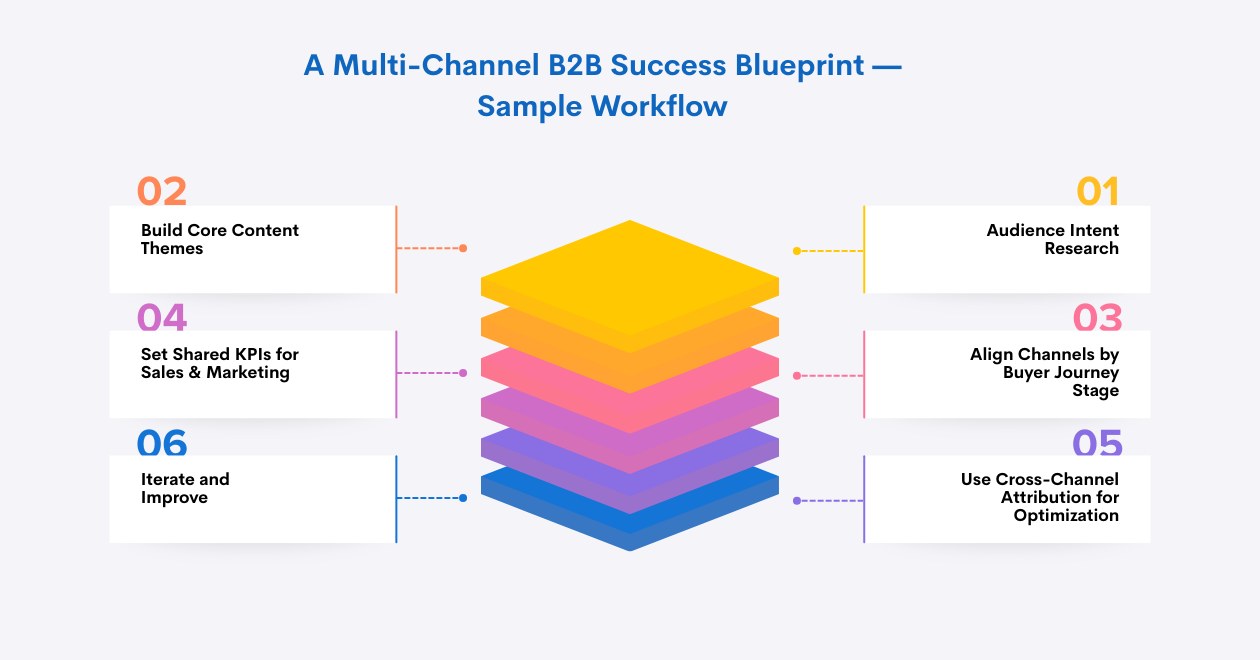
- Audience Intent Research
- Build Core Content Themes
- Align Channels by Buyer Journey Stage
- Set Shared KPIs for Sales & Marketing
- Use Cross-Channel Attribution for Optimization
- Iterate and Improve
Case Study: Total Tools increases customer loyalty sign-ups by 200% using integrated customer information.
Problem
Total Tools didn’t have a unified the customer data channel and segmentation marketing activities. This decreased customer engagement and the number of loyal sign-ups.
Strategy
With SAP Engagement Cloud, Total Tools was able to streamline all the customer information and conduct more refined marketing communications by email, SMS, and social media to provide reliable and relevant communications, regardless of the channel.
Results
The company increased loyalty program enrollments by 200%, and the company’s CRM advertisements had a remarkable 15 times payoff or returns on investment in Total Tools.
Conclusion — Why Multi-Channel is the New Norm
B2B Multi-Channel interaction is the 2026 success factor, enabling faster adoption progress. In the context of channels that unite, buyers expect 10+ touchpoints, and AI reinvents discovery, which provides visibility, trust, and revenue. Adopt it today- scattered attempts are short-lived, and Multi-Channel B2B planned efforts are more than mere survival in complexity.

Author: IDBS Global
Turning Data into Demand, Fueling B2B Growth with Precision and Purpose.