
From System of Record to System of Action: Why B2B CRM Needs an Agentic Upgrade
Follow us

A B2B CRM system is a system of record; it’s been that way for a while. They can keep logs of calls, contacts, track opportunities and provide sales leaders with pipeline view. This might be useful but it is no longer representative of today’s B2B buying habits.
With this, signs from marketing engagement, website events, sales interactions, third-party intent data and business integration tools are reaching buyers. What traditional CRM does, is wait for that signal – for a salesman to recognise it, interpret it and do something about it. An agentic CRM software will change that approach by leveraging AI CRM agents. It interpret context, determine the ‘next best action,’ and automate approved actions across integrated systems.
The agentic CRM frees CRM from being merely a passive database into being an operating revenue engine. It automates accounts, prioritizes leads, enriches records, initiates workflows and guides outreach—without taking the sale out of sales teams’ hands. This shift can help B2B teams to become more responsive. It caan cut down on manual tasks, and to optimize human resources to act based on better judgment.
What Is an Agentic CRM and How Is It Different From Traditional CRM?
Agentic CRM is a CRM where the AI serves you more effectively than it serves to provide data. The old-school CRM stores contacts, deals and notes, and expects someone to take action. It creates itself from your business and updates the records, makes calls, qualifies leads, books meetings, runs follow-ups and everything in between. While you’re out there approving the program! You must know the differences between Agentic and Traditional CRM:
| Factors | Traditional CRM | Agentic CRM |
| Data handling | Stores records entered manually by users | Continuously reads and reasons over updates to unified customer data |
| Task execution | Human initiation required for most actions | Agents execute tasks autonomously based on defined goals and guardrails |
| Personalization | Templates and segments based on expected behavior | Dynamically adjusted per individual based on real-time behavior |
| Adaptability | Fixed rules and workflows | Agents adjust behavior based on outcomes and new context |
| Human involvement | Required at nearly every step | Focused on oversight, strategy, and complex decisions; pulled in by agents when needed |
| User interface and architecture | Only accessible through vendor-directed software | Headless; data and business logic is decoupled and accessible anywhere via APIs and MCPs |
Why Traditional CRM Systems Are No Longer Enough for B2B Sales
Sales Data Is Spread Across Too Many Systems
Customer engagement takes place via emails, chat, support tickets, product metrics and marketing sites. Historical CRMs record contacts’ interactions and histories, but lack real-time behavioral data from out-of-sync sources.
Reps Spend Too Much Time Updating Records and Finding Information
Sales reps have to manually enter Activities, update the fields, and do a cross-Tool search to compile a customer’s story. This slows down the sales CRM process, with the danger of making decisions based on inadequate or up-to-date information.
Important Buyer Signals Get Buried in CRM Data
Drops in product usage, frequent visits to the pricing page, negative support sentiment are several key indicators that may reside outside the CRM. In the absence of CRM integration, these signals are not evident until we’re already too late to do something about them.
Static Workflows Struggle With Complex B2B Buying Journeys
The buying journey for B2B purchases is often multi-stakeholder, complex and uncertain. Rule-based CRM workflows cannot adjust to dynamic behaviors or with real-time, channel-specific actions.
How Does an Agentic CRM Actually Work?
Collecting Signals From CRM, Marketing, Sales, and External Data
It enables the relevant pipeline stages, email engagement, web browsing, support tickets, or third-party intent data to be combined by one single customer profile. This way, agents don’t have to make decisions based on part of the information.
Using AI to Understand Account and Buyer Context
Reasoning engines to interpret intent, urgency, fit due to knowledge of behavior patterns and history – not just rules being matched. It allows for dynamic and account-specific understanding rather than one size fit all segmentation.
Deciding What Action Should Happen Next
Goal-oriented agents use guardrails and business outcomes as their criteria and analyze options, qualify the lead, nurture the account, escalate to risk, etc. It determines the next best action, most likely to move toward the goal.
Executing Tasks Through Connected Tools and APIs
Multipurpose headless APIs and integrations allow agents to independently make marketing campaigns, route tickets and update agent records all while sending emails themselves. Thereby creating meeting briefs without having to switch apps or wait for manual clicks.
Keeping Humans in Control of High‑Impact Decisions
They’re deployed with guardrails, surface reasoning, and audit logs, delivering speed and scale with accountability and oversight. Thereby taking the heat through escalation when processing complex, high-value decisions.
Using AI Voice Agents to Validate Leads and Capture Qualification Data
AI voice agents automate initial outreach and screening, lightening the lead qualification workflow. AI voice agents automate initial outreach and screening, reducing workload in the lead qualification process. They respond quickly to leads they receive and use systematic sales methods such as BANT and MEDDIC, as well as real-time sentiment analysis to tailor conversations. These agents are used to enable live transfers or bookings, filter out the unsuitable prospects and synchronize with CRM systems. For example, Retell AI, Vapi, Bland AI, and Salesforce Agentforce each offer different benefits and costs for better lead management and CRM automation.
Combining CRM Signals With AI-Generated Calls and Voice Conversations
By adding AI voice calls, you can transform your CRM signals into dynamic ongoing sales and service processes, improving your customer interactions. The three parts of the integration are:
- Pre-call data enrichment (AI pull relevant information on customers prior to call)
- In-call execution (AI helps with up to the second notes and updates)
- Post call sync (AI records calls and notes & follow-ups, across channels).
This ensures smooth operations and significant customer engagement. Thereby delivering a great customer experience.
Using Automation Tools Like n8n to Connect Data, Agents, and CRM Workflows
Data is essential to modern business operations. But existing platforms are not able to manage fluidly and effortlessly mix the features of a stiff corporate program with the silky, sleek usefulness of AI. This is exactly where n8n arrives as a vital resource-available. Visual automation CRM platform particularly focused on orchestrating deterministic data pipelines, autonomous AI agents, and complex CRM workflows. As a safe middle layer, technical teams can create scalable and event-driven infrastructure. They can seamlessly extend existing data warehouses right to an LLM and a Customer Data Management (CDM) system.
What Can an Agentic CRM Do for B2B Sales Teams?
Automatically Research Accounts and Enrich CRM Records
An agentic CRM collects company data, decision-maker and industry information. It also includes a history of interactions, providing comprehensive and usable data.
Identify High-Intent Accounts and Buying Signals
It monitors all activity on a website including the page content, browsed products and clicks to see signs of buying behaviour.
Score and Prioritize Leads Based on Context
These are not only demographic factors – it takes into account behaviour, timings, engagement, and account fit to prioritise the most valuable opportunities.
Recommend or Execute Personalized Outreach
The CRM can help you make intelligent decisions about next best actions, compose the messaging, and automate for custom outreach campaigns across channels with very little bandwidth.
Detect Stalled Deals and Trigger Follow-Up
It detects dormant opportunities, reveals potential dangers, and keeps taking corrective steps automatically like reminding or pursuing or executing recovery processes.
Keep CRM Records Updated Without Manual Data Entry
Agentic systems records activities, notifies on deal stages, enrich the data of contacts and keep it accurate automatically.
Building an AI-Powered Sales Workflow
Clay can get sales teams relevant contacts for accounts, assist them with enhanced accounts, and activate automated workflows. Claude and Perplexity can assist in account research, competitor analysis, and prospect intelligence. Voice agents can then verify leads, provide basic customer information. It can engage in follow-up calls when necessary and appropriate, ensuring a more consistent and quicker sales automation process in B2B.
How Agentic CRM Changes the B2B Sales Workflow
Turning New Signals Into Immediate Sales Actions
An agentic CRM decreases the delay in between a buyer signal and also a response from a salesperson. Create an account in seconds, experience fast lead scoring and run the right workflow instantly by following a new intent signal.
Connecting Marketing Engagement With Sales Follow-Up
Marketing engagement is no longer envisioned as an arm of the sales process. Once a prospect interacts with a campaign, the Agentic CRM can link the behavior back to the record of that account and start a campaign-specific sales motion.
Orchestrating Multiple AI Agents Across the Revenue Process
Research, enrichment, qualification, outreach, pipeline hygiene and forecasting can be done through various agents. An agentic CRM can enable all these agents to work together to generate the same revenue.
Creating a Continuous Feedback Loop From Sales Outcomes
If a rep accepts, modifies, or declines an AI suggestion, the intelligent system learns that thing. This feedback over time enhances lead scoring, outreach quality, and next-best-action recommendations.
Orchestrating Clay, Claude, Perplexity, and n8n Across the Sales Workflow
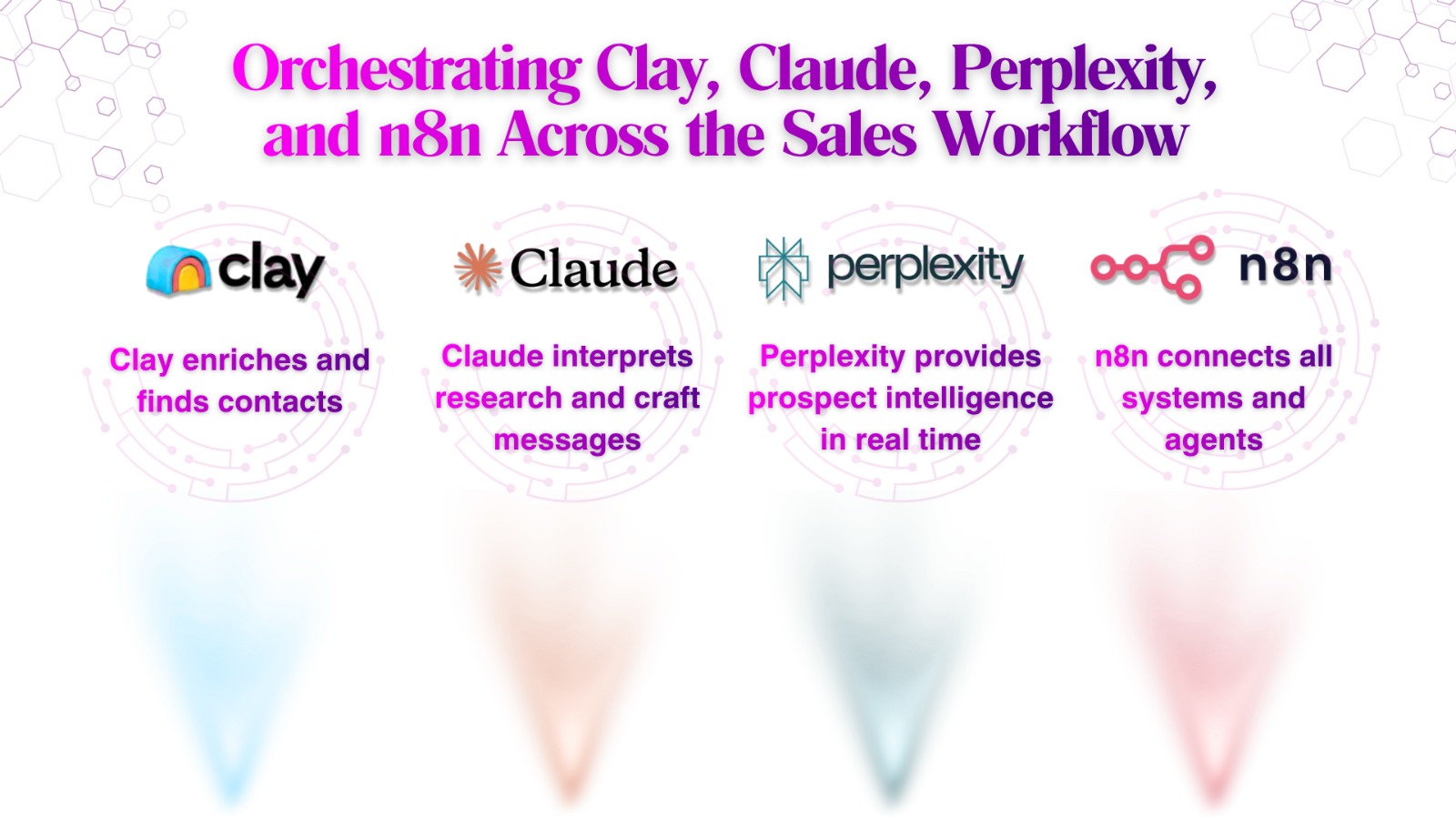
Clay enriches and finds contacts, Claude interprets research and craft messages, and Perplexity provides prospect intelligence in real time. Whereas n8n connects all systems and agents.
Using AI Agents to Move From Research and Qualification to Outreach Automatically
The prospect research for the lead qualification and the personal contact steps are a practical agentic CRM workflow. It can happen without having to manually drive each handoff.
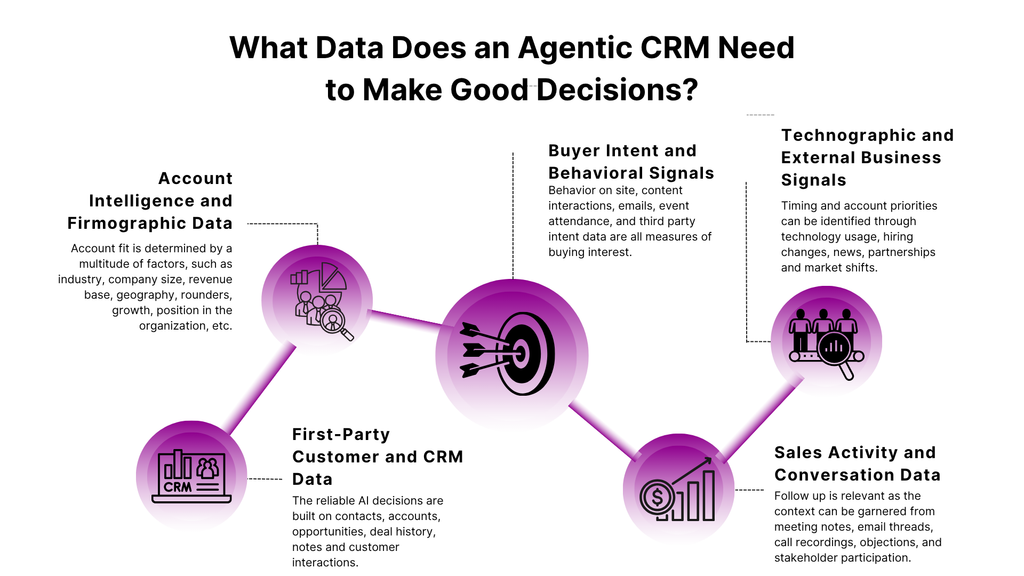
What Data Does an Agentic CRM Need to Make Good Decisions?
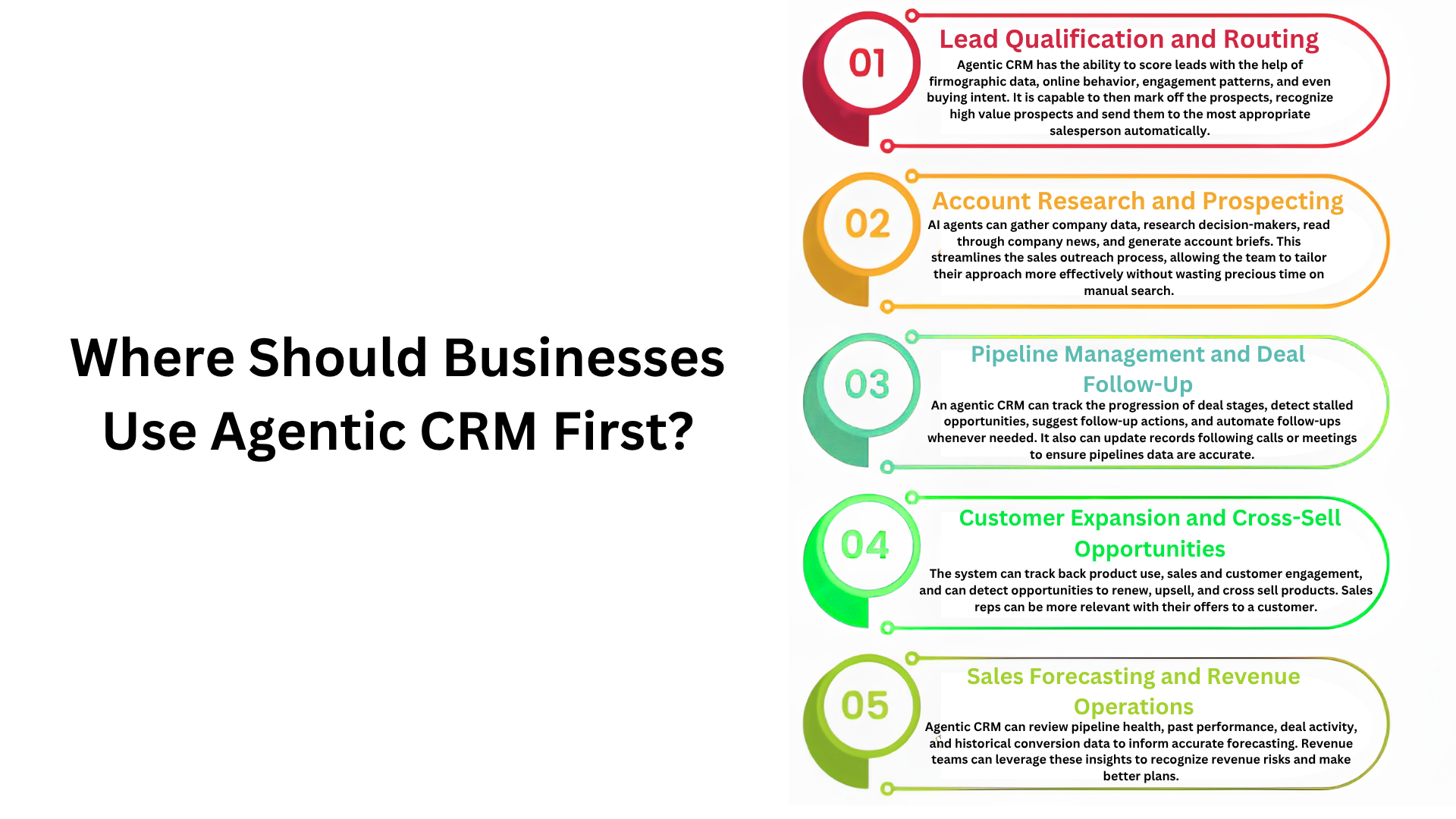
Where Should Businesses Use Agentic CRM First?
What Are the Risks and Limitations of Agentic CRM?
Poor Data Can Lead to Poor Automated Decisions
Agentic CRM decides based on customer profile, sales activity and customer’s purchase history & feedback. With incomplete, outdated, biased, or inaccurate info, the system can generate unsuitable actions, recommended actions, or even having the wrong leads generated in the list. Bad feedback can also lead to bias in sales tactics. To have reliable automation there needs to be a regular data validation, monitoring and review.
Autonomous Actions Need Clear Rules and Guardrails
An agentic CRM connects to other systems and business applications, sets off workflows, reaches out to prospects and updates records. It may cause unwelcome changes or use linked CRM tools without proper permissions and safety rules in place. The following shall be in place for any business:
- Approval checkpoints
- Rate limits
- Budgets
- Rollback
- Explicit restrictions of the application (related to high impact actions)
Data Privacy, Security, and Access Controls Matter
The CRM agent might be accountable for professionals’ enterprise and client knowledge. Insufficient authentication, over-privileged access, compromised credentials or weak identity management can result in access and data leaks. All agents need to be individually identified, access to be limited to necessary access. Also to secure captured credentials and ensure precise tracking of activity logs.
Human Oversight Still Matters in Complex B2B Sales
AI is good at analyzing signals, but don’t expect it to replace human judgment when it comes to relationship management, negotiating and making strategic decisions. It’s a critical need to have human oversight through key events, such as contract decisions or outreach. AI decisions are monitored to ensure proper function and when reps have something the AI doesn’t know, human intervention is required. The best way in B2B sales would be a combination of both AI efficiency and human expertise. So sales agents can handle routine tasks and salespeople focus on trust and strategies for more complex sales.
Conclusion: Moving From a CRM That Records Activity to One That Drives Action
No more a dashboard for a business-to-business Customer Relationship Management system. It’s a system that is context aware with buyers and can coordinate revenue flows, and actually does something.
An agentic CRM tool allows teams to shift from manually keeping the records to automatically searching for accounts. It prioritizes buyers, qualifies leads, follows up with them, and maintains a healthy pipeline. It frees up sales time to focus on relationship building and closing deals for complex sales.
CRM implementation should be done step by step: start a single high paying workflow, set up data and approvals safeguards and begin to grow as the trust in the system. The object is not to eliminate people from the sales arena. To create an intelligent income system to turn signals into action for all vendors.

Author: IDBS Global
Turning Data into Demand, Fueling B2B Growth with Precision and Purpose.