
Syndicated vs. Custom Audiences: How to Choose the Right B2B Targeting Strategy
Follow us

Better B2B audience targeting means better teams can target the right business and buyers and not waste marketing dollars on the wrong people. One of the most common decisions is whether you need a syndicated audience or a custom audience. Syndicated audience are pre-built audiences that turn on rapidly. Whereas, custom audience are audience segments tailored around content, specific user profile, and marketing objectives. The greatest benefit of syndicated audiences is speed, scale, and ease of testing, while the greatest benefit of custom audiences is for more targeted solutions and account marketing. The right approach will vary depending on the stage of your funnel, your budget, your data maturity, and your required level of accuracy.
What Is B2B Audience Targeting, and Why Does It Matter?
B2B audience targeting is the method of targeting marketing by using the data from companies and technographic data. It also uses the intent of the person and people who interact with the site. It is important since it transforms large-scale campaigns into targeted pipeline communications.
Reaching the Right Business Buyers Instead of Maximizing Reach
The focus on B2B target audience is not on impressions, but on qualified prospects like decision makers in companies that fit your market. That saves the budget from being wasted on non-converting audiences and enhances conversion opportunities and ROI.
How Audience Targeting Connects Campaigns to Your Ideal Customer Profile
Your Ideal Customer Profile (ICP) is the first step in targeting, and includes things like industry, company size, revenue, geography, technology stack and buying intent. Combining these attributes will allow marketers create customer segmentation that truly represent a customer’s fit and to reach them through the channels.
The Difference Between Company-Level Targeting and Buyer-Level Targeting
Buyer-level targeting pulls in an account based on the stakeholders though it is a firmographic and technographic account. Company-level targeting pulls in accounts based on firmographics and technographics. Then filters as per the stakeholders (e.g., CMO, IT director, finance decision-maker). Effective B2B programmes include both as purchases involve a multi-person buying committee.
Syndicated vs. Custom Audiences: What’s the Difference?
How Syndicated Audiences Help Marketers Reach Established Segments Quickly
All marketers can launch a campaign in minutes to their already-crowded audiences, since these audiences are already built, and must only be selected from a DSP. They are perfect for awareness and testing for hypotheses, prospecting and product releases where the emphasis is on reach instead of hyper-specificity.
How Custom Audiences Are Built Around Specific Campaign Goals
Custom audiences are built around a brand’s product, its optimal customer and the outcomes they wish to accomplish. They also include their personas or buyer personas. They can apply intent signals, firmographics, technographics or product-specific research behavior in B2B as well as first-party purchase or visit information in consumer marketing. This makes them more convenient for specialized solutions, high-value account-based marketing and campaigns with a specific conversion goal.
Where the Two Approaches Differ in Data, Setup, and Precision
Syndicated segments are based on topic and/or behavior data and trigger right away, and are typically updated monthly or weekly. It takes a few days to more than a week to set up custom audiences. Produce solution level accuracy, more challenging standards, and more applicable signals for complex campaigns.
| Features | Syndicated Audiences / Data | Custom Audiences / Data |
| Who Creates It | Third-party research or data provider | Your team, platform algorithms, or a hired agency for you |
| Data Ownership | Retained by the provider; you only license/access it | Exclusively owned by your business |
| Setup | Instant or very fast (pre-built) | Slower (requires data upload, building, or primary collection) |
| Precision / Focus | Broad market, category, or topic-level | High-precision, solution-level, or brand-specific |
| Cost | More cost-effective (shared across many buyers) | Higher investment (exclusive labor and resources) |
Ideally, use a combination approach; target a custom audience for pipeline or sales relevance, and a syndicated audience for scale and speed.
When Syndicated Audiences Make More Sense
Launching Campaigns Quickly With Pre-Built Audience Segments
Syndicated segments avoid the time of creating a custom audience (defining, modeling and testing it). These users are opt-in and can be activated effectively across programmatic, social and publisher channels.
Testing New Markets, Topics, and Demand Generation Messages
Syndicated audiences are good for low commitment testing. This means when performing several experiments simultaneously to discover which of your buyer types, topics or messages are the likeliest to convert. The findings can then help you to craft a more focused piece of audience brief which you can use before spending any further resources.
Expanding Awareness When Your ICP Matches Broad Industry or Intent Categories
Broad segments based on demographics, interests, purchase behavior or intent are effective for awareness and prospecting. It can provide your ICP with scale. For instance, Experian provides a range of audiences in the following categories:
- Auto
- Financial
- Retail
- Travel
- Demographics
- Intent
- Interests
Understanding the Limitations of Pre-Packaged Audience Data
Success hinging on a narrow outcome, quickly changing behavior, or first party data are not ideal opportunities for pre-built segments. When this happens, custom audiences offer more stringent requirements and a more accurate optimization location.
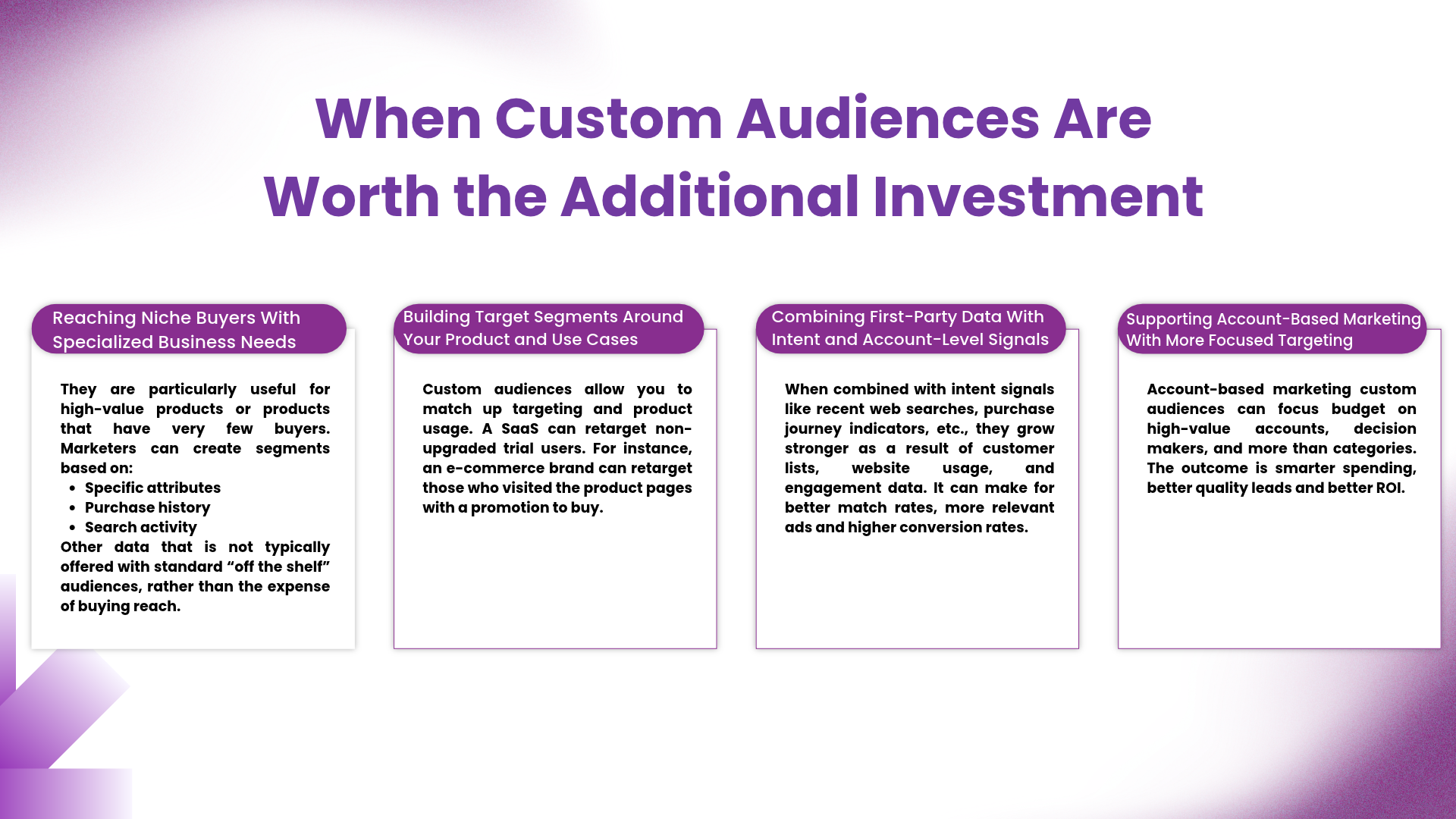
When Custom Audiences Are Worth the Additional Investment
How to Choose the Right B2B Audience Targeting Approach
Match Audience Selection to Your Campaign Objective and Funnel Stage
Prospects can be targeted broadly with firmographic or persona criteria for awareness. After which, they can be targeted more narrowly when they enter consideration and purchase to address intent, retargeting and named accounts. One of the advantages of B2B campaigns is that audience selection matches the recipients’ needs and requirements at various points in the campaign’s infotainment funnel.
Compare Setup Time, Budget, and Data Requirements
ABM and IP-based programmatic targeting may need account lists, building data infrastructure and more budget compared to platform and persona targeting. This can start up rapidly with less set-up work. Select the strategy your team can execute and measure successfully.
Evaluate Audience Accuracy, Reach, and Available Buying Signals
Try to determine if the method is successful in detecting the following:
- Correct companies
- Job positions
- Purchase motivation without reducing coverage
Firmographic, behavioral, and intent data can be stacked on top of each other in programmatic campaigns. IP targeting provides the precision of who is part of a company
Consider How Frequently Your Campaign Needs Audience Updates
Demand generation campaigns (fast) require audience updates with fresh intent, engagement and CRM signals. For longer brand campaigns, more stable brand segments can be utilized, but should be monitored as the buyers’ behavior changes.
Decide Whether You Need Broad Coverage or Account-Level Precision
For market education, focus on scalable displays and programmatic reach. For ABM, use in-line IP targeting or named account lists for focus and precise reach of high-value companies. This usually requires a combination of both for best results. It depends on the time of the day, the usage and the various kinds of information that exist.
Why Data Quality and Audience Segmentation Matter
Build Segments Around Firmographics, Job Roles, and Buying Intent
Create B2B segmentation by company size, industry, location, job title and proven intent. A single customer perspective simplifies sorting for specific customer segments and serves them accordingly.
Use Technographic Data to Identify Relevant Technology Environments
Audience insights gained from technographic data provide information about the tools and systems prospects are already employing. Helps to focus teams on the accounts that could benefit from the market offering introduced.
Reduce Wasted Spend by Excluding Poor-Fit Accounts and Contacts
Before activating, clean, deduplicate and enrich data to get rid of inaccurate, incomplete, or irrelevant contacts. Invalid data doesn’t let campaigns reach out to poor-fit buyers, and incites inefficiency.
Keep Audience Data Aligned With Changes in Buyer Behavior
Preferences vary over time, as do buyer details. Continuous data evaluation, verification and enhancement ensure that segments stay current with the following:
- Changing roles
- Technologies
- Buying behavior
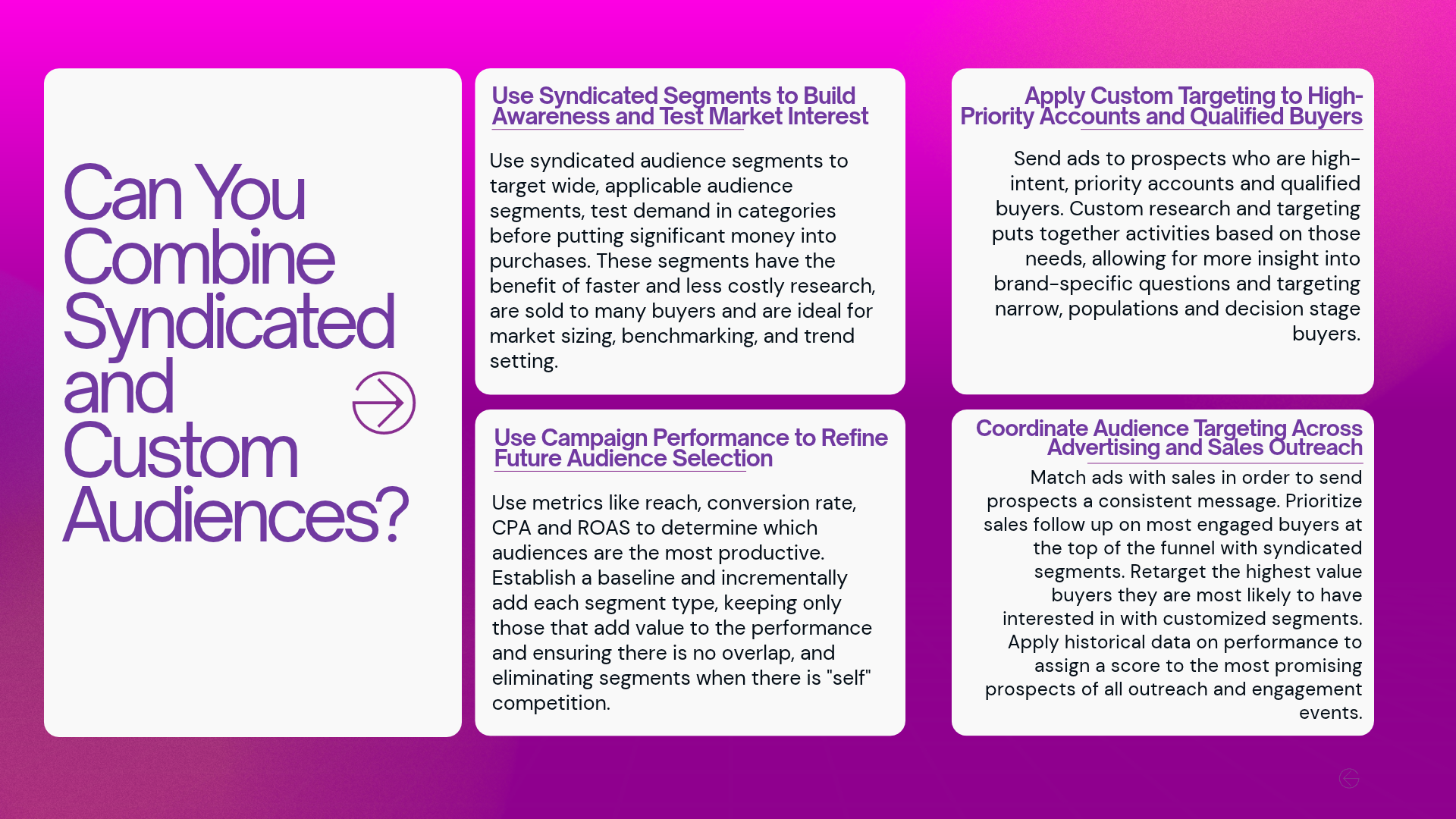
Can You Combine Syndicated and Custom Audiences?
Frequently Asked Questions About B2B Audience Targeting
Q1. What Is the Difference Between Syndicated and Custom Audiences?
An ICP and BP are not “better” per se. Instead they play a unique and complementary part in B2B demand gen.
Q2. Which Audience Type Is Better for B2B Demand Generation?
It’s not an Ideal Customer Profile (ICP); it’s not a Buyer Persona (BP).
Q3. How Does Custom Audience Targeting Support ABM?
Custom audience targeting enables the integration of Account-Based Marketing (ABM) as it helps connect general digital advertising and higher value named lists of accounts.
Q4. What Data Is Needed to Build a Custom B2B Audience?
Creating a customized B2B audience contains layering multiple datasets. These datasets move from general to specific segments, and from generic to specific decision-makers.
Q5. How Often Should B2B Audiences Be Refreshed?
During lead generation, B2B contact and audience data should refresh 70% per year.
Conclusion: Build a B2B Audience Strategy Around Precision and Campaign Goals
In fact, the most successful B2B audience targeting approach does not automatically involve syndication or custom – it’s the audience that fits with your goal. When fast market testing, scale, speed are needed. Use syndicated audiences. Invest in custom audiences when special targeting, ABM, and precision at account level. It will help improve the quality of your pipeline. Many teams mix both, as they see it creating the highest possible return. It an be discovering the broadest and engaging with the accounts and buyers with the best potential to convert.

Author: IDBS Global
Turning Data into Demand, Fueling B2B Growth with Precision and Purpose.