
Unifying Demand Generation in the AI Age: Why AI Alone Won’t Close the Partner Activation Gap
Follow us

AI is redefining the way that B2B teams are creating demand, but new technology isn’t enough to bridge the gap between launching a campaign and activating a partner along the way. By 2026, almost everyone is using AI in their work in some capacity but many have yet to link signals to results in their pipeline. In cases of partner led growth, for example, vendors can get interest, but they may be unnoticed past this point since the partners finally take over execution and become visible. While AI can accelerate B2B demand generation teams and personalize at scale, without operational intelligence, there are crucial points in the buyer and partner journey that go overlooked. Organizations need to have a unified AI and intent data system that integrates all of the elements of AI challenge—including execution visibility—under one system if they are going to become AI winners. This is how to go from more action with AI in demand generation to more predictable revenue.
What Is AI in Demand Generation and What Is Actually Changing?
AI in demand gen is leveraging machine learning, generative AI and autonomous agents to source leads, analyze buyer intent, personalize messages and optimize every step of the buying journey. What’s truly changing is not the tool-set itself, but the operating model: AI is now conducting automated demand gen campaigns. Machine learning and autonomous agents are orchestrating content workflows, lead scoring, and multi-channel execution. Demandgen teams are no longer experimenting with individual AI “helper” tools. They’re implementing intelligent agentic systems that define the strategy, orchestrate the execution, and autonomously optimize campaigns. AI in demand gen has now become “the invisible fabric” connecting the dots between buyer signals and sales.
Why Traditional Demand Generation Struggles in the AI Age
In the beginning, the traditional marketing funnel worked fine, driving awareness down to a purchase. Yet, the reality of buying cycles is quite the opposite; instead of a marketing funnel, a modern demand generation effort needs to be thought of more like a map. The map puts the buyer’s emotional and intellectual status more in action than a CRM box being checked off and sold into the next team.
According to Gartner, B2B buyers take 83% of the buying process before they even have a sales conversation. This is why you need to start working with buyers and build trust with them using knowledge based and valuable content.
However, buying groups are growing, and tailoring content for each stage will never be so important.
How AI Is Reshaping the Demand Generation Workflow
AI Lead Generation and Predictive Prospecting
Demandgen automation uses historical wins, web activity, and third party signals, to generate predictive account lists. They do not statically defined ICP, the models know who’s relevant based on the real outcomes, constantly updating based on closed wins.
AI-Powered Lead Scoring and Qualification
AI for demandgen’s modern lead scoring is about weighing actions against how they affect pipeline- not based on when a user filled out a form. It learns what behaviors lead to a closed deal and scores in real-time.
Buyer Intent Signals and Real-Time Account Prioritization
AI for demandgen takes in site visits, consumption, channel behavior, etc, and identifies ranked accounts by intent. Instead of accounts that expressed intent to buy last month, the sales and marketing teams spend their time talking to those with recent buyer signals.
Personalized Engagement Across Multiple Channels
Generative AI personalizes at scale: emails, ads, and landing pages for specific accounts and personas. Without needing to manually segment every variant, demandgen AI has messages appropriate for the individual buyer and their stage in the journey.
Automated Campaign Optimization Based on Buyer Behavior
AI-based demand generation strategy will test different subject lines, offers and sequence structures, then create budgets as per performance. It becomes self-optimizing and accounts for buyer change, thereby eliminating wasteful ad spend and fatigue.
AI Sales Enablement for Faster Sales Handoffs
AI for demand generation will provide summarized account context, suggested talking points, and will automatically alert sales of potential opportunities when user intent has surpassed a defined threshold. Shortens cycle from intent to sales action.
AI Can Generate More Demand But Can It Understand What Happens Next?
| What AI Does Well | Where AI Falls Short |
| Pattern Recognition: AI can process large amounts of data to identify patterns and predict key market indicators in real time. | Limited Context: AI relies on historical data and performs best when market conditions remain similar to its training data. It may struggle when conditions change dramatically. |
| Automation: AI systems can quickly initiate campaign targeting, adjust pricing, and identify early purchase signals. | Confusing Signals: One-time bulk purchases, sudden stockouts, or artificial campaign spikes can cause AI to mistake temporary changes for genuine demand. |
| Efficiency: AI can automate repetitive tasks, reducing manual work and giving teams more time to focus on strategic activities. | Cognitive Limits: AI may not fully understand external risks, organizational dynamics, ethical considerations, or other factors that require human judgment. |
The Partner Activation Gap: Where AI Alone Falls Short
Why Partner Campaign Adoption Is Difficult to Measure
A large number of vendors monitor MDF spend as well as campaign launches, but not actually on their MDF partner executions or response from their buyers. AI in demand generation is without the data to cut beyond the surface level of tracking and measuring adoption.
Identifying Where Partners Drop Off in the Campaign Journey
It’s difficult to assess if partners are missing steps to get back to leads, reviewing potential leads, and personalize. AI in demand generation has limits in resolving issues that partners can’t see.
Understanding Why Some Partners Activate While Others Don’t
Enablement, incentives, and capacity are just as important as campaign design in many instances for activation. What is required to understand these variances is behavioral data on AI in demand generation.
Moving From Assumptions About Partners to Observable Behavior
Teams need to move from the act of assuming that other teams will perform to get them to instrument and observe what they do. Combining real partner activity data with AI in demand generation is more beneficial.
Connecting Partner Activity With Pipeline Outcomes
The official assessment occurs when the shift from partner actions to opportunities and revenue. The data must move from execution to the CRM databases for AI in demand generation to model these relationships.
Operational Intelligence: The Missing Layer in AI Demand Generation
What Operational Intelligence Adds to AI Marketing
Operational intelligence bridges the gap between data and decisions in AI demand generation. It serves as your own brain above your current martech stack and ties siloed systems together to convert passive data into proactive actions.
Monitoring Real-Time Partner and Campaign Behavior
But operational AI is always on monitoring partner activities and signals through channels. It identifies patterns and anomalies in real-time, no need for static dashboards, for course corrections to be made on the fly.
Finding Execution Bottlenecks Before They Become Pipeline Problems
Partnering with operational intelligence can identify points of friction, such as slow handoffs, misaligned specifications etc. Identification happens before they become revenue delays by analyzing live execution data. It helps to avoid expensive fire-fighting downstream.
Turning Behavioral Data Into Actionable Recommendations
The layer converts raw behavioral data to explicit next steps for teams. Not only does it tell you what has happened, it tells you what to do next, using predictive information.
Creating a Feedback Loop Between Execution and Optimization
Operational intelligence ‘closes the loop’ by taking what happened on the clock and bringing it back to planning and design. This is a positive reinforcing spiral that makes better decisions when you make them.
Unifying AI, Intent Data, and Demand Generation: How AI Can Make Partner Marketing More Predictive
Identifying Partners Most Likely to Activate
AI uses past engagement, certification and campaign data to rate partners based on their likelihood to engage in the campaign. Machine learning models identify high-quality trade partners based on the similarity in background, aptitude, and pattern to other trading opportunities. This prediction-driven prioritization means that vendors are more able to allocate resources to partners that will yield quick results, eliminating unnecessary outreach and turning quicker revenues.
Predicting Campaign Engagement Before Launch
Predictive analytics analyze past data to foresee levels of engagement for partner segments before launching. AI determines which partners are likely to be receptive to these offers, content types and incentives based on past interactions, and similar partner profiles. This allows vendors to continue to test targeting, messaging, and how many resources are spent before implementing a full scale campaign. Thus increasing their return on investment and eliminating underperforming campaigns.
Personalizing Partner Campaigns Based on Behavior
AI personalizes campaigns in real-time, predictive marketing, based on an individual partner’s activity, their interest in the vertical, and their buyer personas. Machine learning produces customized assets, messaging and offers according to the individual’s own value assumption and market factors. With this AI personalization, engagement rates, conversions, and partner satisfaction can be increased. As the relevant and timely content is delivered in large volumes.
Recommending the Next Best Action for Inactive Partners
AI suggests custom strategies for reconnection with inactive partners including ready-to-play & activity signals. Systems propose custom enablement journeys, training programs or campaign chances based, on each partner’s maturity level and his or her own historical experience. This smart nudging effectively re-activates partners, takes them through intelligent routes / high impact activities with no manual effort.
Identifying Which Partner Activities Correlate With Pipeline
AI identifies the hidden relationships between partner activities, like completing training, views on content, getting certified, etc. and the number of produced pipelines. Predictive dashboards are tools that visualize which behaviors result in faster deal velocity and better leads by segment and region. These learnings applies in fine-tune enablement programs, reward top action takers and maximize spending on programs that deliver measurable revenue.
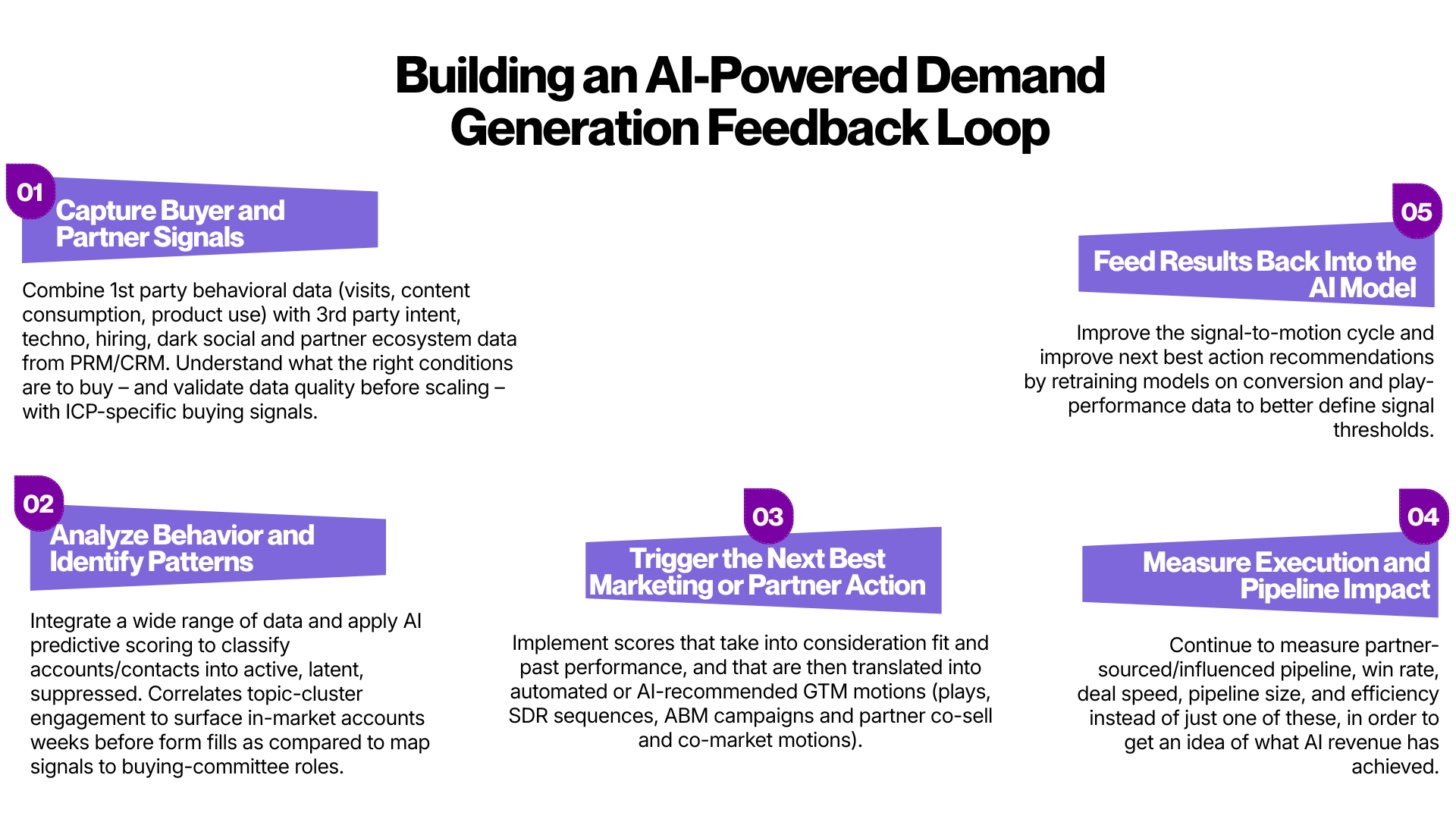
Building an AI-Powered Demand Generation Feedback Loop
An AI-powered demand generation feedback loop enables to integrate detection, decisioning, execution and learning into one system to generate continuous pipeline growth from fragmented signals from buyers and partners.
Signal → Intelligence → Action → Measurement → Learning → Better Action
Above is the pattern that is followed while building an AI-Powered demand generation feedback loop. Let us understand it in depth with the help of the infographic below:
Where AI in Demand Generation Creates the Most Value
Finding High-Intent Accounts Earlier
AI identifies all behavioral cues across channels to uncover accounts ready to make purchases before your competitors. This allows your teams to shorten their sales cycles and increase close rates earlier than anyone else.
Scaling Personalized Demand Gen Without Scaling Manual Work
AI assist your teams to produce hyper-personalized content for entire segments automatically at scale. It reduces manual time and ensures consistent brand messaging.
Improving Lead Quality and Sales Prioritization
Machine learning models assign a score to leads according with previous conversion rates allowing a sales team to focus on the ones best likely to convert close.
Identifying Campaign and Partner Performance Gaps
Then, AI can be used to track campaign performance metrics and identify underperforming partners or channel marketing. So that budget can be diverted in real time to more productive channels instead.
Reducing Time Between Buyer Signal and Sales Action
Marketing automation like automated alerts send out immediate sales alerts whenever a prospect shows the following:
- Buying behaviour
- Reducing the time needed to respond
- Potentially losing out on sales
Turning Demand Data Into More Predictable Pipeline
Advanced analytics use scatter data from demand signals to tell forecasters and users what to expect on the pipeline ahead. This boosts revenue predictability and delivers more accurate strategic planning.
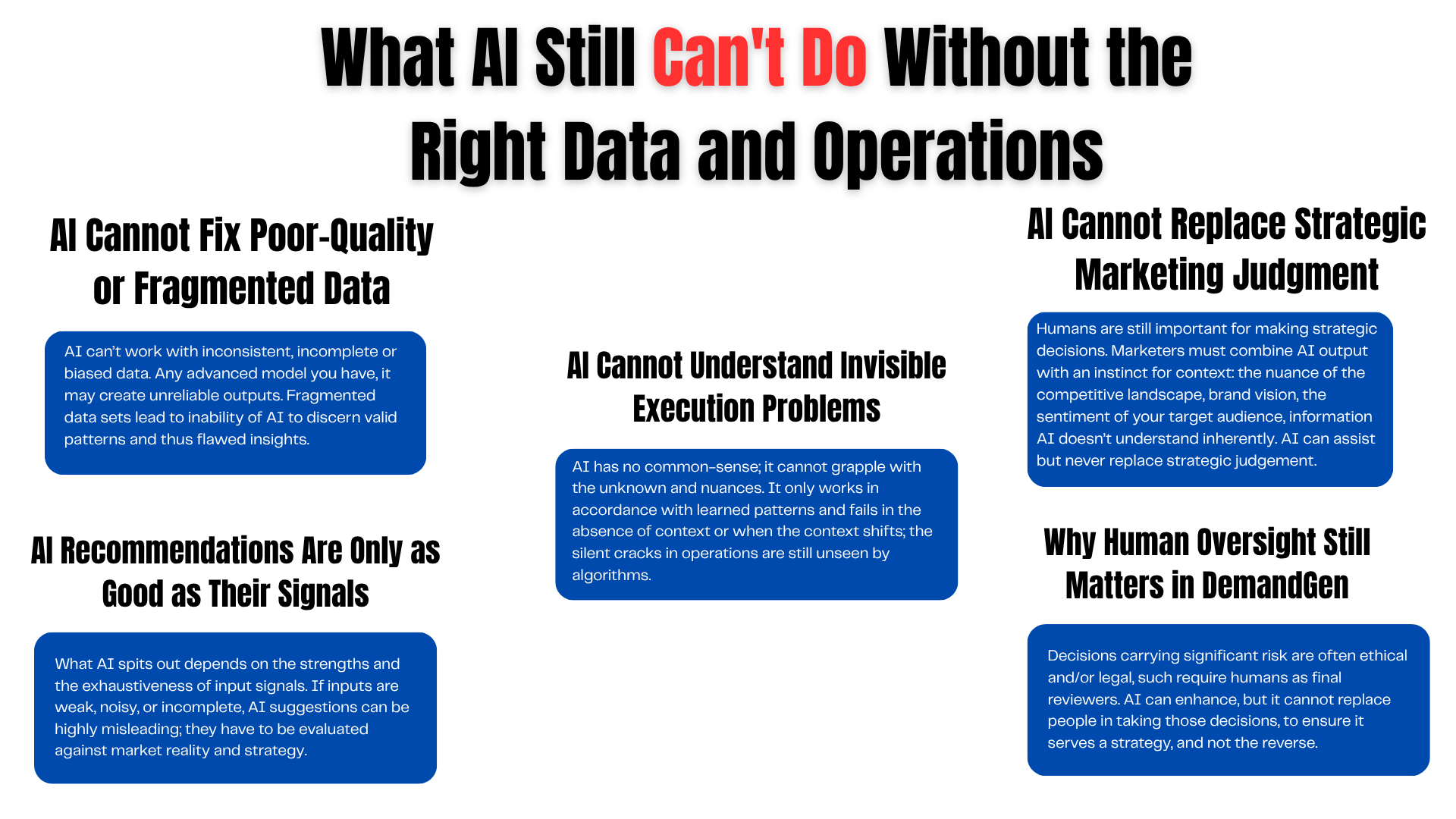
What AI Still Can’t Do Without the Right Data and Operations
Conclusion: How IDBS Global Bridges the AI Demand Generation Gap
AI in demand generation is still only a small piece of the enterprise. In future its success depends on quality data, operational intelligence, human insight and continuous learning. Combining these, companies will be able to not only identify demand, but build an understanding of the evolution of that demand. But IDBS Global is a key enabler in all this. We combine demand generation capabilities with insight and action, helping marketing and sales to prioritise opportunities and remedy performance weaknesses. This all-in-one solution. It creates a cycle where signals are effectively converted into actionable strategies This results in a more predictable revenue pipeline.

Author: IDBS Global
Turning Data into Demand, Fueling B2B Growth with Precision and Purpose.