
Category Creation vs. Category Capture: Where Should B2B Marketers Spend Their Budget?
Follow us

B2B marketers go through a major quarterly decision as to whether to build a new market or harvest an existing one. If decisions are made wrong, they may face serious consequences. This option impacts a lot of things, including your messaging, sales cycles and more. Patience, education, and lots of resources are required for creating categories, but it can create brand positioning in a field you create. Businesses focused on category capture, however, reach buyers who already are seeking out solutions, and they must concede pipeline but contend with more competition.
The correct response is associated with your product maturity, market readiness and finances. Over the years, most B2B teams avoid the category creation effort, since it’s a B2B process that will generate returns over a many years’ span. But effective companies that succeed at the B2B creation take over their industry segments for longer period of time. This guide helps you understand when to take a content approach for B2B category creation, when to stick to capture mode, and how to spend your budget smartly in 2026.
What Is B2B Category Creation and Why Does It Matter?
Category creation is a relatively new term used to refer to a marketing strategy. To put it simply, the creation of something new and fresh, which is part of a particular market is called the creation of a category. While B2B is a saturated market, these businesses give themselves a chance to really stand out by creating a niche. One of the top B2B demandgen strategies is its ability to reverse the business market. It lets companies provide a product or service that is not available from other companies.
Creating Demand for a Problem Buyers Do Not Yet Recognize
The B2B buying journey is a complex process with six distinct stages, from problem recognition, when buyers discover they have a problem, to the search for solutions. Unfortunately, only 20% of companies engage during this important stage, resulting in missed opportunities as 74% of deals go to vendors that create value early. The LinkedIn B2B Institute identifies “category entry points” (CEPs) as major prompts that spark this recognition. It includes buyer cares about their issues, not the products. As such, businesses need to go to the crux of the problem buyers are confronting, beyond simply selling their solutions.
Building a New Market Category Around a Distinct Point of View
The development of a B2B business category marketing is rooted in a different perspective and perspective to that “wisdom. The competition here isn’t about the features, but the way you frame them. New terminology and new metrics and new success criteria and your approach is the natural standard. This is what it takes to get B2B category creation off the ground and moving.
Becoming the Brand Buyers Associate With the New Category
The ultimate goal of B2B category creation is to be able to represent the category itself. Buyers consider your brand name as their first thing when they think of the problem. When you create a category, this is the power, you aren’t only winning deals, you’re winning the game.
Why Category Creation Requires Long-Term Market Education
B2B marketing is not a campaign, it’s a long-term marketing investment over 1-2 years to educate the market. You need to educate your buyers on the importance of the problem. For instance, what’s wrong with the old solution or why your category is the new one. This is why it is vital that there’s alignment between executives and that the budget is committed to B2B category creation.
Category Capture: The Faster Path to Existing B2B Demand
Competing Where Buyers Already Understand the Problem
When a buyer is in ‘evaluation’ mode they already know what they are and aren’t looking for. It also includes the problems with their product, service, or process. Consolidating positions in these high-intent moments is done directly by using SEO, paid search, and comparison content. Comparison content is also called category capture. Rather than selling a perspective on a problem, you satisfy that person where she is going through.
Using Existing Category Demand to Generate Pipeline
Brands capture audiences that are ready-to-buy with keyword targeting phrases such as “best [category] for B2B” or “top [industry] software.” This intent leads to qualified leads through bottom-of-funnel landing pages, into demo requests and pricing pages. This method brings in quicker revenue as compared to wide-ranging awareness efforts.
Differentiating Your Brand in a Crowded Market
The rule of differentiation is the clarity, speed and relevance in saturated categories. Include one-of-a-kind value propositions, social proof and easy CTAs to make a statement. Retargeting and AI search visibility make your brand a part of the consideration.
When Category Capture Makes More Sense Than Creating a New Market
If your solution is a known market, budgets are limited or perhaps there’s a need for speed-to-revenue, the category capture method works best. It’s the wiser option for the majority of B2B companies who invest in brand and content.
Category Creation vs. Category Capture: What Actually Changes?
| Factors | Category Creation | Category Capture |
| Core Goal | Monetize a brand-new problem or unique solution. | Win existing search traffic and market share. |
| Primary Audience | Visionaries, early adopters, and unaware buyers. | Active shoppers comparing known options. |
| Marketing Focus | Educating the market on the “problem.” | Highlighting features, pricing, and differentiators. |
| SEO Strategy | Targeting informational and thought-leadership terms. | Targeting high-intent commercial keywords (e.g., “Best X software”). |
| Sales Cycle | Longer; requires changing buyer habits and mindsets. | Shorter; buyers already have a budget and timeline. |
| Key Metric | Share of Voice (SOV) and search volume growth for the category. | Customer Acquisition Cost (CAC) and Win Rate against rivals. |
| Risk Profile | High risk of market rejection, but high reward (monopoly). | Low market risk, but high competition risk (price wars). |
| Example | HubSpot inventing “Inbound Marketing.” | A new CRM competing directly with Salesforce. |
Differentiation When Competitors Already Own the Category
In capture what you do is, within somebody else’s category, you put down new sub-categories within that category. While in the B2B category creation, you set up that your competitors playing by your rules.
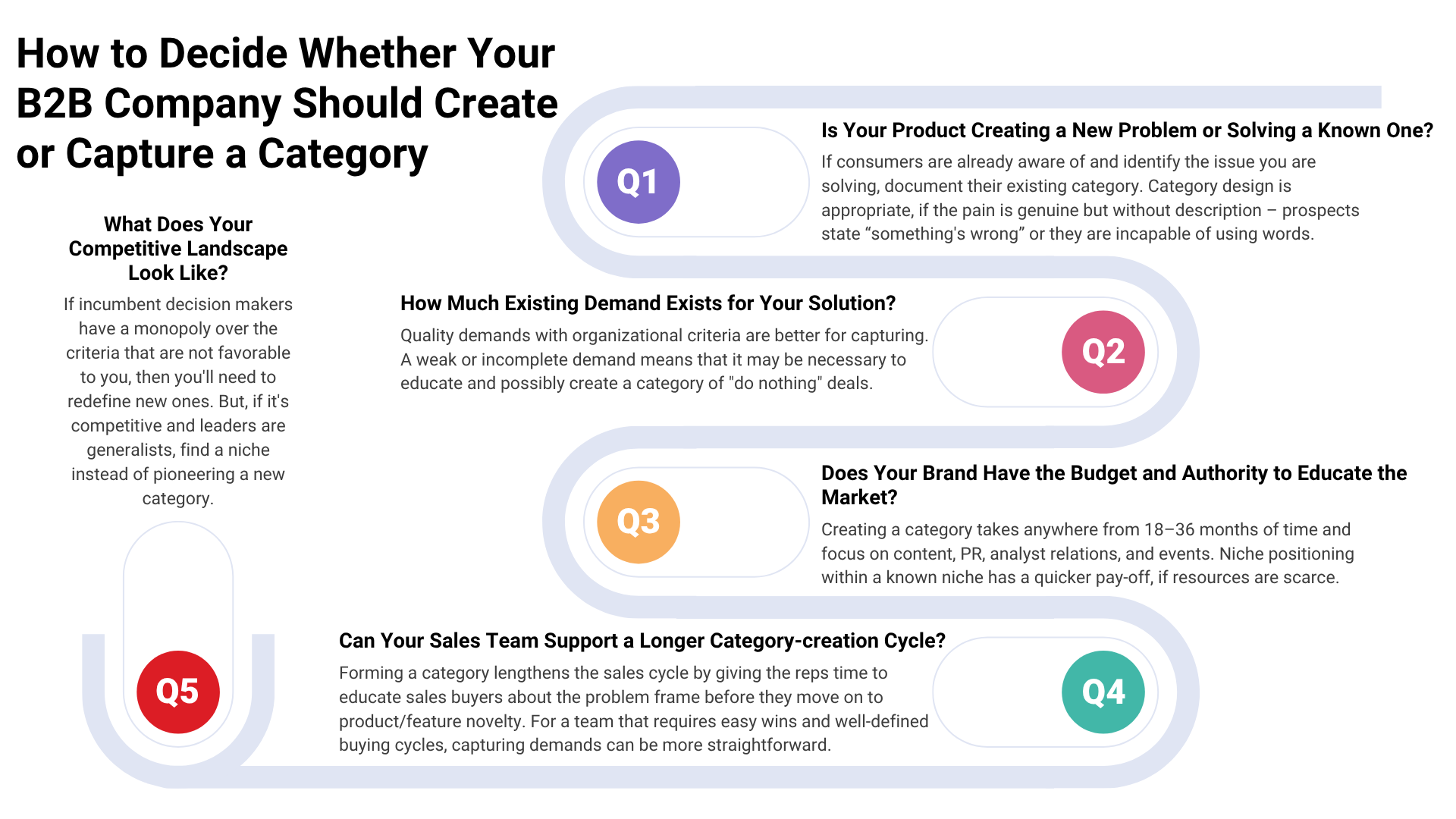
How to Decide Whether Your B2B Company Should Create or Capture a Category
Where B2B Category Creation Fits Into a Modern Marketing Strategy
Building Category Awareness Before Buyer Intent Appears
The process of creating categories starts with identifying a one that doesn’t name an actual problem that buyers have but are not yet able to identify. Whereas, as opposed to waiting for search demand, marketers lead the market with their thought leadership, frameworks, and invented language that makes it industry knowledge. This is early investment to make the brand part of the problem itself.
Using Content Marketing to Shape How Buyers Understand the Market
Content becomes the focus and story of the category. Research reports, named frameworks and point of view pieces create your category authority, ahead of product messaging. Category traction indicates that buyers are using your terms naturally.
Connecting Category Education With Demand Generation
Category education should be done in parallel, not in order! Content at the top of the funnel creates category awareness. Awareness at the middle of the funnel’s content links solution understanding. This establishes a connect point between awareness and consideration without relinquishing the category narrative.
Turning Emerging Category Interest Into Qualified Pipeline
Sales teams can recognize and engage with “early adopters” as category-related signals grow. Early adopters can be recognized and engaged by sales teams as category signals get stronger. Instead, pipeline will be a rear indicator, with ‘category formation metrics’ as the front indicator. Raising children with patience in the education window of 18-36 months transforms the status of category leader to a return on investment.
How to Allocate Your Marketing Budget Between Category Creation and Capture
Why Most B2B Teams Should Prioritize Existing Demand
Demand capture provides real, near-term, business ROI because it targets buyers in the market already doing their research on you. Even for startups or companies with existing pipeline gaps, 60-70% of acquiring will quickly fill your funnel. These channels include paid search, intent-based outbound and retargeting. This is an effective option when the need to raise cash quickly is paramount and brand recognition has yet to be established.
When It Makes Sense to Increase Investment in Category Creation
Track creation spend when you notice capture channels have been saturated, CAC increases from quarter to quarter and branded searches plateau. B2B growth-stage businesses (Series A-B) need to focus on 50/50 or 60% creation by building mental availability before prospects hit the market. The 60-70% creation is needed after brands have matured in the crowded category, in order to differentiate as brands on story, rather than features.
Balancing Short-Term Pipeline With Long-Term Market Leadership
Think of demand creation as pipeline insurance. It builds over the course of 6-12 months via thought leadership, original research and paid social. Examples of leading indicators include branded lift, share of voice and lagging capture metrics such as cost per opportunity. A healthy balance ensures additional pipeline stalls due to over-harvesting of existing demands are avoided.
Adjusting the Mix as Your Category and Brand Mature
To capture, or 70/30, pre-Series A; then to 50/50 at growth; then to 60/70 or higher when scaling. Track win and CAC path and pipeline coverage each month for flexibility in allocation based on forward-looking indicators, not last month’s attribution.
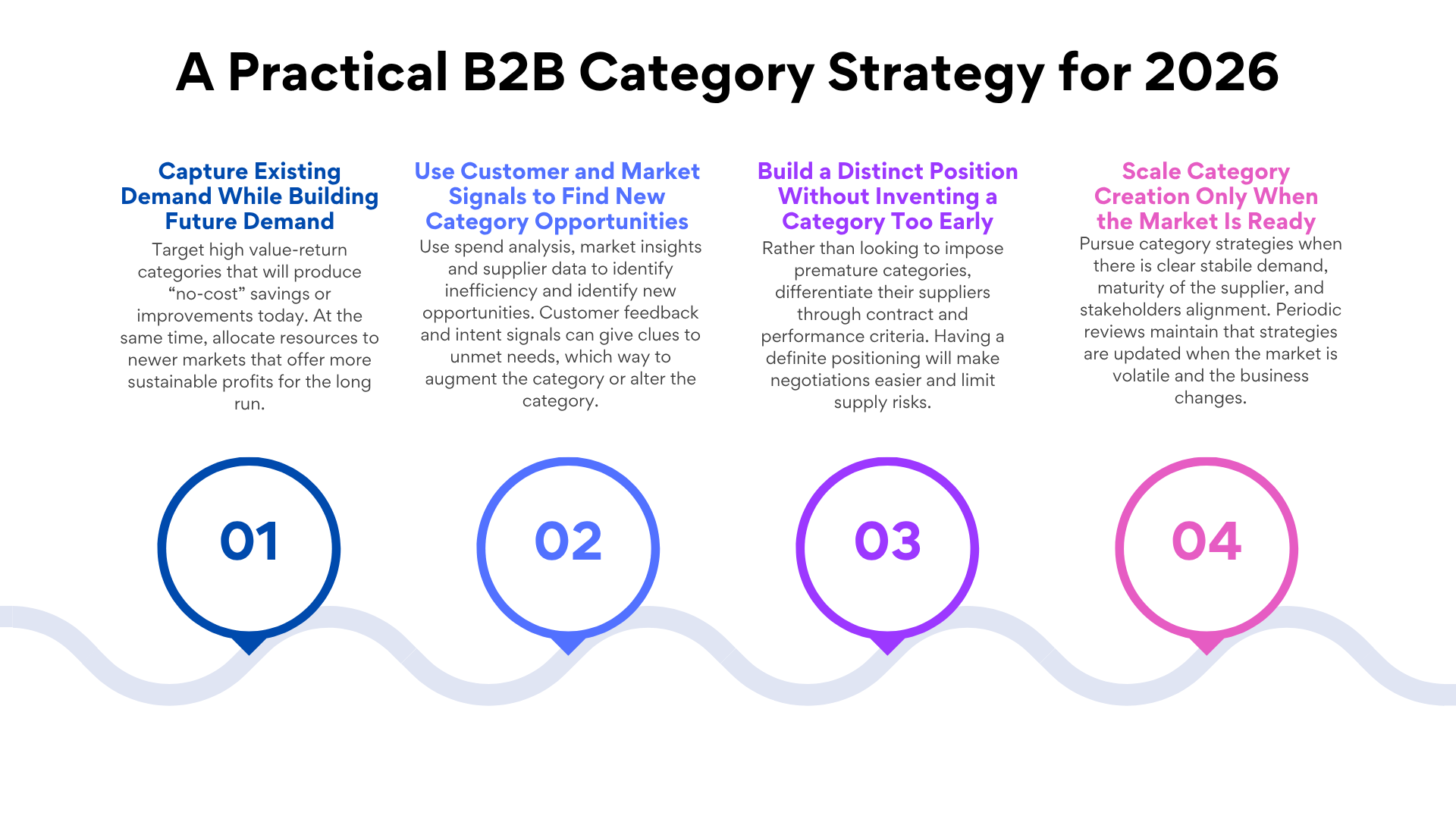
A Practical B2B Category Strategy for 2026
Conclusion: Should Your B2B Brand Create a Category or Capture One?
No there’s no right or wrong in the question of creating a B2B or doing a B2B category capture decision—just a portfolio decision. Nearly all B2B marketers should focus on capture to invest in short-term performance growth. It gives a realistic percentage of the budget to creating B2B categories to drive long-term results. Category creators are not for everyone, but for companies who have an original perspective, resources, and patience. The ultimate goal is to own the category.
Companies must understand and consider these questions: Do I solve a problem that people are aware of or do I create a new thought process? Otherwise, B2B category creation is your route to market leadership. If the latter, try to capture and out execute opponents using the framework that has already been established. Either way, knowing the method means every dollar is going to help your brand progress. The winners in 2026 will be the ones who can achieve a B2B category creation vision and/or capture discipline. Therefore, build for the future, while capturing the present.

Author: IDBS Global
Turning Data into Demand, Fueling B2B Growth with Precision and Purpose.