

White-Label Security Partnerships: A New Channel for MSP Growth in 2026
Follow us

The data security has emerged as one of the fastest development alternatives for MSPs in 2026. In particular, clients are counting on their white label IT partner to safeguard endpoints, cloud applications, identities, email, and business data, not just solve technical problems.
However, it can be costly and challenging for many MSPs to create an undeniable security operation. With analysts required, having them keep their eyes peeled around the clock, maintaining the security tools and staying up to speed with threats is a big investment. That’s where white label MSSP partnerships can help to forge a viable solution.
An MSP can offer more robust managed security solutions under the name of its brand. It is done with the specialized provider taking care of the operational piece of the security solution. The MSP will enhance client relationships and further foster recurring revenue, while the MSSP will provide tech, skills, monitoring, and response.
This means that MSPs can fulfill the growing security requirement without having to hire an entire security team. Managed security is one of the fastest-growing categories of MSP services. It will grow in annual revenue through 2026. White-labeled MSP channel partners are increasingly the preferred model for providing specialized white label services at scale.
Why MSPs Are Turning to White-Label Security Partnerships
Rising Demand for Managed Security Services
The sophistication of cyber threats is increasing and this is leaving businesses in search of all-round managed security services. As customers have more expectations regarding IT package clients are expecting proactive monitoring, a quick response to incidents and compliance support. MSPs are under pressure to provide these capabilities swiftly so they can be competitive and keep the customers.
The Cost and Complexity of Building an In-House Security Operation
Establishing an in-house security operation requires both substantial investment and specialized expertise, and requires constant training. MSPs need to invest in tools, certifications and monitoring infrastructure. This allows them to monitor 24 hours a day, which can be a challenge for resources and add additional delay to the market. This is one of the biggest factors that hampers effective and cost-effective scaling of security offerings for many providers, particularly smaller ones.
How White-Label Services Help MSPs Expand Their Security Portfolio
White-label solutions allow MSPs to quickly add advanced security capabilities like automated phishing training, policy management and breach detection without starting from scratch. These services are congruent with the MSP’s brand, help eliminate clients’ questions about third-party vendors, and enhance the provider-client partnership. Using white-label partnerships, MSP program can build their differentiation, shorten sales cycles, and provide elevated value managed services.
What Are White-Label MSSP Partnerships?
White-label MSSP (Managed Security Service Provider) is the solution where MSPs can resell cybersecurity services without establishing in-house security teams. Development, operation, and maintenance of this solution is in the hands of the MSSP partner, and is offered by the MSP as their offering to end clients.
How the White-Label MSSP Model Works
Here, the partnering is with another MSSP, from which the MSP purchases a ready to deploy security stack. It usually consists of 24/7 SOC services, threat detection, incident response, and compliance reporting. Answer: The MSP onboards its customers, establishes pricing, marketing obligations, and deals with the client. The MSSP provides security operations services in the background on its own platforms, analysts and processes. Sometimes, with custom branding, dashboards and reports are branded to the MSP. This allows MSPs to build up their portfolios fast, with low R&D costs, and infinitely scale security services without hiring specific workers.
What the MSSP Partner Handles Behind the Scenes
The MSSP partner is responsible for all security steps in the security lifecycle:
- Ongoing monitoring through SIEM/EDR/XDR
- Threat hunting
- Alert triage
- Incident investigation
- Containment
- Remediation map
It also upholds the base structure, updates detection rules, standard compliance. For example ISO 27001, or SOC 2, and it produces consistent performance and risk reports for the MSP to embellish for customers. MSPs are able to provide enterprise-level security while offloading these complex and resource-heavy tasks onto sales, customer success, and core IT services.
Which Security Services Can MSPs Offer Through a White-Label Partner?
24/7 SOC Monitoring and Threat Detection
SOCs at Ot provide round-the-clock monitoring for cloud, networks, and endpoints. The white label SOC integrates with logs, identifies anomalies, and escalates real threat events. It enables your clients to achieve faster mean time to detect (MTTD) and mean time to respond (MTTR), without having to staff night shifts.
Managed Detection and Response for Endpoints and Networks
Move the partnership’s EDR/NDR stack to laptops, network devices, and servers to enable a managed detection and response ( MDR ) solution. Your managed services, provided, include playbooks for triage, containment and remediation. Then the partner provides 24/7 hunting, telemetry, and expert analysis.
Vulnerability Management and Security Assessments
Combine regular vulnerability tests with prioritization of the fixing of patches and periodic security audits. Partner performs scans on assets, ranks threats based on the business impact and exploitability, and provides remediation information you can convert into “go/no go” projects in your clients’ tickets.
Cloud, Identity, and Email Security
Include security protection of Microsoft 365/Google Workspace, cloud workloads and identity systems. These services comprise email threat blocking, DLP, conditional access audits and cloud configuration monitoring – all wrapped around your brand as managed services.
Compliance and Governance Support
Manage compliance and controls in compliance frameworks such as ISO 27001, SOC 2, HIPAA or GDPR for regulated clients. The partner assists with mapping controls, audit trails and creating the governance reports. You can use it as you manage compliance as part of an audit managed service.
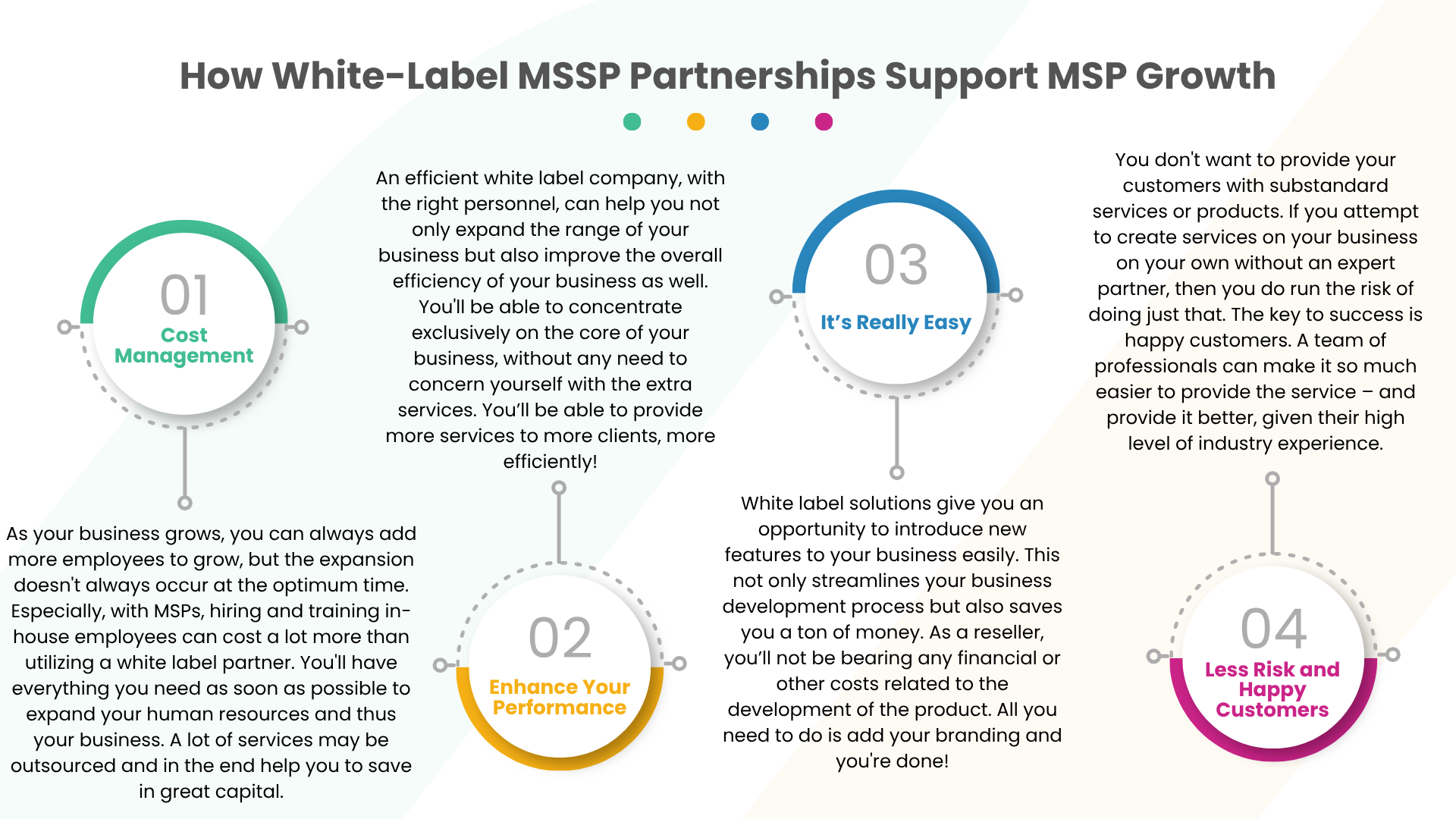
How White-Label MSSP Partnerships Support MSP Growth
What Should MSPs Look for in a White-Label MSSP Partner?
Technical Expertise and 24/7 Security Coverage
Look for partners with extensive, certified deep knowledge on endpoints, networks, cloud and identity. When your team isn’t manning the company’s SOC or working around the clock, your client should still be covered by real time 24/7 monitoring, threat hunting, and incident response.
Multi-Tenant Technology and Scalable Service Delivery
It needs to be a multi-tenant platform, which allows for you to on-board new clients quickly without re-architecting environments. Seeking automation, centralized policy management, and APIs that enable seamless connection with things you’re already using in your RMM and PSA.
White-Label Branding and Client-Facing Support
Your MSSP partner should be transparent for end-client(s). Logos and tone needs to be applied to your portals, reports and communications. For face-to-face support, the next step must be within your team and not to the client. It is because you don’t want to lose the relationship and trust with your client.
Security Certifications, Compliance, and Reporting
Ensure certifications such as ISO 27001, SOC 2 or industry-specific compliance are in place. The partner should offer an easy-to-understand and user-customizable report that will let you show risk reduction and compliance to clients and auditors.
Clear SLAs, Escalation Processes, and Communication
Insist on them describing SLA for response, resolution and uptime. Escalation paths need to be documented, tested, and integrated with your internal escalation. They must also be confirmed during critical incidents, when you need them most!
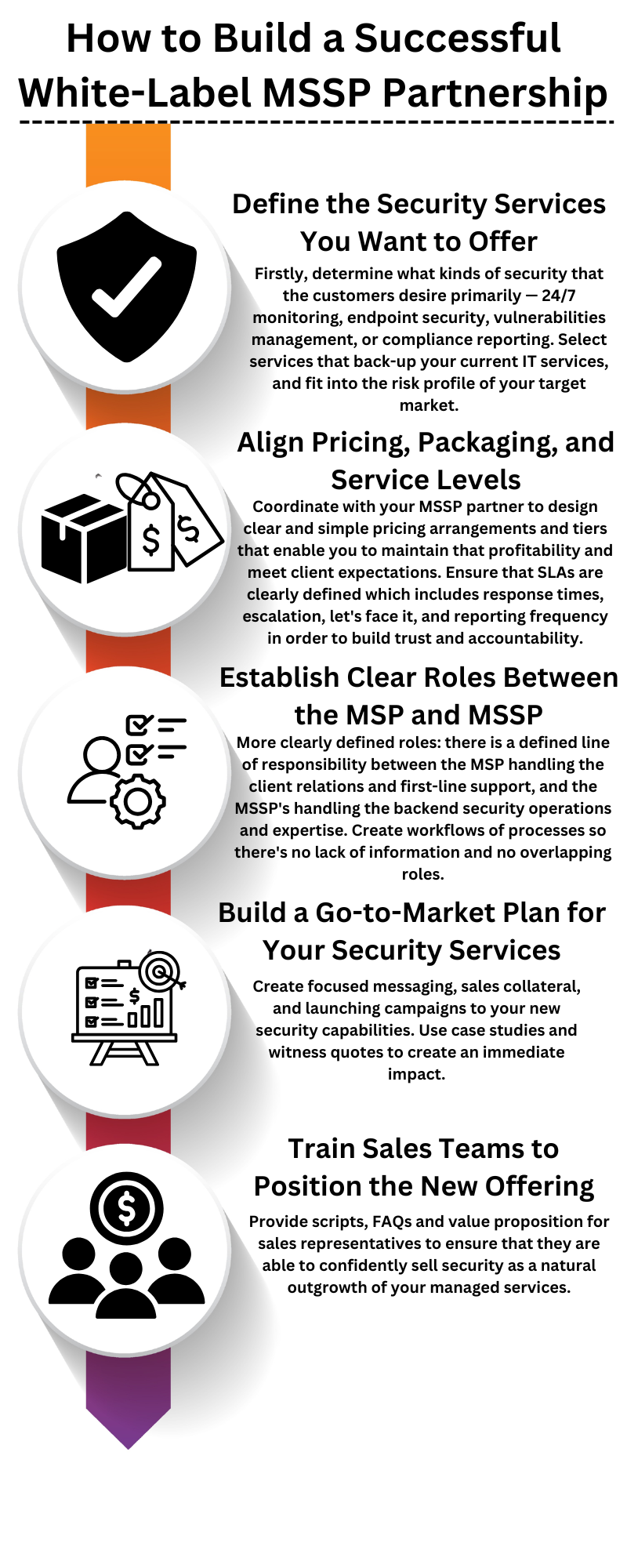
How to Build a Successful White-Label MSSP Partnership
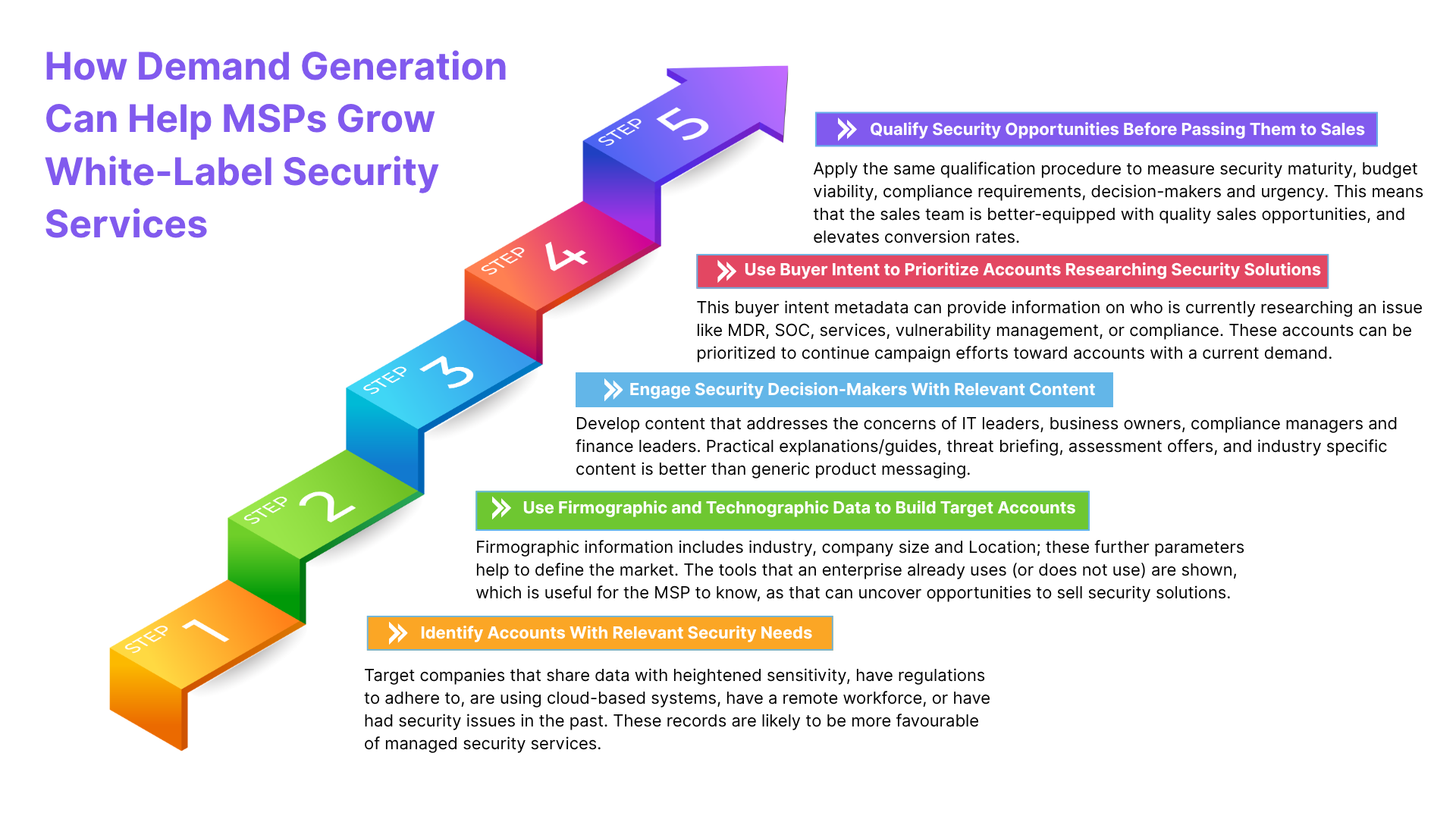
How Demand Generation Can Help MSPs Grow White-Label Security Services
Turning White-Label MSSP Services Into a Scalable Growth Channel
A white-label MSP service provides optimum flexibility to MSPs and enables them to grow their business without worrying about adding to headcount or taking control of their brand. Handling all niche skills and shifts is a distraction. So you’re instead working with a backend service provider that offers NOC/SOC along with help desk and security monitoring, with your brand.
This model turns a fixed payroll into a flexible operating cost. It allows enterprise grade features such as 24×7 support, SIEM logging, compliance-driven monitoring. It also costs significantly less than in-house. Avoiding a full-time night hire, one MSP with three employees added in 40+ hours of capacity by outsourcing after-hours and Tier‑1 tickets.
Coverage is consistent, ensuring that tickets don’t “queue” at 6 p.m., leave to the weekend with vacations, or even shorten response times with better staffing. Meanwhile, owners free up time from fire-fighting to focus on the work that drives the revenue. They should be selling, achieving a standard operating procedure, and working on strategic accounts.
To create a growth strategy, identify a narrow play (after hours helpdesk or MDR), establish SLAs and escalation routes, and promote it as their own. As demand increases, add additional services, vulnerability scanning, DLP, phishing training and do not scope creep your brand.
Conclusion: Building a Scalable Security Business Through White-Label MSSP Partnerships
White label MSSP partnerships provide a viable solution for MSPs. It fills in their pent-up demand for cybersecurity without investing in complex and expensive infrastructure. It also develops their in-house cybersecurity solutions. Once the MSP has established trusted client relationships, the partner brings in their security knowledge; combined, they can offer more robust security solutions. It can bolster their clients’ recurring revenue and differentiate their business.
Depending on the roles to be honed, selecting the right partner is essential, as are clear roles and a proper package. Remember that demand generation is a way to find the right accounts. With an intelligent security strategy, MSPs can leverage their abilities to make it a sustainable path for growth in 2026 and beyond.
Proactive, business-oriented protection is the future – only MSPs can deliver it alongside with providing reliable IT reseller support. This future is within reach if the right white label security partner is used.

Author: IDBS Global
Turning Data into Demand, Fueling B2B Growth with Precision and Purpose.