
12 B2B Lead Generation Predictions for the year 2027
Follow us

B2B Lead Generation is moving into a new era. Buyers do not rely on sales teams to lead them through the funnel anymore; they research on their own, use AI lead generation to compare vendors, and have bigger internal teams in the buying decision. Companies that are able to deliver interesting content alongside accurate account information and quick follow-ups on sales will reap the rewards of the most important B2B lead generation trends 2027. Gone are the days of simply trying to capture volume; a successful team will prioritize building opportunities that can generate revenue. Come with this blog and explore 12 forecasts that are set to influence B2B lead generation trends 2027 and how your company can be prepared for them.
How B2B Lead Generation Is Changing in 2027
Why Generating More Leads Is No Longer Enough
It’s possible to end up with a big list of leads who don’t convert well. Fortunately, businesses are no longer focusing on cost per lead, but on a range of other metrics like qualified opportunities, pipeline contribution, conversion rates, and revenue per campaign. AI can now be used to help teams better understand human behavior, understand which accounts are best fit for high value sales and direct sales efforts toward the accounts most likely to drive sales.
How Buyers Are Taking Greater Control of the Research Process
Buyers investigate online and get answers from AI and social networks, do their own research and review the product before making a purchase. With AI-driven search, the legacy of clicks is being diminished, so it’s imperative that brands become relevant based on content that offers value and specific content that is backed by evidence. That prompts trust, originality and case studies, and clear expertise.
The Shift From Marketing-Qualified Leads to Revenue-Ready Opportunities
The new challenge is to be better able to identify revenue-ready opportunities through intent signals, engagement signals, and qualification with AI. Interest must become a metric business opportunity—through the sharing of definitions, CRM data, and follow-up workflows between Marketing and Sales. Human sellers are still necessary for the factors of trust, negotiations and complex decision-making.
12 B2B Lead Generation Trends to Watch in 2027
1. AI Search and Answer Engines Will Influence How Buyers Discover Vendors
AI tools like ChatGPT, Perplexity and Gemini are becoming essential tools for B2B customers to problem solve, shop vendors and narrow down solutions. This puts generative engine optimization (GEO) on par with SEO. After all, companies and businesses must be provided with straightforward explanations, helpful comparisons, original research, and authoritative answers that AI systems can “understand and cite.” This has implications for lead generation. When your skills aren’t in the field of AI search, you could fall by the wayside before a buyer even lands on your website. Produce content that clearly responds to customer questions, clarifies terms, provides evidence for claims, and is used appropriately in explaining trade-offs.
2. Predictive AI Will Help Teams Identify Accounts With Stronger Buying Signals
AI will no longer be just about content creation but will be a functional tool for recognising accounts that closely mirror your top customers. Predictive models can leverage firmographic, engagement signals, past opportunities and intent metrics to prioritize companies that have a strong likelihood of progressing to revenue. But predictive AI should be used to prioritize, not rule out human judgement. A high score does not necessarily mean budget, authority or urgency, and sales and marketing should continually test the outputs of the model with actual pipeline returns.
3. First-Party Intent Data Will Become More Important for Prospect Targeting
- With reduced reliability of third-party identifiers and increased privacy expectations, first-party data will be a key asset. CRM data, web page visits, email interactions, webinar attendance, webinar and subscription activity, and direct interactions can provide clues as to which accounts are looking into topics relevant to the business. The value does not lie in the individual signal, but in the linking of them. A solitary visit to a page is a weak sign. But repeated visits are probably strong indicators of commercial interest. These are:
- Solution pages
- Pricing content
- Case studies
- Content comparison
4. Human Expertise Will Differentiate Brands From AI-Generated Noise
It is becoming easier to produce AI-generated content, making it less effective because of the use of generic material. There is still a gap that exists for buyers looking for complex, high dollar solutions to receive trusted advice, real-world experience and honest and open communication from someone with an understanding of their business. By 2027, subject matter experts will be the focal point for lead generation. Invite practitioners/representatives, customer teams and product specialists to share their experience, reframe the assumed, and reflect on how they take decisions in reality, explaining the pre- and post-decision process. This is a quality automated content can’t achieve.
5. Original Research and Customer Evidence Will Strengthen Buyer Trust
Buyers must have proof, not promises. Customer stories, implementation examples, verifiable results, and original research endeavors allow prospects to determine if a vendor fully grasps their issue and can provide a tangible result. Specific is good; strong evidence should be specific. Rather than saying “we improve leads”, tell where the leads are coming from, what you did to them, over what time span, and what was the outcome. It is noteworthy that case studies, testimonials and a clear description of process are particularly informative when people are considering and deciding what to do.
6. Buying Committee Engagement Will Replace Single-Contact Lead Strategies
In B2B, end users, technical evaluators, B2B procurement teams, department heads, and perhaps even founders are all involved in the process. One contact can cause lead generation strategies like lead nurturing and lead scoring to falter if they’re not influential, have funding, or have decision-making power. Responses will describe the effective programs, which will involve the entire buying committee with targeted messaging for each role. A marketing leader may be interested in qualified pipeline and B2B marketing trends. Return and cost may interest finance. Technical specialists may have interest in implementation, security and integration concerns. The promise of the brand should stay the same, but the messaging ought to zero in on each of the stakeholder’s priorities.
7. AI Agents Will Automate More Prospect Research and Lead Qualification Tasks
With AI agents researching accounts, summarizing company data, comparing products, preparing outreach, qualifying inquiries, and preparing sales teams for discussions, their capabilities become ever more relevant. Marketers can also track campaign results, make pattern recognitions and advise changes on expansive account lists. The most effective application of AI agents is in eliminating repetitive tasks and maintaining human oversight. Automate research, routing, enrichment and follow-up preparation, but leave people to check accuracy, positioning, building relationships, and making any decisions on final qualification.
8. Account-Based Marketing and Demand Generation Will Work More Closely Together
The days of ABM and demand generation as distinct functions are over. Special attention is paid to B2B accounts that may contain high-value accounts. ABM focuses on maximizing the effort on accounts that top the target list for awareness and education, “demand generation.” Successful teams in 2027 will be blending high-level education with targeting and engagement at the account level and personalized. This holistic approach ensures vendors are “front of mind” even when buyers are in the “buy cycle. By the time the intent signals appear further down the list, the sales team already has context, engagement history and material to help have a timely conversation with the Account!
9. Private Communities and Peer Recommendations Will Shape Vendor Discovery
Professional parts, industry organizations, peer groups and expert-led forums are emerging as new means of discovery. When considering less familiar categories or risky investments, customers tend to rely on the anecdotes of fellow vendors more than the advertising, particularly. Rather than simply promoting, brands in the B2B space should be involved in a meaningful way. Provide helpful information, respond to questions, point out customer learnings and make it simple for the happy customers to advertise about. Paid media can take time to build trust, but peer validation can bring it about faster!
10. Paid Campaigns Will Focus More on In-Market Accounts and Buying Intent
Marketers will be able to target and weave through intent signals and company-specific targeting and create a significantly more precise paid media approach. Campaigns will focus on accounts aligned with ICP. These include meaningful engagement with topics, rather than optimizing for clicks or low cost leads. While LinkedIn is a good choice for professional targeting, open web programmatic advertising, trade publications, and contextual ads can take reach beyond social media platforms. It’s about getting your brand in front of the right companies, not necessarily getting immediate conversions.
11. Sales, Marketing, and RevOps Will Share Responsibility for Pipeline Growth
Lead generation is unsuccessful when marketing maximizes form completion and sales dogmatize that this is an unqualified lead because they have been unable to find and relate with the ideal customer. In 2027, everyone will focus on creating consensus on the definition of an ideal account, a qualified lead, a sales-ready opportunity and the contribution of the pipeline.
By merging website analytics, ad platforms, marketing and sales automation, and CRM data, RevOps will be a bigger driver here. The common view enables teams to uncover weak accounts, perform lucrative campaigns, and pinpoint areas that require adjustment within their follow-up processes.
12. Lead Generation Programs Will Use Engagement Data to Improve Future Campaigns
The best programs will adopt a learning system approach to any campaign. Engagement information, including mainstream, webinar attendance, returns and email engagement, and departmental pathway. These should all be used to optimize further targeting, messaging, offers, sales interactions, etc. Next, it is time to go beyond the numbers of leads captured to reconciled opportunities, pipeline value, conversion rates, customer acquisition cost, and revenue impact. With B2B journeys typically having a large number of touchpoints, it is important to consider the interpretation of attribution, not just the last click.
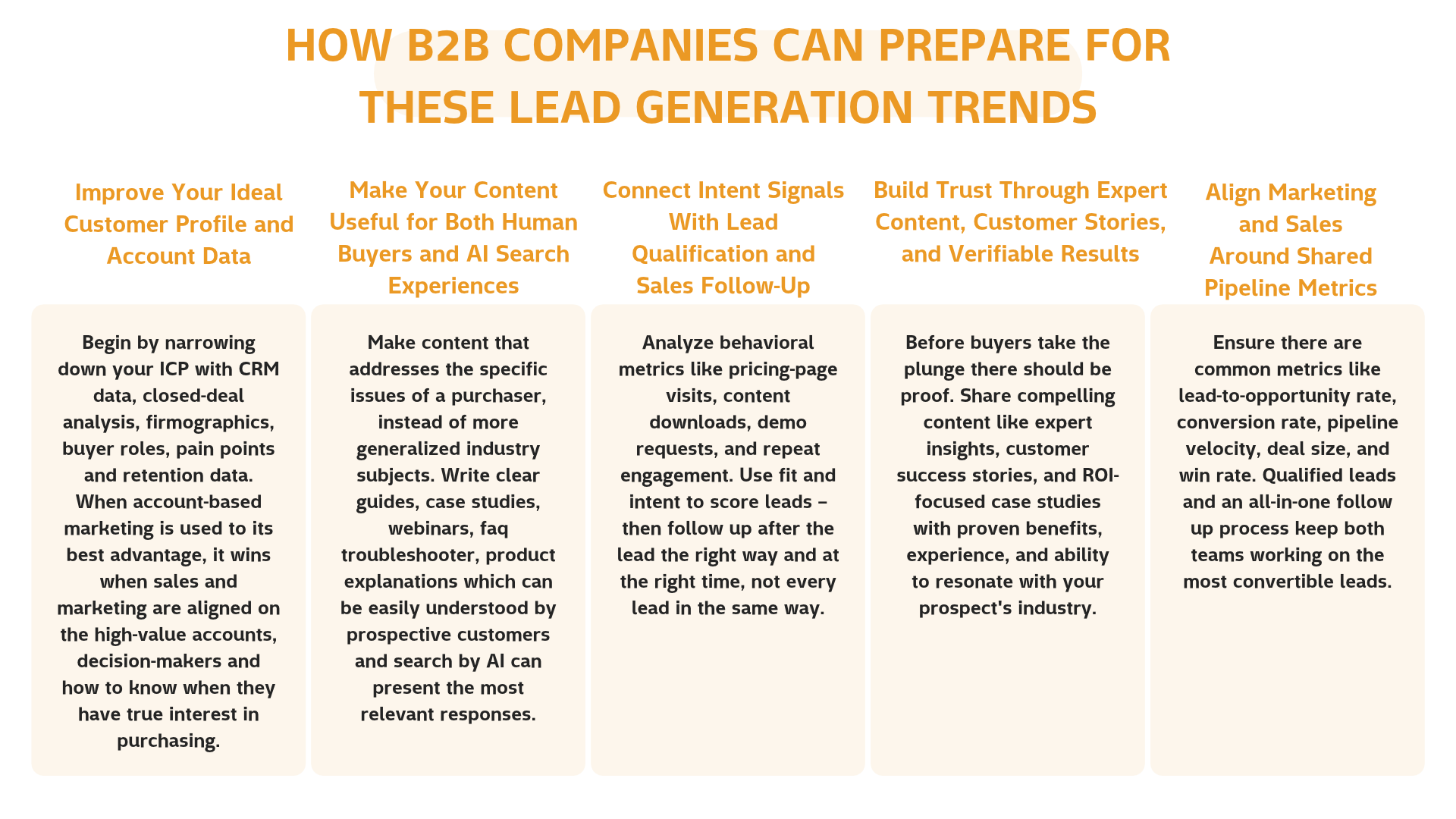
How B2B Companies Can Prepare for These Lead Generation Trends
Which B2B Lead Generation Metrics Will Matter Most in 2027?
| Metrics | Description |
| Qualified Opportunities and Lead-to-Opportunity Conversion | In 2027, B2B teams should prioritize qualified opportunities over raw lead volume. Track the percentage of marketing-qualified leads that become sales-qualified opportunities using agreed MQL and SQL definitions. This reveals whether campaigns attract accounts with real business fit, needs, and buying readiness. |
| Pipeline Contribution and Customer Acquisition Cost | Measure pipeline value, marketing-influenced revenue, and customer acquisition cost rather than clicks or form fills alone. These metrics show whether demand generation creates commercially valuable opportunities. A higher cost per lead may be justified when it delivers better conversion rates and stronger revenue outcomes. |
| Buying Committee Engagement and Account Progression | B2B decisions increasingly involve several stakeholders. Track engagement across champions, decision-makers, technical evaluators, finance, and procurement. Use account progression metrics to identify whether ABM and multi-channel outreach are building consensus and moving the full buying committee toward a decision. |
| Lead Quality, Sales Acceptance, and Revenue Conversion | Sales acceptance rate, opportunity progression, win rate, and revenue conversion are stronger indicators of lead quality than lead count. Combine intent data, trigger events, and CRM outcomes to prioritize accounts showing active buying signals. This shifts optimization from vanity metrics to revenue confidence. |
Conclusion: Build a B2B Lead Generation Strategy Around Trust, Intent, and Revenue
The future belongs to B2B companies that know buyer intent, work the full B2B buying committees, and establish value with solid proof. The top B2B lead generation trends 2027 are fostering better sales and marketing relationships, leveraging AI tools for prospecting, working with first-party data and creating AI-generated content with expert guidance. Don’t waste energy on volume of leads; drive towards building qualified and revenue ready opportunities. If B2B lead generation trends 2027, trust, intent and measurable pipeline growth are your focus, your business will be prepared for the new B2B buying journey.

Author: IDBS Global
Turning Data into Demand, Fueling B2B Growth with Precision and Purpose.